

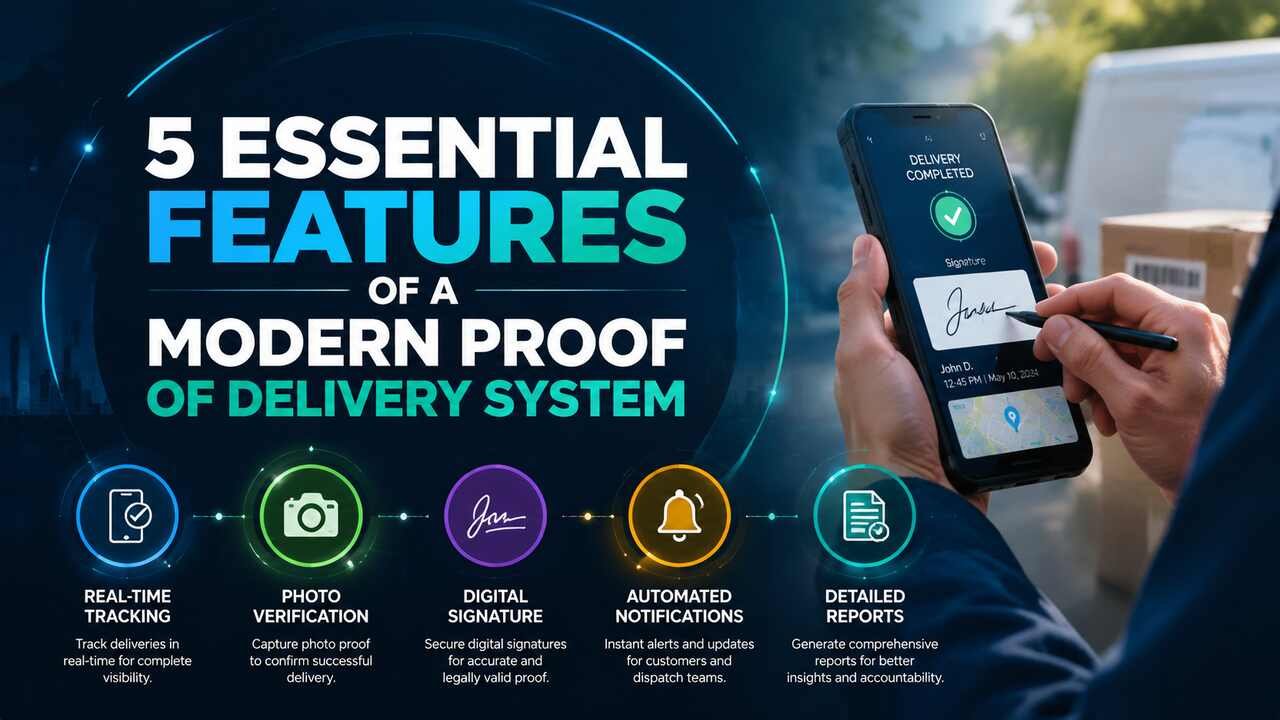
Using paper-based proofs of delivery (PODs) isn’t just a little inconvenient for your team – it’s hurting your bottom line. Only a modern POD solution can give you the speed, agility, and insight to protect your business in real time.
Real-Time Data Synchronization
In the past, drivers collected signatures on paper or a basic device, and someone uploaded the data at the end of the shift. Customers nowadays demand live updates. If that doesn’t happen, they start calling. WISMO – “Where Is My Order” – inquiries rank as one of the most costly groups of inbound customer service communications, and almost all of them stem from real-time sync information gaps.
A modern POD system automatically syncs GPS coordinates, delivery status changes, and timestamps straight into the cloud. The information feeds customer-facing tracking pages, in-house management dashboards, and automatic notification triggers. There’s no delay and no room for error.
This becomes even more vital for operations spanning huge territories with significant distance between stops. Oceania businesses, for example, benefit from using courier software Australia designed for regional transit distances and the coverage (or lack thereof) and infrastructure peculiarities of that region.
Multi-Modal Signature Capture
A “digital signature” was once just a finger-scrawl drawn on a cracked phone screen. It’s not proof of anything. Modern systems support multiple forms of verification, and the most appropriate one will vary depending on what’s being shipped.
With a normal residential delivery, a high res photo of the package at the door with a timestamp and geocoords is often more solid than a signature; the client wasn’t home, the shipment was dropped safe and sound, and there’s photographic evidence. A proper glass signature from an authorized receiver is still the best solution on commercial shipments. For valuable items, there’s also PIN confirmation: that code gets sent to the customer ahead of time, and they give it at the door before the driver relinquishes anything.
The idea isn’t to get x type of confirmation, but to ensure that the right type is taken for each shipment, and that it’s stored in a form that’s useful if the matter goes to arbitration later.
Automated Exception Logging
Deliveries don’t always go as planned. Drivers frequently arrive at gated properties with no access code or nobody lives there to receive the package. A damaged box is clearly a problem with the shipment, not the delivery. And how many times do you have a not-at-home exception when the recipient never intended to be home that time of day, or was available and the driver never knocked?
These are not unusual circumstances. Unfortunately, in many companies, they are described in a text message sent by a driver three hours after they return to the terminal. That’s a problem. These are things you should be documenting instantly while you’re still at the truck. The smartphone in your hand can do all that for you; you just have to use it.
A good POD solution should provide a way to instantly log failures in the field by situation type, photo of the issue taken now, and optional short notes (which may well just be the receiver’s instruction that it’s OK to leave the package outside the garage door). These, then, get tied to that delivery event for that address, sender, and driver.
Integration With Back-Office Billing
Most courier businesses have cash flow issues that are not easily visible. For instance, a delivery is made on Monday. The POD data is checked on Tuesday or Wednesday. An invoice is raised on Thursday. The customer makes the payment based on 30-day credit terms. Thus, there is a gap of around five to six weeks between the delivery of service and the payment of service for a job completed in the first half of the week.
When the POD system is interconnected with billing and invoicing systems, the delivery confirmation will account for the billing trigger. As soon as the system captures a signature, photo, or PIN verification, the invoice is generated and dispatched. The payment term clock begins ticking right away.
97% of organizations are in consensus about the non-sustainability of current last-mile deliveries when it comes to complete implementation in all locations (Capgemini). Shortening the billing cycle is one of the few profit levers that would not demand additional trucks or manpower.
Offline Functionality
Connectivity isn’t always available. The countryside, warehouse loading docks, basement storage areas, and entire regions with unreliable cellular reception exist and are part of everyday business. A POD app that goes offline and stops working is, therefore, a risk and not a solution.
Offline mode means that the app continues to operate as normal – taking photos, capturing signatures, tracking GPS coordinates to the inch, and time-stamping every step – all while storing the data on the driver’s device. When the connection is re-established, the data is automatically uploaded. No fuss, no action required by the driver, no manual uploads, and no gaps in the chain of custody.
Reverse logistics often involves a collection from a location where goods are being returned, rather than a delivery. This is frequently a location that has poor cellular reception. The same rules apply: the process must be recorded meticulously. With offline mode, it is.
Getting The System Right
A Point of Delivery system that takes care of real-time sync, multi-modal verification, exception logging, billing integration, and offline operation is not a premium add-on. These should be the basic standards to not lose margins due to disputes, delayed invoicing, or having to deal with customer complaints in any delivery operation. The question for any logistics manager is not whether they need these features. It’s how fast they can get rid of what’s not bringing in any.
