

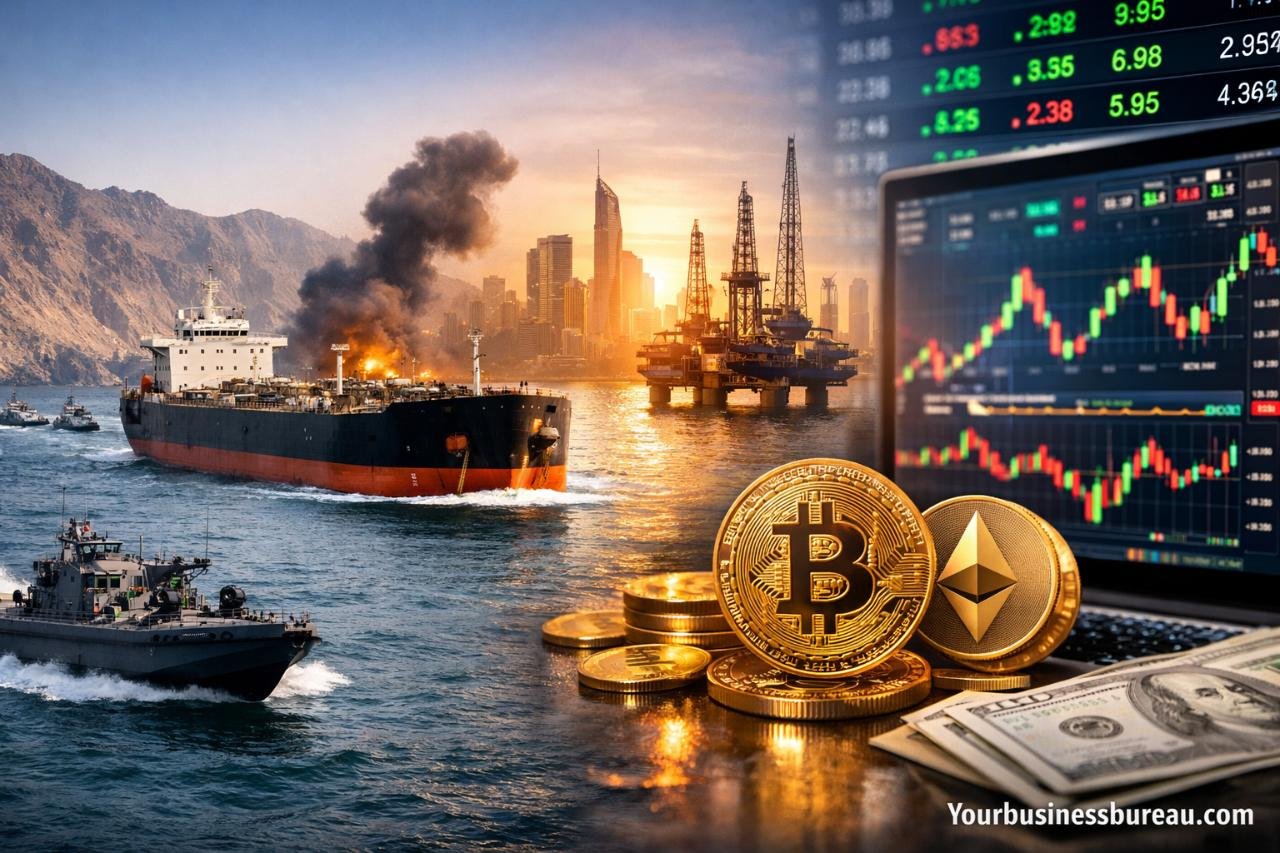
As of April 17, 2026, the immediate market signal points to a falling Hormuz risk premium, not a fresh spike. Donald Trump said the Strait of Hormuz is open for passage while also stating that a U.S. naval blockade on Iran remains in force until a broader agreement is reached. Iran separately confirmed that commercial shipping can pass, yet Iranian authorities also indicated that vessels must coordinate movement through controlled lanes. That combination of reopening, military control, and incomplete diplomacy explains why oil declined, equities strengthened, and crypto shifted toward risk-on behavior while volatility remained structurally present.
Why did Donald Trump’s statement change Strait of Hormuz risk?
Donald Trump’s statement changed market pricing because traders interpreted the message as partial normalization rather than escalation. A fully blocked Strait of Hormuz threatens a significant share of global crude and LNG flows, so any confirmation of open commercial passage immediately reduces worst-case assumptions embedded in commodities and financial assets. Markets therefore adjusted rapidly to a lower probability of severe supply disruption.
Open passage. Open passage became the dominant signal because energy markets prioritize logistics certainty over political rhetoric. Tanker operators, refiners, and commodity traders depend on uninterrupted maritime corridors for pricing benchmarks. A statement confirming navigability reduces expectations of stranded cargo, delayed deliveries, and emergency inventory drawdowns, which directly compresses the geopolitical premium embedded in oil prices.
Blockade risk. Blockade risk remained relevant because the continuation of U.S. restrictions on Iranian shipping preserves uncertainty in enforcement and compliance. A partial reopening without full removal of military pressure creates a layered risk environment where access exists but remains conditional. Markets therefore priced a reduction in extreme outcomes rather than a complete return to stability.
IRGC control. IRGC oversight introduced operational friction because coordinated passage under military supervision differs from unrestricted navigation. Shipping companies, insurers, and charterers treat controlled corridors as higher-risk environments due to potential delays, inspections, and route limitations. Such conditions sustain a residual risk premium even during periods of reduced tension.
Ceasefire credibility. Ceasefire credibility influences forward expectations because financial markets evaluate durability rather than announcements alone. A temporary diplomatic alignment reduces volatility in the short term, yet unresolved negotiations preserve the possibility of renewed conflict. That uncertainty keeps hedging activity active across commodities and financial derivatives.
Supply psychology. Supply psychology accelerated the price reaction because traders had already priced in severe disruption scenarios. When the perceived probability of closure declines, markets unwind fear-based pricing rapidly. Price declines therefore reflect changing expectations rather than immediate physical changes in supply flows.
How are oil prices reacting to the new Hormuz outlook?
Oil prices are reacting with a sharp downward adjustment because the probability of a complete supply disruption has decreased. Benchmark crude prices had incorporated a significant geopolitical premium during heightened tensions, and the reopening signal triggered a rapid repricing across futures markets.
Risk premium compression. Risk premium compression became the primary driver of price movement because traders removed a portion of the geopolitical buffer embedded in crude contracts. Futures markets respond quickly to changes in perceived risk, and even partial de-escalation can trigger substantial declines in front-month pricing.
Physical supply expectations. Physical supply expectations improved because open transit suggests that delayed cargoes may begin moving toward key import regions. Refiners adjust procurement strategies based on expected delivery timelines, and improved logistics visibility supports more stable inventory planning even before full normalization occurs.
Regional price divergence. Regional price divergence continues to influence global markets because some regions remain more exposed to Gulf supply routes than others. Import-dependent economies in Europe and Asia react more sensitively to Hormuz developments, while alternative supply sources provide partial insulation to other regions.
Gas and LNG spillover. Gas and LNG markets also responded because the Strait of Hormuz functions as a critical corridor for multiple energy commodities. Lower perceived disruption risk reduces pressure on global energy prices, contributing to broader disinflationary expectations across industrial and consumer sectors.
Inflation and central banks. Inflation expectations shifted as lower oil prices reduce cost pressures across transportation, manufacturing, and consumer goods. Central banks monitor energy-driven inflation closely, and declining crude prices can influence monetary policy expectations by easing concerns about persistent inflation.
How could global trade routes change after the statement?
Global trade routes are likely to remain operational but controlled, reflecting a balance between accessibility and security oversight. Commercial shipping may continue, yet routing constraints and compliance requirements introduce inefficiencies compared to normal conditions.
Safe-lane routing. Safe-lane routing may become standard practice because designated corridors improve security coordination. Such routing reduces uncertainty for naval forces but introduces scheduling rigidity for commercial operators, affecting delivery timelines and fleet utilization.
Insurance costs. Insurance costs are expected to remain elevated because war-risk assessments depend on actual hazard levels rather than political assurances. Elevated premiums increase transportation costs, which can influence commodity pricing and trade margins across multiple industries.
Shipping delays. Shipping delays may persist due to backlog effects created during the period of heightened tension. Delayed vessels, revised schedules, and operational bottlenecks contribute to gradual rather than immediate normalization of global shipping flows.
Alternative corridors. Alternative corridors gain strategic relevance as companies reassess supply chain resilience. Diversification of sourcing, increased storage capacity, and exploration of non-Gulf routes become part of long-term risk management strategies following geopolitical disruptions.
Legal and maritime governance. Legal considerations emerge because controlled passage raises questions about compliance with international maritime norms. Shipping companies must navigate evolving regulatory frameworks, which influence contractual obligations, insurance coverage, and operational decision-making.
What is happening in stock markets after the Hormuz signal?
Stock markets are responding positively because reduced energy risk supports broader economic stability. Lower oil prices ease inflation concerns, improve corporate cost structures, and enhance investor confidence across multiple sectors.
Airlines and transports. Airlines and transportation companies benefit directly from lower fuel costs, which improve profit margins and support demand forecasts. Reduced operating expenses allow for more competitive pricing and stronger financial performance expectations.
Energy sector pullback. Energy stocks experience downward pressure because lower crude prices reduce revenue expectations for producers. Companies that benefited from elevated prices during the crisis phase may see valuation adjustments as markets normalize.
Rates-sensitive equities. Rates-sensitive sectors gain momentum because lower inflation expectations increase the likelihood of favorable monetary conditions. Lower interest rate pressure supports housing, technology, and consumer discretionary segments.
Risk sentiment reset. Risk sentiment shifts toward growth-oriented assets as geopolitical stress declines. Investors move capital from defensive positions into equities, reflecting increased confidence in economic stability and reduced systemic risk.
Fragility beneath the rally. Fragility remains beneath the rally because unresolved geopolitical factors can quickly reverse sentiment. Markets remain sensitive to new developments, and any escalation could trigger rapid corrections.
Why is crypto volatility still important even after the market relief?
Crypto volatility remains significant because digital assets respond to both macroeconomic signals and speculative dynamics. The easing of geopolitical tension supports risk appetite, yet structural volatility persists due to leverage and sentiment-driven trading.
Risk-on correlation. Risk-on correlation explains the upward movement in crypto markets because digital assets often rise alongside equities during periods of improving sentiment. Lower perceived risk encourages capital inflows into higher-volatility assets.
Oil-inflation channel. The oil-inflation relationship influences crypto through monetary policy expectations. Lower energy costs reduce inflation pressure, which can support more accommodative financial conditions favorable to crypto valuations.
Headline sensitivity. Headline sensitivity remains high because crypto markets react rapidly to geopolitical news. Continuous trading and global participation amplify price movements in response to real-time developments.
Speculative leverage. Speculative leverage intensifies volatility because derivative markets amplify both upward and downward movements. Liquidations and momentum trading contribute to sharp price swings during periods of uncertainty.
Cross-asset narrative. Cross-asset relationships connect crypto performance to broader financial conditions. Changes in oil prices influence inflation, inflation affects interest rates, and interest rates shape liquidity conditions that ultimately impact crypto markets.
What is the most important takeaway for investors and readers?
The most important takeaway is clear: the statement reduced immediate closure risk but did not eliminate strategic uncertainty in the Strait of Hormuz. Oil declined because disruption risk decreased, trade routes stabilized under controlled conditions, stock markets rallied due to easing inflation concerns, and crypto strengthened with improved risk sentiment. Residual military presence, controlled navigation, and incomplete diplomacy ensure that volatility remains embedded across global markets.
