

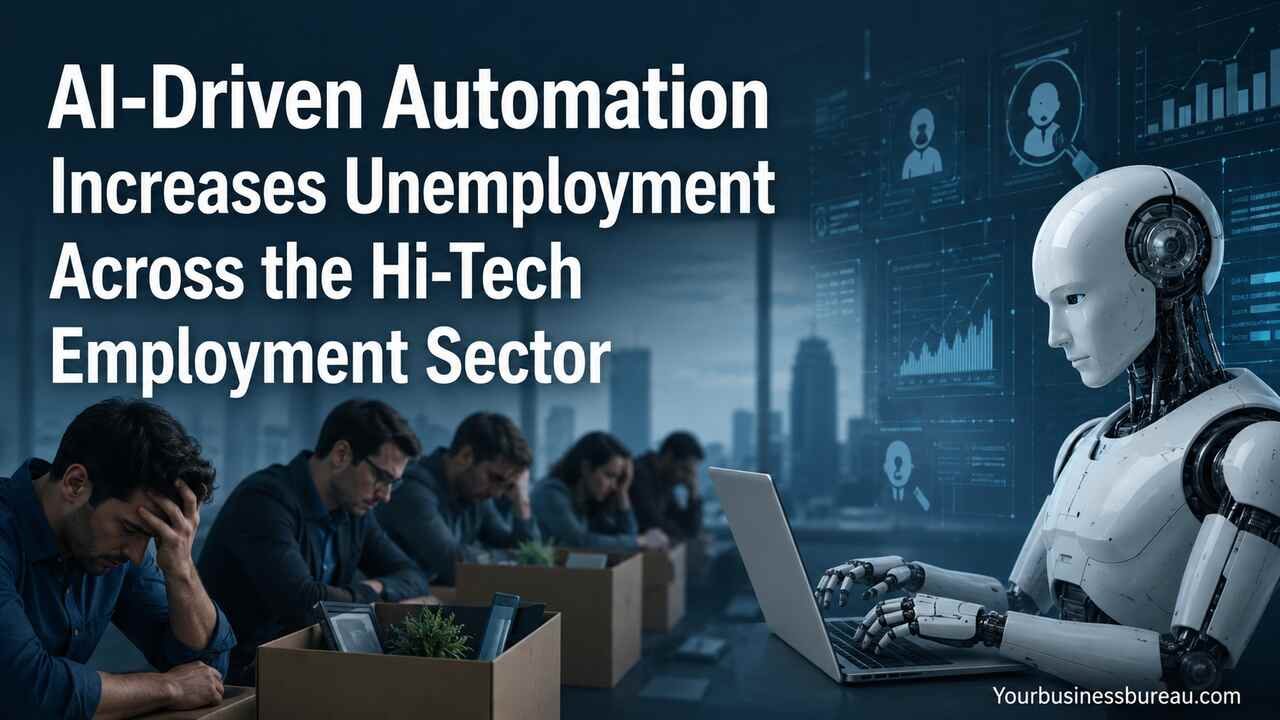
Artificial intelligence is reshaping the global labor market by reducing demand for certain technology roles while simultaneously increasing demand for advanced AI-related expertise. Employment agencies, technology companies, and labor market analysts are reporting a growing mismatch between available talent and current hiring needs. According to the head of the employment service, artificial intelligence has become a significant factor behind rising unemployment within the hi-tech sector, particularly among professionals whose skills no longer align with evolving business priorities.
Why Is Artificial Intelligence Increasing Unemployment in the Hi-Tech Sector?
Artificial intelligence is replacing repetitive and predictable digital tasks that were traditionally performed by software developers, quality assurance engineers, technical support specialists, and data processing professionals. Organizations are adopting AI-powered automation to improve operational efficiency, reduce labor costs, and accelerate software development cycles. Business leaders increasingly view AI as a productivity multiplier capable of completing coding, documentation, testing, and customer support functions with fewer human resources.
Technology companies are also restructuring their workforces as investment priorities shift toward AI infrastructure, machine learning platforms, cloud computing, and large language models. Budget allocations that previously supported conventional software development teams are now directed toward AI research, data engineering, and intelligent automation initiatives. Workforce restructuring has therefore contributed to layoffs across multiple segments of the technology industry.
Another contributing factor is the rapid increase in workforce productivity enabled by generative AI. Modern AI assistants help experienced developers complete projects in significantly less time, reducing the number of employees required for many software projects. Employers therefore hire fewer entry-level professionals while expecting existing teams to accomplish greater workloads using AI-enhanced development tools.
Global economic uncertainty also amplifies the impact of AI adoption. Technology companies facing slower revenue growth often combine automation with hiring freezes and organizational restructuring. Artificial intelligence therefore becomes one element within a broader cost-optimization strategy rather than the sole cause of workforce reductions.
Which Hi-Tech Jobs Are Most Affected by AI?
Entry-level software development positions are experiencing some of the greatest pressure because AI coding assistants can generate boilerplate code, debug applications, and automate routine programming tasks. Junior developers now compete with increasingly capable AI systems that enhance the productivity of senior engineers.
Quality assurance and software testing roles are also evolving rapidly. Automated testing platforms powered by artificial intelligence identify software defects, generate test cases, and monitor application performance with greater speed than many traditional manual testing processes. Companies therefore require fewer professionals dedicated exclusively to repetitive testing activities.
Technical support departments are increasingly deploying AI-powered chatbots and virtual assistants capable of resolving common customer inquiries without human intervention. Customer service automation reduces staffing requirements while enabling continuous support across multiple languages and time zones.
Data entry, documentation, and content management positions are similarly undergoing transformation. Natural language processing models organize information, summarize documents, classify datasets, and generate reports with increasing accuracy. Administrative technology roles built around repetitive information processing therefore face heightened automation risks.
How Is the Labor Market Responding to AI Adoption?
Employers are prioritizing professionals with expertise in artificial intelligence, machine learning, cybersecurity, cloud architecture, data science, and AI governance. Hiring demand has shifted toward specialists capable of developing, managing, auditing, and integrating AI systems within enterprise environments.
Educational institutions and workforce development agencies are expanding reskilling initiatives to help displaced professionals transition into emerging technology careers. Training programs increasingly emphasize prompt engineering, AI model evaluation, cloud computing, data analytics, and responsible AI implementation alongside traditional software engineering skills.
Many technology professionals are also embracing continuous learning as a career necessity. Certifications, online courses, practical AI projects, and interdisciplinary technical knowledge have become increasingly valuable as employers seek candidates capable of adapting to rapidly changing technological environments.
Governments and employment services are monitoring labor market trends to balance innovation with workforce stability. Policymakers are evaluating investments in digital education, vocational retraining, and employment transition programs designed to reduce the social impact of AI-driven disruption.
What Skills Will Remain Valuable in the AI Era?
Human expertise remains essential for solving complex business problems, designing software architecture, managing cybersecurity risks, and making strategic technology decisions. Artificial intelligence performs best when experienced professionals guide implementation, validate outputs, and oversee ethical decision-making.
Creativity, critical thinking, communication, leadership, and cross-functional collaboration continue to distinguish human professionals from automated systems. Organizations increasingly value employees who combine technical knowledge with business strategy, customer understanding, and innovation management.
AI literacy is becoming a foundational competency across the technology industry. Professionals who understand how to use AI tools effectively while maintaining expertise in software engineering, cloud computing, cybersecurity, and data management are expected to remain highly competitive in the evolving employment landscape.
What Does the Future Hold for Hi-Tech Employment?
Artificial intelligence is expected to continue transforming the technology workforce rather than eliminating all technology careers. Automation will reduce demand for repetitive digital tasks while creating new opportunities in AI development, infrastructure engineering, model governance, cybersecurity, robotics, and intelligent system integration.
Future employment growth will likely favor professionals who continuously update their skills and work alongside AI instead of competing directly with automation. The evolving labor market suggests that adaptability, lifelong learning, and specialized expertise will become the defining characteristics of successful careers in the global hi-tech sector.
