

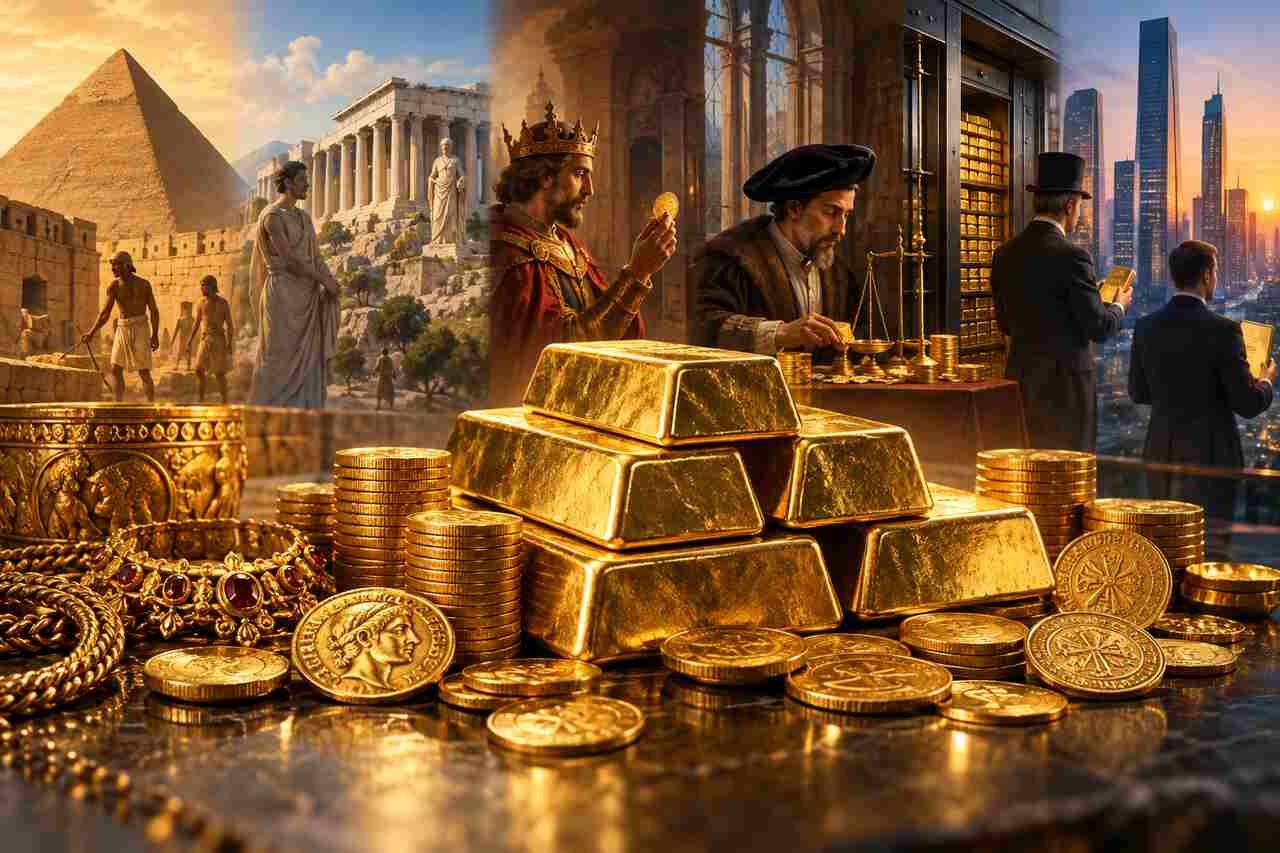
For more than 5,000 years, gold has occupied a uniquefin place in human economic life. Long before modern banking or paper currency, civilizations across the world came to use gold as a durable store of value and medium of exchange. Understanding why means looking at the recurring economic events that have tested this precious metal’s role as a store of wealth.
Why Gold Has Historically Been Used as a Store of Value
Gold’s staying power starts with chemistry. It doesn’t rust, tarnish, or decay, meaning gold mined thousands of years ago still exists today in roughly the same form. It’s also naturally scarce, and its supply generally expands much more slowly than the supply of modern currencies can. These traits made it a natural medium of exchange for ancient societies, from Egypt and Mesopotamia to Lydia in modern-day Turkey, where the first gold coins of a standardized purity were minted around 600 BCE.
Because gold could be divided, weighed, and universally recognized, it became a practical bridge between different economies. A merchant trading in one empire could carry gold into another and expect it to hold value, regardless of local politics. That portability is part of why gold became the backbone of trade for millennia.
Gold During Periods of Currency Instability
Much of gold’s reputation as a store of value comes from its historical role during periods of currency instability and high inflation.
Ancient debasement: Roman emperors repeatedly reduced the silver content of coins like the denarius to stretch government finances, fueling inflation and eroding trust in currency. Gold, which was debased far less, held more of its value; during the reign of Emperor Septimius Severus, for example, more soldiers demanded payment in gold or commodities rather than debased silver coinage.
A collapse of a paper currency experiment: In 18th-century France, the Mississippi Company scheme and the subsequent collapse of paper livres wiped out enormous amounts of wealth almost overnight.
Hyperinflation in the 20th century: The most studied example is Weimar Germany in the early 1920s, when the government printed money to cover war debts, causing prices to double every few days at the crisis’s peak. As the paper mark lost purchasing power, tangible assets and foreign currencies – including gold – became increasingly valuable.
The end of the gold standard: For much of modern history, currencies were directly tied to gold reserves, which constrained how much money governments could print. The United States formally ended the dollar’s convertibility into gold in 1971. Since then, some investors have continued to view gold as a potential hedge against risks such as currency devaluation, deficit spending, and monetary policy shifts.
Why Investors Still Consider Gold Today
Modern economies rarely see hyperinflation on the scale of Weimar Germany in major, stable economies like the United States. However, gold’s historical role still shapes how investors think about wealth preservation, for a few recurring reasons:
· Inflation hedge. Gold’s supply grows slowly—by about 1.8% per year, per the World Gold Council—and it is limited by geology rather than policy. Over long periods, gold has at times helped preserve purchasing power as other currencies lose value.
· Diversification. Gold often behaves differently from stocks and bonds during economic stress, which is one reason investors may consider it for portfolio diversification.
· Performance during periods of uncertainty. Historically, during major shocks—the 2008-09 financial crisis, 1970s stagflation, and various currency crises—gold has often held or gained value while other assets declined sharply.
None of this means gold is immune to price fluctuations. The price of gold rises and falls based on interest rates, currency strength, and investor sentiment, sometimes significantly over shorter periods. Gold’s reputation as a store of value is based largely on its long history of use across different economic systems rather than its performance over any particular short-term period.
Gold, Inflation and Portfolio Diversification
The pattern is clear: When confidence in paper currency breaks down, many people look to gold as a store of wealth. That doesn’t guarantee identical behavior in future crises, but it explains why gold has remained relevant across economic systems as different as ancient Rome, revolutionary France, and modern emerging markets.
Companies such as Preserve Gold help individuals learn about precious physical metals and explore how gold may fit within a broader long-term financial strategy. Understanding gold’s track record—rather than reacting to short-term headlines—is the most useful starting point for anyone researching how precious metals might fit into their wider financial plans.
What Gold’s History Can – and Can’t – Tell Investors
It’s worth being clear-eyed about what history can and cannot tell us. Past performance during currency crises doesn’t predict future outcomes, and gold, like any asset, carries risks and trade-offs, including the fact that it generates no yield on its own. What history does offer is a long record of gold serving as a reliable long-term store of value when other financial instruments faltered.
For readers interested in learning more, educational resources can provide additional information about physical gold and silver, precious metals investing, and the factors investors may consider when evaluating gold as part of a broader financial strategy.
