

Key Takeaways
- Variable frequency drives can improve motor control while introducing harmonics, fast voltage pulses, and high-frequency electrical noise.
- Cable routing, bonding, shielding, cooling, drive programming, and motor compatibility all affect reliability.
- Reactors, filters, and transformers should be selected to solve a defined system problem, not added as generic fixes.
- Higher switching frequency can reduce audible motor noise, but it can also increase heat within the drive.
- Temperature, current, vibration, alarms, and power-quality measurements help identify problems before they create downtime.
Variable frequency drives give facilities precise control of motor speed, torque, acceleration, and process output. They are widely used on pumps, fans, conveyors, compressors, and other motor-driven equipment. However, a VFD installation requires more attention than simply matching drive horsepower to a motor. In some applications, an isolation transformer can support electrical separation and help manage disturbances between the supply and the drive.
A typical VFD converts incoming AC power to DC power, then uses high-speed switching to create a controlled AC output for the motor. That switching process can produce input harmonics, common-mode currents, and fast voltage transitions. If the complete system is not designed carefully, those effects may contribute to sensor errors, motor stress, nuisance trips, excess heat, or interference with nearby controls.
Recognize the Warning Signs
Electrical noise and thermal stress do not always appear as an immediate drive fault. A motor may continue operating while components slowly experience conditions that shorten service life. Maintenance teams should investigate recurring symptoms rather than treating each one as an isolated event.
- Motor whine that changes with speed or carrier-frequency settings.
- Intermittent PLC, encoder, network, or instrumentation faults.
- Overheated motor bearings, cable terminations, transformers, or drive enclosures.
- Nuisance trips during acceleration, deceleration, or high-load operation.
- Repeated motor insulation failures or bearing damage.
- Unusual transformer noise, elevated winding temperature, or ground-current alarms.
Start With a System-Level Review
Many VFD issues result from the interaction of the drive, motor, cable, power source, grounding system, and driven load. Before changing settings or purchasing hardware, document the installation.
- Record motor voltage, full-load current, speed range, load type, and duty cycle.
- Verify the drive input rating, output-current rating, overload capability, and programmed motor data.
- Measure the motor-cable length and confirm whether the cable is VFD-rated and shielded where required.
- Trace the grounding and bonding path from the drive enclosure to the motor frame and facility grounding system.
- Identify nearby low-voltage controls, communications wiring, sensors, and sensitive electronics.
- Review the transformer, generator, utility connection, and other nonlinear loads served by the same distribution equipment.
Improve Cable Routing and Grounding
Good physical installation practices often resolve or reduce noise problems before specialized equipment is needed. Keep VFD output conductors away from low-voltage signal, communication, and instrumentation wiring. When cables must cross, crossing at right angles generally reduces the length of parallel exposure.
Prioritize Low-Impedance Bonding
High-frequency currents do not behave exactly like 60 Hz current. Short, wide bonding connections are generally more effective than long, coiled conductors. Inspect cabinet doors, conduit connections, cable glands, enclosure seams, and motor-frame bonds for loose hardware, corrosion, paint, or other conditions that interrupt electrical continuity.
- Use continuous shields and terminate them according to the cable and drive manufacturer’s instructions.
- Avoid long parallel runs of motor leads beside analog, data, or encoder wiring.
- Keep motor leads as short as practical.
- Use separate wireways or conduits where the installation calls for segregation.
Manage Switching Frequency and Heat
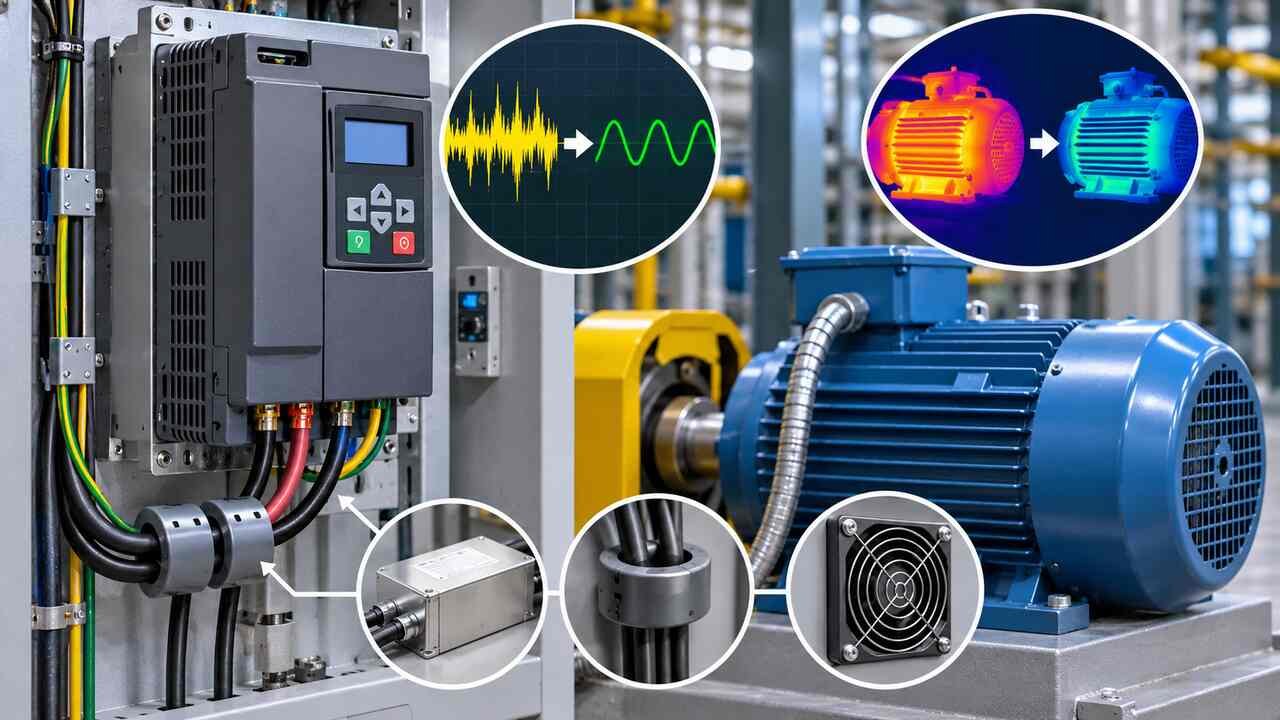
Increasing the carrier frequency can make motor noise less noticeable, but it also increases switching losses within the drive. That additional heat can require output-current derating, especially in warm or poorly ventilated enclosures. Use the manufacturer’s limits, confirm the ambient temperature, and avoid changing carrier frequency solely to hide audible noise.
Maintain clear airflow through the enclosure. Clean intake filters, verify cooling-fan operation, keep heat-producing equipment from crowding sensitive controls, and confirm that enclosure spacing allows heat to escape. Thermal imaging during normal operation, when performed safely by qualified personnel, can help locate abnormal heating at terminals, breakers, cable connections, and cabinet components.
Select Harmonic and Noise Controls by Function
The right mitigation method depends on the actual problem. Harmonic mitigation solutions for VFDs commonly include reactors, filters, multipulse arrangements, active front ends, and transformer-based approaches, but these options address different operating conditions.
- Line reactors: Add impedance on the input side and can help limit current changes and reduce harmonic effects in suitable applications.
- Load reactors: Add impedance between the drive and motor and can help reduce stress on long motor-lead installations.
- dv/dt filters: Reduce the steepness of voltage rise reaching the motor terminals.
- Sine-wave filters: Produce a smoother output waveform for applications with demanding cable lengths or motor requirements.
- Harmonic filters: Are selected to address supply-side distortion after system measurements and engineering review.
Apply IEEE 519 Carefully
IEEE 519 addresses harmonic control at the point of common coupling, not merely at the terminals of one drive. A drive can operate within its own specifications while the facility still experiences power-quality concerns caused by the combined effect of multiple nonlinear loads. Measure voltage and current distortion, consider transformer impedance and available fault current, and account for generator operation or future expansion before choosing a filter size.
Protect Motors From Reflected-Wave Stress
Fast voltage transitions can become more severe at motor terminals when cable runs are long. Confirm that the motor insulation system is appropriate for inverter service, use cable designed for VFD output where applicable, and evaluate whether a load reactor, dv/dt filter, or sine-wave filter is warranted. Repeated bearing failure, unexplained vibration, or evidence of shaft-voltage damage should prompt a qualified review of common-mode current, shaft grounding, and insulated-bearing options.
Commission and Maintain for Reliability
Effective commissioning establishes a baseline for future troubleshooting. Motor and VFD design considerations include matching the drive to motor ampacity and load type, as well as evaluating cable, harmonic, and motor-duty requirements.
- Confirm nameplate data, acceleration settings, speed limits, protective functions, and control modes.
- Test the system at several operating speeds and load points.
- Record phase current, motor temperature, enclosure temperature, vibration, alarms, and abnormal noise.
- Inspect cooling paths and visible contamination monthly.
- During planned outages, inspect terminals, fans, shields, grounding points, and cable condition.
- After a fault or system change, document operating conditions and repeat relevant measurements.
Conclusion
Reliable VFD operation depends on more than drive size. A system-level approach to cable routing, grounding, motor protection, harmonic control, cooling, commissioning, and maintenance can reduce electrical noise and thermal stress. By measuring conditions and matching the solution to the source of the problem, facility teams can protect motors, controls, and production equipment while supporting longer service life.
For more informative articles visit our blog YourBusinessBureau.
