

Introduction
Business intelligence exercises help professionals transform raw data into meaningful insights that support operational, financial, marketing, and strategic decisions. Organizations increasingly rely on dashboards, reports, key performance indicators, and predictive analysis to remain competitive in data-driven markets. As a result, practical exercises have become one of the most effective ways to develop business intelligence skills.
Whether you are a student, analyst, manager, data professional, or business owner, structured business intelligence exercises allow you to practice gathering data, cleaning information, creating reports, building dashboards, analyzing trends, and communicating findings. These activities bridge the gap between theoretical knowledge and real-world business applications.
This guide explores comprehensive business intelligence exercises designed to improve analytical thinking, reporting accuracy, visualization capabilities, and decision-making skills. Each exercise focuses on practical outcomes that can be applied in modern business environments using common business intelligence platforms, databases, spreadsheets, and reporting tools.
Gather Business Data From Multiple Sources
The first step in any business intelligence exercise is collecting data from various business systems. Start by obtaining information from sales records, customer databases, inventory systems, financial reports, website analytics, or customer support platforms. Working with multiple datasets mirrors real business environments where information is distributed across departments.
Focus on understanding data structures and relationships. Customer records may connect with sales transactions, while inventory data may influence revenue performance. Identifying these connections helps establish a foundation for deeper analysis.
As organizations grow, data volume and complexity increase significantly. Practicing data collection exercises helps analysts understand integration challenges, data consistency issues, and the importance of creating a unified reporting environment.
Sample Data Collection Exercise
| Data Source | Information Collected | Business Purpose |
| Sales System | Orders and revenue | Performance analysis |
| CRM | Customer details | Customer segmentation |
| Inventory Database | Stock levels | Supply chain monitoring |
| Website Analytics | Visitor behavior | Marketing optimization |
| Financial Reports | Expenses and profits | Financial management |
Clean and Standardize Raw Data
Once data has been collected, cleaning becomes a critical business intelligence exercise. Raw datasets often contain duplicate records, missing values, inconsistent formats, and inaccurate entries that can distort analysis.
Begin by identifying incomplete records and correcting formatting inconsistencies. For example, date formats, currency symbols, and customer names should follow standardized conventions. Duplicate entries should be removed to ensure accurate calculations.
Data quality directly influences business outcomes. Organizations that rely on poor-quality data often generate misleading reports and make ineffective decisions. Practicing data cleansing exercises develops attention to detail and strengthens analytical reliability.
A useful exercise involves importing a messy dataset into a spreadsheet or database and systematically correcting all quality issues before analysis begins.
Create Meaningful Key Performance Indicators
Business intelligence professionals must convert business goals into measurable metrics. KPI development exercises help analysts understand how organizations evaluate performance.
Start by defining objectives such as increasing revenue, improving customer retention, reducing operational costs, or enhancing employee productivity. Then create KPIs that align with those objectives.
Common KPI examples include:
| Business Area | KPI | Measurement |
| Sales | Monthly Revenue Growth | Percentage Increase |
| Marketing | Conversion Rate | Leads to Customers |
| Customer Service | Resolution Time | Average Hours |
| Operations | Inventory Turnover | Turnover Ratio |
| Finance | Profit Margin | Percentage |
Effective KPI exercises encourage participants to distinguish between metrics and actionable indicators. Not every metric contributes directly to business decisions. The strongest KPIs align closely with organizational objectives and strategic priorities.
Build Interactive Dashboards for Stakeholders
Dashboard creation is one of the most valuable business intelligence exercises because it combines data analysis, visualization, and communication skills.
Begin by identifying stakeholder needs. Executives may require high-level summaries, while department managers often need operational details. Design dashboards that display relevant KPIs, trends, and performance indicators clearly.
Include charts, scorecards, filters, and drill-down capabilities. Avoid clutter and prioritize information hierarchy. Users should immediately understand current performance without extensive interpretation.
Dashboard exercises teach the importance of balancing visual appeal with analytical value. A visually attractive dashboard that lacks actionable insights provides little business benefit. The most effective dashboards guide users toward informed decisions.
Analyze Sales Trends Across Time Periods
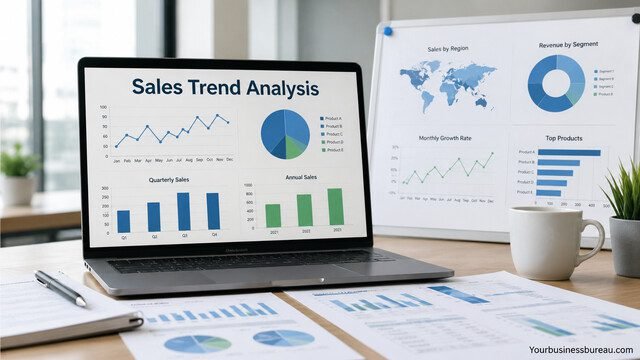
Sales trend analysis exercises help analysts identify patterns, opportunities, and risks. Use historical sales data to compare monthly, quarterly, and annual performance.
Calculate growth rates and identify seasonal fluctuations. Determine whether specific products, regions, or customer segments contribute disproportionately to revenue growth. Visualize trends through line charts and comparative reports.
Analyzing sales trends also develops forecasting skills. Historical patterns frequently reveal future opportunities and potential challenges. Understanding trend behavior allows organizations to plan inventory, staffing, marketing, and budgeting activities more effectively.
A useful exercise involves evaluating three years of sales data and presenting recommendations based on observed performance patterns.
Segment Customers Using Business Data
Customer segmentation exercises help organizations understand different customer groups and tailor business strategies accordingly.
Start by categorizing customers based on demographics, purchasing behavior, location, product preferences, or spending patterns. Identify high-value customers, occasional buyers, loyal customers, and at-risk segments.
Once segments have been established, analyze performance metrics for each group. Compare average order value, retention rates, lifetime value, and purchasing frequency.
Segmentation exercises demonstrate how business intelligence supports personalized marketing, customer retention initiatives, and revenue optimization. Organizations that understand customer differences can allocate resources more effectively and improve customer experiences.
Evaluate Marketing Campaign Performance
Marketing analysis exercises teach analysts how to measure campaign effectiveness and return on investment.
Collect information from email campaigns, social media advertising, search marketing initiatives, and promotional activities. Compare impressions, clicks, conversions, and revenue outcomes.
Determine which campaigns generated the highest returns and identify factors influencing success. Analyze audience behavior, channel performance, and customer acquisition costs.
Marketing intelligence exercises highlight the importance of connecting spending decisions with measurable business outcomes. Strong analytical skills enable organizations to optimize budgets and maximize marketing efficiency.
Monitor Operational Performance Through Reporting
Operational reporting exercises focus on efficiency, productivity, and process performance. These activities help analysts understand how day-to-day operations affect overall business results.
Review production volumes, delivery times, service levels, staffing metrics, and resource utilization rates. Identify bottlenecks, delays, and inefficiencies that impact performance.
Create reports that summarize operational effectiveness and highlight improvement opportunities. Managers rely on these reports to optimize workflows and allocate resources appropriately.
Operational intelligence exercises strengthen the ability to identify root causes and support continuous improvement initiatives.
Analyze Financial Performance Indicators

Financial analysis exercises help professionals connect business intelligence with organizational profitability.
Begin by examining revenue, expenses, operating costs, cash flow, and profit margins. Compare actual performance against budgets and forecasts. Identify areas where spending exceeds expectations or revenue falls below targets.
Financial intelligence requires both numerical accuracy and business understanding. Analysts must interpret results rather than merely calculate values.
Regular financial exercises improve strategic thinking by demonstrating how operational decisions affect profitability, sustainability, and growth potential.
Build Data Visualizations That Drive Action
Data visualization exercises focus on transforming complex information into understandable visual formats.
Experiment with various chart types, including:
- Bar charts
- Line graphs
- Scatter plots
- Heat maps
- Geographic maps
- Treemaps
- Funnel charts
- KPI scorecards
Choose visualizations based on analytical objectives. Line charts reveal trends, while bar charts support comparisons. Heat maps expose patterns that may remain hidden in tabular reports.
Visualization exercises develop communication skills by teaching analysts how to present information effectively to technical and non-technical audiences.
Create Forecasting Models Using Historical Data
Forecasting exercises help analysts estimate future outcomes based on historical performance.
Use previous sales, customer activity, operational metrics, or financial results to project future trends. Apply moving averages, growth assumptions, or statistical forecasting methods.
Evaluate forecast accuracy by comparing predictions with actual outcomes. Adjust models to improve reliability over time.
Forecasting provides valuable business benefits because organizations can prepare resources, budgets, staffing plans, and inventory levels more effectively when future expectations are understood.
Conduct Profitability Analysis Across Products
Profitability analysis exercises help identify which products, services, or business units generate the greatest value.
Calculate revenue, direct costs, indirect costs, and margins for each product category. Compare profitability across departments and market segments.
Some products may generate high revenue but low profit due to significant operational expenses. Others may contribute smaller revenue amounts while producing stronger margins.
These exercises encourage strategic thinking by helping decision-makers focus resources on high-value opportunities.
Product Profitability Example
| Product Category | Revenue | Cost | Profit Margin |
| Product A | $500,000 | $300,000 | 40% |
| Product B | $400,000 | $280,000 | 30% |
| Product C | $300,000 | $150,000 | 50% |
| Product D | $200,000 | $160,000 | 20% |
Investigate Customer Retention Patterns
Customer retention exercises focus on understanding why customers remain loyal or discontinue their relationship with a business.
Analyze purchase frequency, repeat transaction rates, service interactions, customer satisfaction scores, and engagement levels. Identify characteristics shared by retained customers.
Examine customers who stopped purchasing and investigate potential causes. Pricing changes, service issues, competitive alternatives, and product dissatisfaction may influence retention outcomes.
Retention analysis demonstrates how business intelligence supports long-term growth because acquiring new customers often costs significantly more than retaining existing ones.
Compare Regional Business Performance
Regional analysis exercises help organizations identify geographic strengths and weaknesses.
Evaluate sales performance, customer growth, profitability, and operational efficiency across locations. Compare urban and rural markets, domestic and international regions, or individual branches.
Regional comparisons often reveal opportunities for expansion, resource reallocation, or targeted marketing efforts. High-performing regions may provide best practices that can be replicated elsewhere.
These exercises enhance analytical capabilities by introducing geographic dimensions into business intelligence projects.
Design Executive Reports for Decision Makers
Executive reporting exercises focus on communicating insights clearly and concisely.
Executives typically require summarized information rather than detailed datasets. Create reports that highlight:
- Strategic KPIs
- Major trends
- Key risks
- Growth opportunities
- Performance comparisons
- Actionable recommendations
Avoid overwhelming stakeholders with excessive detail. Instead, prioritize information that directly supports business decisions.
Executive reporting exercises improve storytelling skills by teaching analysts how to translate technical findings into business language.
Identify Business Risks Through Data Analysis
Risk analysis exercises help organizations anticipate potential problems before they become significant challenges.
Review data related to declining sales, customer churn, inventory shortages, supplier performance, financial instability, or operational disruptions. Identify warning indicators and develop monitoring frameworks.
Risk intelligence enables proactive decision-making. Organizations that recognize emerging threats early can implement corrective actions more effectively.
Exercises in this area strengthen critical thinking and strategic awareness while demonstrating the preventative value of business intelligence.
Automate Reporting Processes
Automation exercises teach analysts how to reduce manual reporting effort while improving consistency and accuracy.
Create automated workflows that refresh datasets, update dashboards, generate reports, and distribute insights to stakeholders. Schedule regular updates and establish monitoring mechanisms.
Automation increases efficiency by minimizing repetitive tasks. Analysts can then focus more time on interpretation and strategic recommendations rather than manual report preparation.
Organizations increasingly prioritize automation because data volumes continue to expand rapidly across industries.
Develop End-to-End Business Intelligence Projects
Comprehensive projects combine multiple business intelligence exercises into a single workflow.
A complete project typically includes:
- Data collection
- Data cleaning
- Data integration
- KPI creation
- Dashboard development
- Trend analysis
- Forecasting
- Reporting
- Recommendation development
- Stakeholder presentation
Working through an entire project simulates real business environments and reinforces connections between analytical stages.
These projects also strengthen portfolio development for students and professionals seeking careers in analytics, reporting, and business intelligence.
Present Findings and Recommend Actions
The final business intelligence exercise involves communicating insights and recommending actions.
Analysis alone does not create business value. Organizations benefit when findings lead to improved decisions and measurable outcomes. Present conclusions clearly and support recommendations with evidence.
Focus on explaining:
- Key findings
- Supporting data
- Business implications
- Recommended actions
- Expected outcomes
- Potential risks
Presentation exercises strengthen communication skills and demonstrate the strategic role of business intelligence within organizations.
Advanced Business Intelligence Exercise Ideas
For professionals seeking greater challenges, consider the following advanced exercises:
Revenue Optimization Analysis
Analyze pricing structures, customer behavior, and product performance to identify revenue growth opportunities.
Supply Chain Intelligence Project
Evaluate inventory management, supplier reliability, shipping performance, and fulfillment efficiency.
Workforce Analytics Study
Examine employee productivity, turnover rates, training effectiveness, and workforce utilization.
Customer Lifetime Value Modeling
Estimate long-term customer value and identify factors influencing retention and profitability.
Competitive Performance Benchmarking
Compare internal performance against industry standards and market competitors.
Predictive Customer Churn Analysis
Build models that identify customers likely to discontinue purchases and recommend intervention strategies.
These advanced projects provide deeper analytical experience and align closely with enterprise business intelligence initiatives.
Conclusion
Business intelligence exercises provide practical opportunities to develop the skills required for modern data-driven organizations. Through activities such as data collection, cleansing, KPI development, dashboard creation, forecasting, customer analysis, financial reporting, and executive communication, professionals gain valuable experience that extends beyond theoretical learning.
Consistent practice strengthens analytical thinking, improves reporting accuracy, enhances visualization capabilities, and supports better business decisions. Whether the goal is career development, organizational improvement, or technical mastery, structured business intelligence exercises create a strong foundation for transforming data into actionable insights.
FAQ’s
Business intelligence exercises are practical activities that involve collecting, analyzing, visualizing, and interpreting data to solve business problems and support decision-making.
These exercises improve data analysis, reporting, dashboard creation, visualization, forecasting, communication, and strategic decision-making skills.
Common tools include spreadsheets, databases, SQL platforms, reporting software, dashboard solutions, and data visualization applications.
Regular practice is recommended. Weekly projects and daily analytical tasks help reinforce technical and business skills over time.
Yes. Beginners can start with data cleaning, KPI calculations, and simple reports before progressing to dashboards, forecasting, and advanced analytics.
An end-to-end project that includes data collection, cleaning, analysis, dashboard development, and presentation is often the most effective way to build comprehensive business intelligence skills.
