

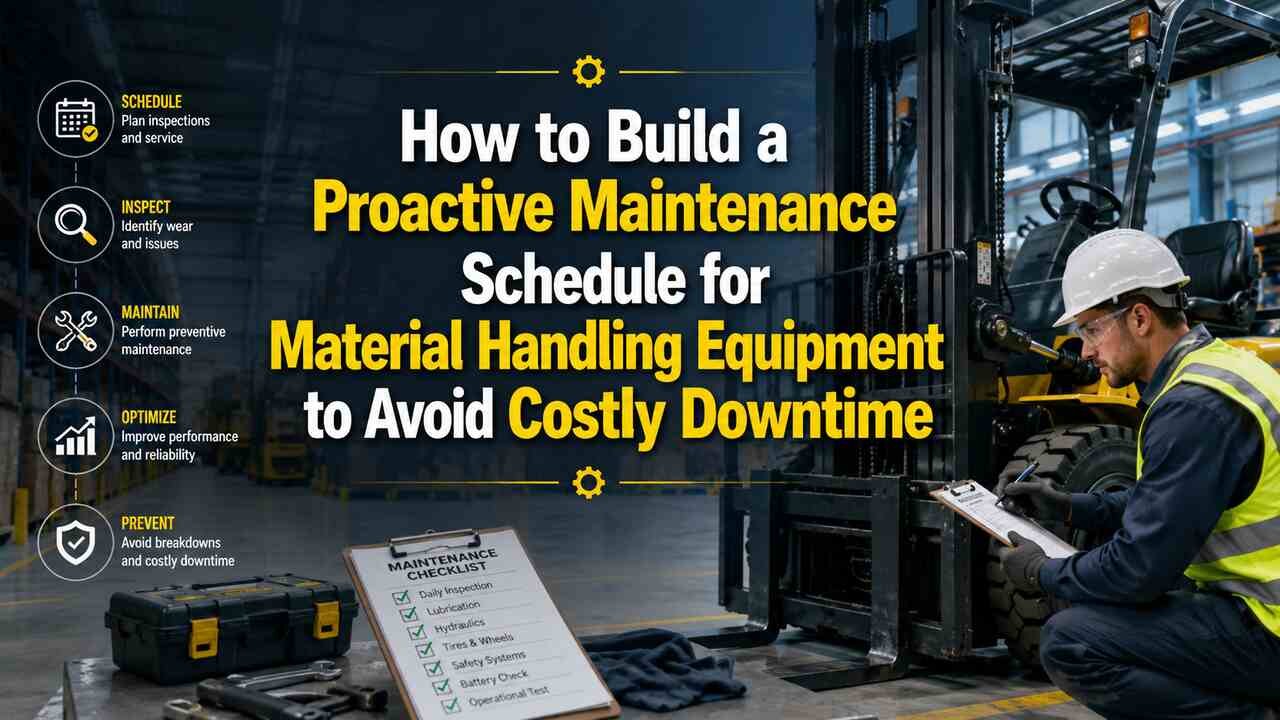
React to the problem at hand and it’s all too easy to believe reactive maintenance is cheaper. But the risks and costs associated with unexpected equipment failure quickly add up. A reactive maintenance schedule typically allows equipment to run to failure and then be serviced. A proactive maintenance schedule plans regular, preventive maintenance when it will least disrupt operations.
Recommended service checklists and intervals can be obtained from the manufacturer of each piece of equipment and will cover items such as lubrication, hose and belt wear, tire and battery condition, and bolt tightness.
Why Reactive Maintenance Costs More Than You Think
Skipping scheduled maintenance might save a few bucks in the short term on a maintenance budget, but the result is almost always a higher total cost to the business. The question for any manufacturer isn’t “should we stick with a PM (preventive maintenance) schedule, or just run it to failure?” The question is how to optimize your PM schedule for maximum equipment uptime and cost efficiency.
PM can waste a lot of time and resources if you’re not careful. Over-maintaining rarely solves problems, and under-maintaining leads to breakdowns. The key is finding the sweet spot where scheduled service reduces your operating costs without unnecessary maintenance.
Start With A Full Equipment Audit
Before establishing a schedule, you must first determine what you’re scheduling the maintenance of. Walk the floor and write down every single asset – forklifts, reach trucks, hand pallet jacks, platform trolleys, scissor lifts, order pickers, and any other machinery your team operates to handle goods or materials. Give each machine a unique code and also note its make, model, age, and current status.
Next, put that list in order of operational importance. Consider which part of your operation would immediately grind to a halt if that machine broke today, and prioritize it accordingly. Whether it’s receiving, dispatch, or perhaps a primary pick aisle, top-priority equipment needs to be maintained the most frequently and spare stock kept for it. Conversely, any redundant kit or back-up equipment should be set low on the agenda.
Sorting out the schedule of maintenance can quite often highlight machines you hadn’t realized you still had, machines performing well beyond their years, and machines for which no maintenance record exists. This is all good input.
The Tiered Inspection Model
A proper maintenance regimen isn’t a single box-ticking exercise that repeats monthly. It’s three specific tiers of review, each with its own focus and its own overseer.
Daily pre-start inspections are the first tier. Every day, before a shift starts and a single pallet is moved, the operator walks around the equipment and gives it a quick once-over with their eyes, checking for obvious signs of damage or malfunction. Are there hydraulic leaks on the ground? Is there a strange smell or noise? Are the wheels obstructed by a loose extension cord? The lift and lower functions are tested with no load attached, to ensure hydraulics are responding properly. The whole process should take a few minutes, maybe 180 seconds per machine. This check is essentially an early warning system. It’s not long enough to diagnose problems, but it is long enough to catch glaring red flags.
The second tier is a more thorough, monthly, mechanical audit. That’s a half-hour job for a maintenance tech or a senior operator, who goes down a written checklist that likely includes items such as hydraulic fluid levels, castor alignment, flat spots or cracking on polyurethane wheel surfaces, stress or crack propagation on welded seams in the frame or load backrest, and tightness of all fastened joints on forks or platform. Records are kept by equipment ID of all writeups, and actions thereon.
The final tier is an in-depth, certified inspection. Once a year, an outside inspector – a person trained and certified in the appropriate safety standards for the equipment in question – comes by to repeat the more in-depth tasks your people do monthly, but adds some more invasive examinations and tests and provides you with a sticker, and a report you’ll need to keep handy if you’re ever asked to produce your maintenance records by a forensics team looking into a nasty industrial accident.
Choosing Equipment That Reduces Maintenance Overhead
The maintenance guidelines you implement can only achieve their goal if the equipment they’re designed for is up to the task. Low-priced systems with sub-standard components will lead to breakdowns occurring more frequently, between service check-ups, and the system reaching the end of its lifecycle while other systems still have years of useful life remaining. Invariably, the more resilient, long-lasting, more reliable components that make up systems designed for long service life will prove the cheaper option over the total lifecycle of the asset.
When sourcing new or replacement gear, companies like Verdex supplies industrial-grade material handling equipment built for the demands of heavy daily warehouse use. It’s all in the specs, but having the right castor and hydraulic cylinder rating and using strong, long-lasting gauge structural steel can dial up the difference between how often you’re replacing wheels, seals, and bearings and how long you can keep your fleet running without major repairs.
Equipment you can service on site with locally sourced spares is always going to prove cheaper to maintain over time than equipment you must send back to the factory for specialized maintenance or that custom parts must be manufactured for, and it’s always worth paying extra for the easier-to-maintain model if it is an option.
Manual And Semi-Electric Equipment: The Overlooked Bottleneck
Many maintenance guides to warehouse equipment focus primarily on the most expensive and failure-prone assets – forklifts and automated conveyor systems. Those are solid choices, of course, as forklifts cost tens of thousands of dollars each and failures are dramatic. It’s hard to ignore a forklift stuck in the air because of a hydraulic leak. But in most distribution centers and manufacturing facilities, those aren’t the pieces of equipment causing friction in your day, every day.
Hand pallet jacks, platform trolleys, and semi-electric stackers are used constantly, by multiple operators, often with minimal supervision. They’re small enough that a fault doesn’t feel urgent until it becomes a safety incident. A hand pallet truck with stiff hydraulics forces the operator to exert more force on every load – that translates directly into physical strain on your employee, slower cycle times, and a higher probability of a musculoskeletal injury claim. A trolley with a flat-spotted wheel generates vibration on every push, which gets absorbed by the operator’s wrists and shoulders over the course of a shift. None of those issues is likely to show up on a near-miss report, so they can go ignored for years.
These aren’t hypothetical risks. They’re the ergonomic cost of deferred maintenance on a low-capital, immobile asset that most managers don’t even think of as “real” equipment. If these assets aren’t getting the maintenance they need, they’re getting replaced more often than they should be – and they’re a very cheap replacement.
Building The Documentation System
An effective maintenance schedule should be a written document that gives specific, detailed instructions about when and how to inspect equipment. The whole process should be tracked and stored. The document should specify what to look or listen for that may indicate a pending failure. Also, when you anticipate that parts will wear out this should be noted as well, so you have the ability to replace just the parts of the system that need attention when needed rather than creating more downtime by taking the entire system down.
These schedules help you avoid the common mistake of doing a lot of preventative maintenance and still having outages because the right thing broke. Keep in mind that fixing the wrong parts, too soon, is just another form of failure.
Spare Parts Inventory: Stock What Fails
Every hour that your fleet is out of action because a three-dollar part failed to arrive is a crushing cost. And the solution is very simple: keep a small inventory of the parts that fail most often.
For a typical fleet of material handling equipment, that might mean a few wheels and castors in the common sizes for your equipment. Add a few common hydraulic seals for your hand pallet jack, a lift or drive battery for your semi-electrics, and a few new fastener bins for the common thread sizes of your equipment. For heavy trolleys and stackers, it could also include a few shields of common bearings.
This isn’t a significant investment compared with the cost of even a half-day’s equipment downtime. Simply work out which of your assets are on the “critical” list, identify the two or three components that fail most frequently on each of them, and keep at least one set of replacement parts in stock. Revisit your inventory once a quarter and reorder as necessary.
The Repair-Vs-Replace Decision
Every piece of machinery or equipment has a specific shelf life after which it becomes more of a liability than a useful asset. The issue with most warehouse operations is that they keep their machinery and equipment running for longer than necessary because they don’t have the budget for an immediate replacement.
A simple way to determine if a piece of equipment is costing more money than it’s worth is to calculate the total maintenance costs of the equipment over its lifetime. If the annual maintenance cost comes to more than half of the cost of replacing that unit, it’s probably a good time to think about retiring that piece of equipment. But the costs are not just about the money you spend on repairs. You also need to take into account other costs like how frequently the equipment breaks down, how long it takes to repair the unit, as well as its current performance level in terms of what it was supposed to do when you first bought it.
For example, if you have a hand pallet truck breaking down every other month and it’s unable to reach the height specified by the manufacturer while lifting normal loads, the frequency of repairs and the subpar performance might be costing you more than it would to just replace it with a new unit. And this isn’t even accounting for the number of hours lost because the equipment was under repair.
Making The Schedule Stick
The most common failure mode for maintenance programs is not technical but organizational in nature. The program is established, operates well for a quarter, then falls behind during a busy period. After that, the program is never quite the same. To avoid this, maintenance tasks need to be assigned to a specific person, not a maintenance tech. The specific person should then log their completion. They should log this immediately as opposed to weekly. The program manager should check the log frequently enough to identify and correct missed tasks before they become missed weeks. An engine room culture of maintenance readiness does not just happen. It happens because of a prior decision that it is a non-negotiable and with sufficient force applied to the system to make easy compliance the path of least resistance. When you make this happen, the daily arguments and frictions are greatly reduced, plus your equipment lasts longer and your team stops paying the hidden tax for operating equipment that is wearing out.
