

Managing business gas and electricity effectively can help your company reduce operating expenses, improve energy efficiency, and maintain predictable monthly costs. Whether you operate a small retail store, restaurant, office, warehouse, or manufacturing facility, understanding commercial energy rates and choosing the right utility arrangements can make a meaningful difference to your bottom line.
What Is Business Gas and Electricity, and How Does It Work?
Business gas and electricity refer to energy services supplied to commercial properties for operating equipment, heating buildings, lighting workspaces, and supporting daily business activities. These services generally fall under commercial utility accounts rather than standard residential arrangements.
Electricity powers equipment such as computers, refrigeration systems, lighting, air conditioning, and machinery. Natural gas commonly supports space heating, water heating, commercial cooking, and certain industrial processes. Some businesses use both, while others operate entirely on electricity.
In the United States, commercial energy service depends heavily on state regulations and local utility infrastructure. In regulated markets, businesses typically receive electricity or gas through designated utilities. In certain competitive markets, eligible customers can choose their energy supplier while the local utility continues delivering the energy.
How Commercial Electricity Supply Works
Commercial electricity is generated from sources such as natural gas, nuclear energy, wind, solar, and hydropower. It travels through transmission and distribution networks before reaching your business.
Your electricity bill may include energy consumption measured in kilowatt-hours (kWh), customer charges, delivery fees, and demand charges where applicable. Larger commercial customers often have more complicated billing structures because their maximum electricity demand can influence monthly costs.
How Commercial Natural Gas Supply Works
Commercial natural gas is delivered through pipelines and used primarily for heating, cooking, water heating, and industrial equipment. Consumption is commonly measured in therms or hundred cubic feet, depending on the utility.
Your gas bill may contain separate supply and delivery charges. In some states, eligible businesses can purchase natural gas from competitive suppliers while continuing to receive transportation and distribution services from the local gas utility.
How Much Does Business Gas and Electricity Cost in the U.S.?
Business gas and electricity costs depend on your location, usage patterns, commercial rate classification, and energy supplier. There is no single nationwide price that applies to every company.
Commercial electricity rates are generally expressed in cents per kWh, while natural gas rates may be expressed in dollars per therm. However, comparing only these unit prices can be misleading because additional charges often affect the final bill.
For example, two businesses consuming the same amount of electricity could receive different bills if one has high peak demand or operates under a different rate schedule. Seasonal changes, weather conditions, and utility-approved rate adjustments can also affect expenses.
Understanding Commercial Electricity Rates
The following table illustrates how electricity consumption affects the energy portion of a monthly bill. These are hypothetical rates for calculation purposes, not current market quotes.
| Monthly Usage | Example Rate | Energy Charge |
| 1,000 kWh | $0.12/kWh | $120 |
| 2,500 kWh | $0.12/kWh | $300 |
| 5,000 kWh | $0.12/kWh | $600 |
| 10,000 kWh | $0.12/kWh | $1,200 |
| 20,000 kWh | $0.12/kWh | $2,400 |
Actual bills can be higher because these calculations exclude demand charges, fixed customer fees, delivery charges, taxes, and other applicable costs.
To understand your electricity expenses accurately, review your utility’s commercial rate schedule and calculate the total bill rather than focusing exclusively on the advertised energy price.
Understanding Commercial Natural Gas Rates
Natural gas pricing varies according to regional supply conditions, seasonal demand, transportation expenses, and utility tariffs. Businesses that use natural gas for winter heating may experience substantial seasonal changes in consumption.
Consider a restaurant using 500 therms of natural gas monthly. At a hypothetical supply rate of $0.90 per therm, the commodity charge would equal $450 before delivery fees and other charges.
For current U.S. commercial energy price information, the Energy Information Administration publishes electricity and natural gas statistics. These figures provide useful benchmarks, although your actual business rate may differ considerably.
How to Choose the Best Business Gas and Electricity Supplier
The best business energy supplier is one that provides competitive total costs, suitable contract terms, reliable customer support, and clear billing arrangements. The cheapest advertised rate does not always produce the lowest overall expense.
Your first step should be determining whether your business operates in a state that permits competitive energy supply. Electricity and natural gas choice rules differ, and some areas allow competition for one service but not the other.
Where supplier choice is available, compare written offers using the same estimated consumption, billing period, and service requirements. Ask each supplier to identify fixed charges, variable components, renewal provisions, and potential termination fees.
Comparing Fixed-Rate and Variable-Rate Energy Plans
Businesses may encounter different pricing arrangements when selecting competitive energy suppliers.
| Plan Type | Advantages | Potential Disadvantages |
| Fixed-rate plan | More predictable contracted supply price | May cost more if market prices decline |
| Variable-rate plan | May benefit from falling market prices | Rates can increase unexpectedly |
| Indexed-rate plan | Pricing follows a specified market benchmark | Greater exposure to wholesale price changes |
| Renewable energy plan | Supports renewable electricity purchasing goals | Pricing and renewable claims require careful review |
A fixed-rate supply contract does not necessarily guarantee a fixed total utility bill. Delivery charges, taxes, and actual consumption can still change.
For businesses with predictable energy usage and limited flexibility in their budgets, fixed supply pricing may simplify planning. Companies comfortable with market fluctuations may prefer other arrangements.
What to Check Before Signing an Energy Contract
Review the contract duration, pricing formula, cancellation terms, billing procedures, and renewal conditions before committing.
Pay particular attention to automatic renewals, early termination charges, and whether the supplier requires a minimum usage commitment. Some contracts may contain provisions related to consumption deviations or changes in business operations.
Also verify the supplier’s authorization to serve commercial customers in your state. Your state public utility commission or relevant regulatory agency can help you understand supplier eligibility and consumer protections.
How to Reduce Business Electricity and Gas Bills
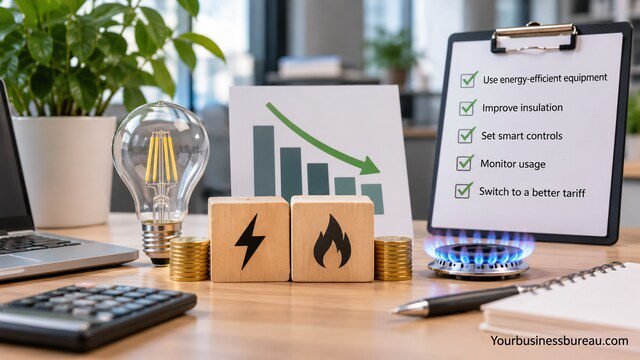
Reducing business energy costs starts with identifying unnecessary consumption and improving the efficiency of equipment you already use. Small operational improvements can produce meaningful savings when applied consistently.
A practical starting point is reviewing at least 12 months of electricity and natural gas bills. Look for seasonal patterns, unexpected consumption increases, demand charges, and changes in operating hours.
You should also distinguish between reducing energy consumption and reducing energy prices. Using fewer kilowatt-hours lowers usage-related expenses, while choosing a different rate schedule or supply contract may reduce the price paid for energy.
Improve Lighting, Heating, and Cooling Efficiency
Replacing inefficient lighting with LED fixtures can reduce electricity consumption, especially in facilities where lights operate for extended periods.
Heating and cooling systems deserve similar attention. Regular maintenance, clean filters, properly calibrated thermostats, and sealed air leaks can improve performance and reduce wasted energy.
For example, an office operating from 9 a.m. to 6 p.m. may not need the same heating or cooling settings overnight. Programmable controls can adjust temperatures automatically while maintaining comfortable working conditions.
However, facilities storing temperature-sensitive products must maintain appropriate environmental conditions even outside normal business hours.
Use Smart Meters and Energy Monitoring Tools
Smart meters and energy monitoring systems help businesses understand when and how electricity is consumed. Depending on the utility, interval data may reveal usage patterns that ordinary monthly bills cannot show.
Suppose a retail store records unexpectedly high electricity consumption after closing. Further investigation might reveal that display lighting, ventilation equipment, or other nonessential systems remain active overnight.
Monitoring can also identify equipment that is consuming more energy than expected. For businesses with demand charges, controlling simultaneous equipment operation may reduce peak demand, provided operational and safety requirements are maintained.
Business Energy Contracts, Billing, and Hidden Charges
Commercial energy bills often include more than the cost of electricity or natural gas consumed. Understanding each charge helps you identify billing problems and evaluate whether a different rate arrangement would be beneficial.
Electricity bills may contain customer charges, energy charges, demand charges, fuel adjustments, and distribution-related fees. Natural gas bills may include commodity charges, transportation costs, and fixed service fees.
The exact terminology differs between utilities. Some charges are regulated, while others depend on the supply contract or tariff.
A business owner who understands these distinctions is better positioned to compare offers accurately and avoid making decisions based on incomplete pricing information.
Common Charges on Commercial Utility Bills
One important distinction is the difference between electricity consumption and electricity demand.
Consumption measures the total electricity used over time in kWh. Demand measures the rate at which electricity is used, usually expressed in kilowatts (kW).
For example, a commercial facility may consume 8,000 kWh during a billing period while reaching a maximum measured demand of 40 kW. If its tariff includes a demand charge, both figures can influence the final bill.
Some tariffs also include time-of-use rates, power factor adjustments, or demand ratchets. These provisions can significantly affect larger commercial customers.
Avoiding Contract Renewal and Billing Problems
Businesses should maintain a calendar of energy contract expiration dates and review renewal terms well before the agreement ends.
When comparing a renewal offer, request the complete pricing structure rather than accepting a headline rate. Confirm whether delivery fees are included, whether the contract permits price adjustments, and what happens when the initial term expires.
Check bills regularly for unusual consumption, incorrect account classifications, unexpected fees, and meter-reading issues. If you discover a discrepancy, contact the utility or supplier and retain documentation of the dispute.
Renewable Energy Options for Commercial Buildings

Renewable electricity can help businesses reduce dependence on conventional energy sources and support environmental objectives. However, the financial benefits depend on local electricity prices, installation costs, incentives, and the structure of the renewable energy arrangement.
Commercial solar systems are one option for businesses with suitable rooftops or available land. Other businesses may participate in community solar programs or purchase electricity products backed by renewable energy certificates.
Renewable electricity purchasing does not automatically mean that the electricity physically entering your building comes exclusively from renewable generators. Claims about renewable energy use depend on the applicable certificate and accounting arrangements.
Is Commercial Solar Power Worth the Investment?
Commercial solar may be financially attractive when a business has substantial daytime electricity consumption, suitable installation space, and favorable utility policies.
Before investing, evaluate the system’s projected annual output, installation expenses, maintenance requirements, financing terms, and expected electricity savings.
Consider a warehouse that uses significant electricity during daylight hours. A properly sized solar installation may offset some grid purchases, but the financial result depends on the utility tariff and how solar generation aligns with demand.
Businesses should also investigate applicable federal, state, and local incentives. Eligibility and program rules can change, so verify current requirements before including incentives in a financial projection.
Renewable Electricity Plans and Energy Certificates
In competitive electricity markets, some suppliers offer renewable electricity products supported by renewable energy certificates, commonly called RECs.
A REC represents the renewable attributes associated with one megawatt-hour of qualifying electricity generation. Businesses can use properly acquired and retired certificates to support certain renewable electricity claims.
Before purchasing, examine the supplier’s documentation, certificate tracking arrangements, and the percentage of renewable electricity represented by the product.
For businesses unable to install solar panels, renewable electricity purchasing may offer an alternative way to pursue sustainability goals.
How to Build a Long-Term Business Energy Management Strategy
A long-term energy management strategy combines cost monitoring, equipment maintenance, purchasing decisions, and realistic efficiency improvements. Instead of treating utilities as unavoidable monthly expenses, businesses can manage energy as an ongoing operational responsibility.
Start by establishing a baseline using historical electricity and natural gas consumption. Record monthly costs, operating hours, building occupancy, and major equipment changes.
This information makes it easier to evaluate whether energy-saving projects are producing measurable results. It also helps you distinguish genuine efficiency improvements from changes caused by weather, production volume, or business activity.
Conduct a Business Energy Audit
An energy audit evaluates how a building uses energy and identifies opportunities to improve efficiency.
A basic assessment may examine lighting, heating and cooling systems, insulation, ventilation, refrigeration, and equipment schedules. More detailed audits can include interval meter analysis, equipment testing, and financial estimates for recommended improvements.
For example, a restaurant audit might reveal opportunities to improve refrigeration maintenance, kitchen ventilation controls, and water heating efficiency.
Prioritize recommendations according to their expected savings, implementation costs, safety considerations, and operational impact.
Create an Energy Budget and Track Performance
An effective energy budget should account for seasonal consumption, expected business activity, contracted supply prices, and potential utility rate changes.
Instead of tracking only total dollars, consider using performance measures that reflect your operations. A restaurant might monitor energy use per customer served, while a warehouse could compare electricity consumption with operating hours or occupied square footage.
Review these measurements regularly and investigate significant changes.
When planning equipment upgrades, compare the full lifecycle cost, including purchase price, energy consumption, maintenance, and expected service life. This approach helps you avoid choosing equipment solely because it has the lowest upfront price.
FAQ’s
Business electricity is not always cheaper than residential electricity. Commercial customers may pay different average rates, but actual costs depend on location, consumption, demand charges, and utility tariffs. Some businesses benefit from lower energy rates, while others face additional charges that increase their effective electricity cost.
You may be able to switch suppliers if your business operates in a state that permits competitive energy supply. Eligibility depends on the location, utility territory, and service type. In regulated markets, your options may be limited to the designated utility. Always check existing contract obligations before switching.
Small businesses can reduce energy bills by installing efficient lighting, maintaining heating and cooling equipment, adjusting operating schedules, and monitoring consumption. Reviewing utility rate schedules and supplier contracts may reveal additional savings opportunities. Begin with inexpensive improvements before investing in major equipment upgrades.
A fixed-rate plan generally locks in a specified energy supply price for an agreed period, while a variable-rate plan allows that price to change according to contract terms or market conditions. Fixed pricing provides greater supply-cost predictability, but neither arrangement necessarily fixes your total utility bill.
In some competitive markets, suppliers offer both commercial electricity and natural gas services. However, availability depends on state regulations, supplier authorization, and local utility arrangements. Combining services may simplify account management, but you should compare each service independently to determine whether the overall pricing is competitive.
Monthly electricity consumption varies widely by business type, equipment, building size, climate, and operating hours. A small office may use substantially less electricity than a restaurant with commercial refrigeration and cooking equipment. Your previous 12 months of utility bills provide a more useful estimate than a generic national average.
Conclusion
Managing business gas and electricity effectively requires more than finding an attractive advertised energy rate. Understanding commercial tariffs, contract conditions, consumption patterns, and equipment efficiency helps you control expenses and avoid unnecessary costs.
Businesses can often improve energy performance through better monitoring, preventive maintenance, efficient equipment, and carefully evaluated supply arrangements. Renewable electricity options may also provide financial or environmental benefits when they suit your location and operating requirements.
The most practical next step is to review your last 12 months of utility bills, identify your largest energy expenses, and evaluate improvements based on their actual costs and expected savings.
