


Introduction
Small business inventory management is the process of tracking, organizing, purchasing, storing, and selling products while maintaining the right stock levels. Effective inventory control helps businesses avoid stockouts, reduce excess inventory, improve customer satisfaction, and protect cash flow. Whether a business operates a retail store, e-commerce shop, wholesale operation, manufacturing workshop, or hybrid sales model, inventory management directly influences profitability and operational efficiency.
As businesses grow, inventory becomes more complex. Product variations, supplier lead times, demand fluctuations, warehouse capacity, and customer expectations all create challenges that require structured processes. A well-designed inventory management system allows business owners to make informed purchasing decisions, monitor stock movement, forecast demand, and maintain accurate inventory records. This guide explains how small businesses can establish and improve inventory management practices through practical, step-by-step actions.
Assess Current Inventory Operations
The first step in small business inventory management is understanding how inventory currently moves through the business. Review how products are purchased, received, stored, counted, sold, and replenished. Document every stage of the inventory lifecycle to identify inefficiencies and gaps.
Evaluate key operational areas such as stock accuracy, receiving procedures, supplier relationships, warehouse organization, sales channels, and reporting systems. Determine whether inventory records match physical stock levels and identify products that frequently experience shortages or overstock situations.
A complete assessment provides a foundation for improvement. Businesses often discover hidden issues such as duplicate product listings, inconsistent counting procedures, poor storage practices, or delayed purchase orders. Identifying these problems early makes future inventory optimization significantly easier.
Organize Inventory Into Clear Product Categories
Creating structured product categories improves visibility and simplifies inventory control. Every item should belong to a logical category, subcategory, and product group. Consistent organization makes tracking, reporting, and forecasting more accurate.
Important classification methods include product type, supplier, brand, seasonality, profitability, and sales velocity. Businesses should also establish standardized naming conventions and unique stock keeping units (SKUs) for each item. Product variations such as size, color, material, or packaging should be clearly distinguished.
Organized inventory creates operational consistency across purchasing, storage, fulfillment, and accounting. Employees can locate products faster, reports become more meaningful, and managers gain better insight into inventory performance across different product lines.
Inventory Classification Example
| Category | Subcategory | Example Products | Tracking Priority |
| Apparel | T-Shirts | Cotton T-Shirts | High |
| Electronics | Accessories | Chargers, Cables | Medium |
| Home Goods | Kitchenware | Storage Containers | Medium |
| Health Products | Supplements | Vitamins | High |
| Office Supplies | Stationery | Notebooks, Pens | Low |
Create Accurate SKU and Product Identification Systems
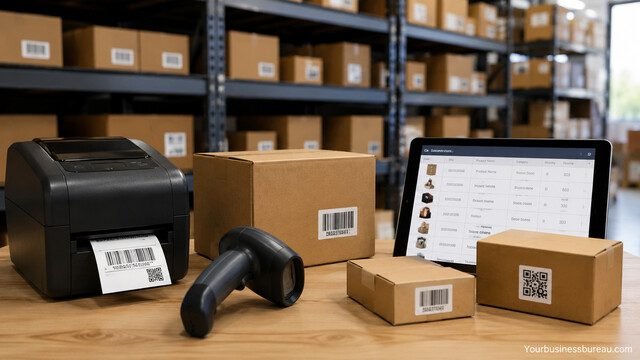
A reliable SKU system serves as the backbone of inventory management. Each product should have a unique identifier that allows employees and systems to distinguish one item from another without confusion.
Effective SKU structures often include category codes, product type indicators, size identifiers, and variation markers. For example, a blue medium shirt may use a different SKU than the same shirt in another color or size. Consistency is more important than complexity.
Accurate identification reduces receiving errors, fulfillment mistakes, and inventory discrepancies. As product catalogs expand, a structured SKU system becomes increasingly valuable because it supports reporting, forecasting, barcode integration, and warehouse organization.
Establish Reliable Inventory Tracking Methods
Inventory tracking allows businesses to monitor stock movement in real time or near real time. Every inventory transaction should be recorded, including purchases, sales, returns, transfers, adjustments, and damaged goods.
Common tracking methods include manual spreadsheets, barcode systems, inventory software, mobile scanning applications, and integrated point-of-sale systems. Small businesses should select a tracking method that matches their size, transaction volume, and growth objectives.
Consistent tracking creates trustworthy inventory data. When stock information remains accurate, managers can make better purchasing decisions, improve customer service, and reduce losses caused by inventory inaccuracies.
Implement Inventory Management Software
Inventory software centralizes inventory information and automates many routine tasks. Instead of relying solely on manual spreadsheets, businesses can use software to monitor stock levels, generate reports, create purchase orders, and track sales performance.
Important software capabilities include stock monitoring, barcode support, supplier management, order tracking, reporting dashboards, low-stock alerts, and integration with accounting or e-commerce systems. Automation reduces administrative workload and minimizes human error.
As business operations become more complex, software improves scalability. It enables better coordination between purchasing, warehousing, sales, and finance while providing management with real-time inventory visibility.
Essential Inventory Software Features
| Feature | Purpose | Business Benefit |
| Stock Tracking | Monitor inventory levels | Improved accuracy |
| Barcode Scanning | Fast product identification | Reduced errors |
| Purchase Orders | Automate procurement | Better replenishment |
| Reporting | Analyze inventory data | Smarter decisions |
| Forecasting | Predict future demand | Reduced stockouts |
| Multi-Channel Integration | Connect sales channels | Unified inventory control |
Apply Inventory Counting Procedures Regularly
Regular inventory counts ensure that recorded stock matches actual inventory. Physical verification helps detect theft, damage, administrative mistakes, and process failures before they become significant financial issues.
Businesses commonly use full physical counts, cycle counts, and spot checks. Full counts examine all inventory, while cycle counting focuses on selected products throughout the year. High-value and fast-moving products generally require more frequent verification.
Consistent counting improves inventory accuracy and strengthens confidence in inventory reports. Reliable data supports purchasing decisions, financial reporting, and operational planning across the organization.
Set Reorder Points for Every Product
Reorder points determine when additional inventory should be purchased. Establishing these thresholds prevents stockouts while avoiding excessive inventory accumulation.
Reorder calculations should consider average daily sales, supplier lead times, seasonal demand patterns, and safety stock requirements. Fast-selling products often require higher reorder thresholds than slow-moving items.
Effective reorder management creates balance between product availability and cash flow efficiency. Businesses can maintain customer satisfaction without tying excessive capital to unnecessary inventory.
Maintain Safety Stock for Critical Products
Safety stock serves as a protective buffer against unexpected demand increases, supplier delays, transportation disruptions, or forecasting errors. Without safety stock, businesses risk losing sales during periods of uncertainty.
The appropriate safety stock level depends on demand variability, supplier reliability, product importance, and lead time consistency. Essential products typically require greater protection than items with predictable demand patterns.
Safety stock strengthens operational resilience. Businesses can continue serving customers even when market conditions or supply chains become temporarily unstable.
Forecast Demand Using Historical Data
Demand forecasting helps businesses predict future inventory requirements. Accurate forecasting reduces both overstocking and stock shortages while improving purchasing efficiency.
Historical sales records, seasonal trends, marketing campaigns, economic conditions, customer behavior, and industry developments all contribute to forecasting accuracy. Businesses should regularly compare forecasts against actual results and refine their models accordingly.
Better forecasts lead to smarter inventory investments. Instead of reacting to shortages or excess inventory, businesses can proactively align purchasing decisions with expected demand.
Strengthen Supplier Management Processes
Supplier performance directly affects inventory availability and operational reliability. Businesses should evaluate suppliers based on quality, pricing, lead times, communication, consistency, and responsiveness.
Developing relationships with multiple suppliers can reduce dependency on a single source. Businesses should maintain supplier performance records and periodically review delivery accuracy, product quality, and order fulfillment rates.
Strong supplier partnerships create more predictable inventory operations. Reliable vendors help businesses maintain adequate stock levels, minimize disruptions, and improve customer satisfaction.
Key Supplier Evaluation Factors
| Factor | Measurement Area | Impact |
| Lead Time | Delivery speed | Inventory availability |
| Quality | Product consistency | Customer satisfaction |
| Pricing | Cost competitiveness | Profit margins |
| Reliability | On-time delivery | Operational stability |
| Communication | Response speed | Problem resolution |
| Capacity | Production capability | Growth support |
Optimize Warehouse and Storage Layouts
Efficient storage improves inventory accessibility, reduces handling time, and minimizes errors. Products should be arranged logically based on sales frequency, size, weight, and operational requirements.
Fast-moving items should be placed in easily accessible locations, while slower-moving inventory can occupy secondary storage areas. Clear labeling, designated zones, shelving systems, and organized pathways contribute to warehouse efficiency.
A structured storage environment supports faster receiving, picking, packing, and counting activities. Employees spend less time searching for products, which improves productivity and order fulfillment performance.
Control Inventory Carrying Costs

Inventory carrying costs include storage expenses, insurance, depreciation, obsolescence, financing costs, and operational overhead. Excess inventory increases these costs and reduces available working capital.
Businesses should monitor inventory turnover, eliminate slow-moving products, negotiate favorable supplier terms, and optimize order quantities. Regular analysis helps identify products that consume disproportionate resources without generating sufficient returns.
Managing carrying costs improves profitability and cash flow. Businesses can allocate financial resources more effectively while maintaining adequate inventory availability.
Reduce Dead Stock and Obsolete Inventory
Dead stock refers to inventory that no longer sells or has extremely low demand. Obsolete inventory often results from changing customer preferences, product updates, poor forecasting, or excessive purchasing.
Businesses should regularly review inventory aging reports and identify products with declining sales activity. Promotional campaigns, bundled offers, discounts, and liquidation strategies can help recover value from stagnant inventory.
Reducing dead stock frees warehouse space, improves cash flow, and increases inventory efficiency. Continuous monitoring prevents inventory accumulation from becoming a long-term financial burden.
Integrate Sales Channels Into One Inventory System
Many small businesses sell through multiple channels, including physical stores, websites, marketplaces, social platforms, and wholesale partnerships. Inventory synchronization across these channels is essential for accuracy.
Integrated systems automatically update inventory quantities whenever sales occur. This prevents overselling, duplicate stock allocations, and customer disappointment caused by inaccurate availability information.
Unified inventory visibility supports better decision-making. Business owners gain a complete view of inventory performance regardless of where products are sold.
Improve Order Fulfillment Accuracy
Order fulfillment accuracy directly affects customer satisfaction and operational costs. Inventory errors can lead to incorrect shipments, returns, refunds, and negative customer experiences.
Businesses should implement barcode scanning, verification checkpoints, organized picking procedures, and employee training programs. Standardized fulfillment workflows reduce variability and improve consistency.
Accurate fulfillment strengthens customer trust and supports long-term growth. Reliable delivery performance encourages repeat purchases and positive brand reputation.
Monitor Inventory Performance Metrics
Inventory management requires continuous measurement. Businesses should track key performance indicators that reveal inventory efficiency, profitability, and operational effectiveness.
Important metrics include inventory turnover, stockout rate, carrying cost percentage, order accuracy, inventory accuracy, gross margin return on inventory investment, and days of inventory on hand. These measurements help identify trends and opportunities for improvement.
Performance monitoring transforms inventory management from a reactive activity into a strategic business function. Data-driven decisions often produce better outcomes than intuition alone.
Important Inventory Metrics
| Metric | Purpose | Desired Outcome |
| Inventory Turnover | Measures sales efficiency | Higher turnover |
| Stockout Rate | Tracks shortages | Lower percentage |
| Inventory Accuracy | Compares records to reality | Higher accuracy |
| Carrying Cost | Measures holding expenses | Lower cost |
| Order Accuracy | Evaluates fulfillment quality | Higher accuracy |
| Days on Hand | Measures inventory duration | Balanced levels |
Train Employees on Inventory Procedures
Even advanced systems cannot compensate for inconsistent employee practices. Training ensures that inventory procedures are followed correctly throughout the organization.
Employees should understand receiving processes, stock adjustments, cycle counting, product identification, storage standards, fulfillment procedures, and reporting requirements. Documentation and refresher training reinforce consistency.
A knowledgeable workforce contributes to inventory accuracy and operational efficiency. Clear expectations reduce mistakes and create accountability across inventory-related activities.
Protect Inventory From Loss and Damage
Inventory losses can occur through theft, mishandling, environmental factors, administrative errors, or supplier discrepancies. Preventing these losses protects profitability and improves inventory reliability.
Businesses should implement security measures, access controls, surveillance systems, receiving inspections, damage reporting procedures, and regular audits. High-value inventory may require additional safeguards.
Inventory protection supports financial stability and operational confidence. Reduced losses contribute directly to stronger margins and improved stock accuracy.
Automate Repetitive Inventory Tasks
Automation allows businesses to reduce manual work and improve consistency. Routine tasks such as stock updates, reorder alerts, reporting, purchase order generation, and inventory synchronization can often be automated.
Automated workflows minimize data entry errors and free employees to focus on higher-value activities. Inventory software can also generate alerts when stock levels fall below predetermined thresholds.
As businesses scale, automation becomes increasingly important. It enables growth without requiring proportional increases in administrative workload.
Review and Improve Inventory Processes Continuously
Inventory management is not a one-time project. Customer demand, supplier performance, market conditions, and business objectives change over time, requiring ongoing process evaluation.
Businesses should conduct regular reviews of inventory policies, forecasting methods, storage layouts, software capabilities, supplier relationships, and performance metrics. Continuous improvement initiatives help maintain operational efficiency.
Organizations that regularly refine inventory practices typically achieve better stock accuracy, stronger cash flow, and greater customer satisfaction than those relying on static processes.
Conclusion
Small business inventory management plays a critical role in profitability, customer satisfaction, and operational stability. Businesses that organize products effectively, track inventory accurately, forecast demand, manage suppliers, optimize storage, and monitor performance metrics gain a significant competitive advantage. By implementing structured inventory procedures and continuously improving processes, small businesses can reduce costs, prevent stockouts, improve cash flow, and support sustainable growth. Successful inventory management is not simply about knowing what products are in stock. It is about creating a system that consistently delivers the right products, in the right quantities, at the right time.
FAQ’s
Most small businesses should perform cycle counts weekly or monthly and conduct a complete physical inventory count at least once or twice per year. High-value products may require more frequent verification.
The best method depends on business size and complexity. Many small businesses benefit from inventory software combined with barcode scanning and regular cycle counting procedures.
Effective inventory management reduces excess stock, lowers carrying costs, prevents unnecessary purchases, and ensures capital is invested in products that generate revenue.
Common causes include manual data entry errors, theft, damaged goods, receiving mistakes, fulfillment errors, unrecorded adjustments, and inconsistent counting procedures.
Safety stock levels depend on demand variability, supplier reliability, and lead times. Critical products with unpredictable demand typically require larger safety stock reserves.
No single metric provides a complete picture. Inventory turnover, stockout rate, inventory accuracy, carrying cost, and order accuracy should all be monitored together to evaluate overall inventory performance.
