

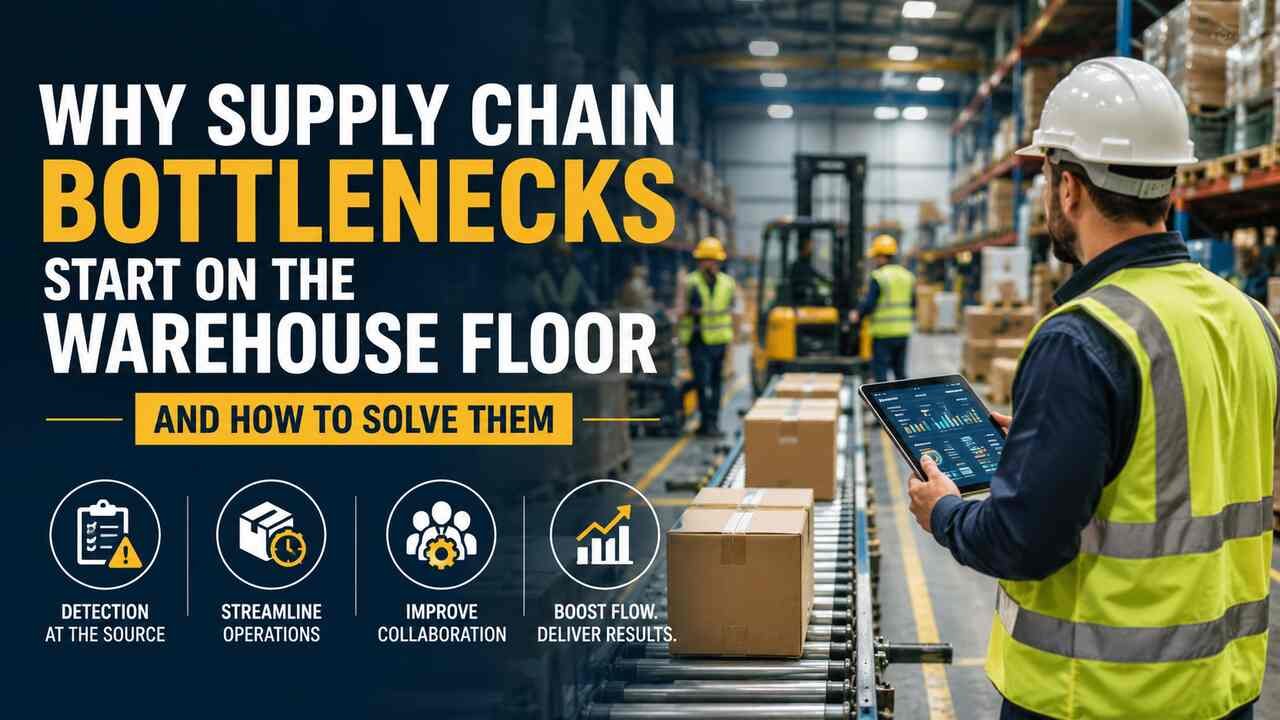
Many supply chain failures are attributed to port delays, freight rates, or carrier capacity. Although these factors are relevant, operational data indicates that the real bottlenecks causing reduced throughput rates and missed freight departure windows are actually right there on your warehouse floor, usually within a 30-meter radius of your staging area. Fixing those issues will to a large extent resolve the downstream disruptions.
How small delays multiply into supply chain failures
A delay of five minutes at the racking face multiplies because of the nature of interlinked supply chain operations.
For example, if the forklift operator needs to get three pallets to fulfill one order, poor aisle geometry may lead to multiple repositioning moves for every pick, adding five to eight minutes to the process. Multiply that by 40 picks in a shift and you have three to five hours of compounded time loss – or enough to miss a freight truck departure time. The truck departs late. The distribution center schedules its inbound activity. Retail’s just-in-time replenishment process is disrupted. All from a minor issue on your warehouse floor.
This compounded-for-chaos scenario is better known as the micro-bottleneck multiplier. It is a key reason why intralogistics (the physical operation behind your day-to-day management of materials and goods) demands the same strategic consideration as network design. You cannot remedy a micro-bottleneck with an over-the-road carrier solution.
Aisle design and equipment mismatch
Most warehouses did not start as clean-sheet designs. They were built out over time – racking systems were added to, SKU counts increased, and different material handling equipment was brought in without a complete spatial check. The upshot of that is a frequently occurring layout issue: narrow aisles combining with equipment that requires more clearance than the existing space will allow.
It’s made worse by SKU proliferation. The more unique inventory items a warehouse stores, the denser the storage mapping and the greater the travel distances. Operators make more journeys through more cramped passageways, perform multi-point turns to access pallet positions, and do so against the clock. The physics aren’t forgiving here. Every extra turn added is an extra second. Every rack upright narrowly missed is a point of risk. Over the course of an entire shift, those points of friction add up to an easily quantifiable loss of throughput and a real safety risk.
The solution is to first pick the equipment that suits the environment, not the other way around. Selective racking in a wide-aisle layout suits your standard counterbalance forklifts. Go to a narrow aisle, and you’ll have to switch over to reach trucks or turret trucks that are capable of operating in a smaller turning circle. Drive-in and double-deep racking systems, meanwhile, both require specific equipment capable of reaching the greater lift heights and safely handling the double-deep loads. This shift – more than almost any other – is the root cause of bottlenecks and one of the easiest to fix.
Why fleet versatility matters more than fleet size
Managing a forklift fleet of a single type seems easier than managing a mixed fleet. One set of specs, one compliance track for operator certification, one maintenance plan. The reality is that your operation is constantly waiting for the one machine type’s functionality where and when it doesn’t fit.
Loading docks are often blocked because high-capacity counterbalance lift trucks are the only option. Cross-docking may have you waiting on product as very fast-cycling, rapid directional-changing lift trucks or AGVs (automated guided vehicles) from the single-type fleet shuttle inbound to outbound transport. Your outdoor yard lift equipment, with different tires and frame construction from indoor lift trucks, might currently be shifting from uneven surfaces back into the warehouse for more-productive indoor floor activities. If you have elected to run your operation all off of one machine type, you are losing time and money somewhere every day in this scenario. That’s not fleet versatility, that’s lead in your operational shoes.
Utilization, the other side of the versatility coin, is the percentage of time your lift equipment is actively being productive. A warehouse that has three counterbalance lift trucks sitting while one moves inbound and outbound freight and often uses the lift truck forklift extensions as a feed truck doesn’t need three lift trucks of any type. It needs one counterbalance truck, one reach truck and one walkie pallet-jack. The others just cost money.
CapEx vs. OpEx in fleet scaling
Buying material handling equipment outright may seem like a good idea because you become the owner, there is no continuous hiring cost, and it becomes a tangible asset on your company’s balance sheet. But in reality, warehouse operations face fluctuations in their material handling equipment needs. For instance, your business might need three times the forklifts during the holidays than during regular days. If you purchase all the equipment you need during peaks, you risk having unused equipment during off-peak periods, which adds to your costs. On the other hand, if you only purchase the equipment you need during regular days, you risk having your operations suffer during peak periods because of insufficient equipment. So what should you do?
This situation is where operational expenses come in handy. With operational expenses, you can easily acquire additional equipment whenever you need it without incurring a high cost. Operational expenses spread the cost of the equipment over its lifetime, while capital expenses require you to pay for the full cost upfront. This helps you manage your current liquidity and overall finances better. If you have specific requirements for the type of equipment you need but don’t want to pay for the full cost upfront, options like forklifts hire melbourne let you use the equipment you need on a short-term or long-term rental basis, and make more cash available to invest back into your business.
Predictive maintenance and the cost of peak-season downtime
Equipment breaking down in the middle of peak season can be financially damaging to your business. From repair costs, idle labor, and lost throughput to the overtime needed for catch-up and even penalties due to missed deliveries, the costs quickly add up. Predictive maintenance minimizes these risks by preempting most breakdowns. But a successful program needs quick access to service data and a cycle of maintenance planning that doesn’t rely on equipment ownership. With a hire agreement that includes all necessary maintenance, this responsibility is transferred to your supplier.
Eliminating deadheading through data integration
The movement of an empty forklift from one place to another, known as deadheading, is a clear example of wasted time in the warehouse. It is also something that can be easily solved.
For example, a forklift goes to the dock, picks up a pallet, stores it in the rack, and then returns to the dock for another inbound pallet. If the outbound order pallet was waiting at the dock and picked up while that forklift is on its way to storage anyway, the forklift would only have gone from dock to rack and back to dock to rack in one “productive” cycle.
WMS directs and optimally assigns these kinds of cycles in real-time. Without location data and access to the right side of forklift and robot lift data, the velocity of warehouse operations can be continuously flattened out.
The data layer matters here. Telematics on material handling equipment generates the real operational picture: utilization rates by machine and by shift, high-traffic zones where congestion occurs, and idle time patterns that point to scheduling gaps. Without that data, floor optimization is guesswork. With it, you’re making evidence-based decisions about equipment deployment, staging area layout, and shift structure.
Operator performance and the ergonomics factor
Sometimes, the bottlenecks affecting operation efficiency aren’t due to infrastructure but to the operators themselves.
Fatigue must be considered an important variable when assessing throughput. An operator who has been driving a cabin without proper design, features, and ergonomics for 6 hours, with poor sightlines, hard steering, and vibrating seat, will drive slower and less accurately than one driving ergonomic equipment. The hourly rate of pallet movement decreases this way, and with it the safety threshold. Machines or equipment incidents are frequently concentrated in the second half of the shift, which is coherent with the performance decaying due to fatigue.
Designing a comfortable and ergonomic cabin, with intuitional standard control design, and providing good preoperational training that avoids bad postures will not only lower the injury and health risk of the operator but help maintain the throughput steadily across the entire shift. This is even more important when, due to the peak season, you are forced to rapidly scale with temporary workers. An operator hired on a temporary basis should not require much time to reach a decent productivity level if the machine is well designed and standardized. Operators should not waste their time in the shift while fighting the machine or adapting their driving style to avoid biomechanical overload.
Workplace safety standards around pedestrian-machinery separation, load weight certification, and operator licensing exist because the consequences of getting it wrong are severe. Those requirements also represent a minimum bar, not an optimal target. The best warehouse floors build in additional clearance, clear sightlines, and traffic flow design that reduces conflict zones before incidents occur.
Transitioning to electric power
The transition from LPG and diesel forklifts to lithium-ion electric units is in progress in indoor warehouse environments. But there are reasons beyond emissions compliance that’s driving this trend.
LPG demands ventilation, fuel management, and engine maintenance. Diesel increasingly is non-permissible in enclosed environments. Lithium-ion electric units have zero exhaust, greatly reduced noise levels that contribute to operator fatigue and miscommunication, and in modern configurations, virtually zero battery swapping.
Fast-charge lithium technology has transformed the discussion around electric fleet management. If a machine can charge 90% in 90 minutes during a shift break, versus battery exchange of up to 30 minutes of a skilled technician’s time, the electric machine in essence becomes a non-issue in shift management. Add on that energy is generally less expensive per hour compared to LPG and for most types of facilities the business case for electric indoors now leads the regulatory push.
The floor is where supply chain velocity is won or lost
Global logistics networks are complicated, and some of the points of failure are truly beyond your control. The warehouse floor isn’t one of them. Equipment selection, aisle geometry, fleet scaling strategy, maintenance programs, data integration, and operator environment are all at the command of a logistics manager that’s ready to look at the operation at ground level. Getting those fundamentals right doesn’t just reduce internal costs. It removes the friction points that, if unchecked, compound into the supply chain disruptions that are far harder and more expensive to fix later.
