

The Business of Fashion (BoF) is a global media and business intelligence company covering the commercial side of fashion, luxury, beauty, and retail. Founded by Imran Amed in 2007, it provides journalism, research, career resources, events, and professional insights to help industry professionals, entrepreneurs, students, and investors understand how the fashion industry operates.
What Is The Business of Fashion?
The Business of Fashion is a London-founded media and intelligence company that reports on the commercial side of the global fashion and beauty industries. Its stated mission is to “open, inform and connect” these industries through journalism, research, professional resources, and events.
BoF was founded by Imran Amed, who currently serves as founder, CEO, and editor-in-chief. Amed started writing about the fashion business in 2007 after identifying a gap between traditional fashion coverage and the deeper business analysis needed to understand how brands, retailers, designers, investors, and suppliers actually operated.
What began as a blog eventually developed into a much broader organisation. BoF says it now reaches more than 1.5 million unique visitors per month, has more than 7 million social-media followers across 190 countries, and serves a community of about 125,000 BoF Professional members. Its staff includes journalists, analysts, engineers, designers, strategists, and commercial professionals.
What Does The Business of Fashion Cover?
BoF approaches fashion primarily as an industry rather than simply as culture, style, or entertainment. Its reporting therefore follows the decisions and economic forces that affect companies operating across fashion, luxury, beauty, and retail.
Major areas of coverage include:
| Area | What BoF Typically Examines |
| Luxury | Brand strategy, pricing, leadership changes, creative direction, demand, and major luxury groups |
| Retail | Stores, e-commerce, wholesale, resale, merchandising, and changing shopping behaviour |
| Marketing | Advertising, influencers, brand building, customer acquisition, PR, and cultural relevance |
| Technology | Artificial intelligence, digital commerce, platforms, data, and emerging retail technology |
| Sustainability | Supply chains, environmental commitments, regulation, materials, and corporate responsibility |
| Global markets | China, India, Europe, the US, emerging markets, trade policy, and international expansion |
| Beauty | Cosmetics, skincare, wellness, beauty brands, investment, and consumer behaviour |
| Workplace and talent | Fashion careers, recruiting, leadership, compensation issues, and changing job requirements |
This range is one reason BoF can serve different readers simultaneously. A designer may follow creative leadership changes, while a retail executive looks at margins and consumer demand. An investor may focus on acquisitions and market performance, while a marketing professional follows changes in social platforms, brand positioning, and customer behaviour.
How The Business of Fashion Started
The origins of BoF are closely connected to Amed’s position as an industry outsider. Before launching the publication, he worked as a management consultant rather than as a fashion editor or designer. According to BoF’s account of its history, he began writing a blog from his London home in 2007 because he struggled to find the kind of analytical information he wanted about how the fashion industry functioned.
The timing proved significant. Fashion was undergoing major structural changes as digital media grew, e-commerce expanded, social networks altered marketing, international markets became more important, and the financial crisis changed consumer expectations.
BoF subsequently evolved from a publication into a larger professional platform. In 2013, Amed raised $2.5 million in seed funding led by Index Ventures. BoF later announced a partnership with the Financial Times in 2019, when the FT led a Series B investment round in the company.
The result is a business that now combines editorial publishing with subscriptions, research, advisory services, recruiting products, professional education, and industry events.
How Does The Business of Fashion Make Money?
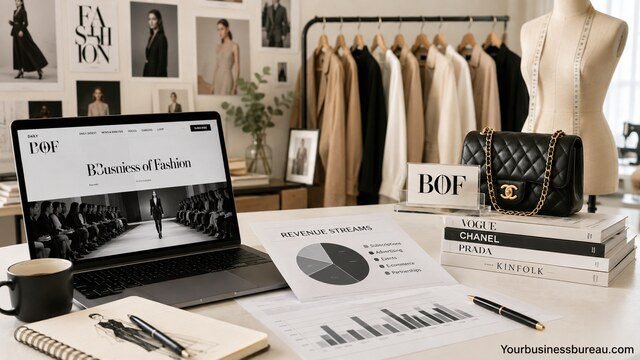
Subscriptions are central to BoF’s business model.
The company states that the majority of its revenue comes from users who subscribe to BoF Professional, its paid news and analysis membership. It also earns revenue from events, advertising and sponsorships, and commercial services connected with BoF Careers.
That gives BoF a somewhat different model from a fashion website relying primarily on display advertising.
Its broader commercial ecosystem now includes several products:
| BoF Product | Main Purpose |
| BoF journalism | News, analysis, commentary, and industry reporting |
| BoF Professional | Paid membership with deeper reporting, briefings, reports, case studies, events, and other resources |
| BoF Insights | Research, data, strategy, advisory services, and business intelligence |
| BoF Careers | Fashion and beauty job marketplace and recruiting platform |
| BoF 500 | Editorially curated index of influential fashion-industry figures |
| BoF VOICES and other events | Industry gatherings, discussions, and networking |
| The Business of Beauty | Coverage focused on beauty and wellness |
| BoF Podcast | Audio discussions and interviews covering fashion-business subjects |
BoF Insights has expanded the company’s role beyond publishing. It provides research and strategic support on subjects such as market entry, consumer understanding, growth strategy, brand positioning, and investment decisions.
What Is BoF Professional?
BoF Professional is The Business of Fashion’s paid membership product.
It provides members with deeper access to the company’s journalism and professional material, including analysis, industry briefings, newsletters, masterclasses, digital events, business case studies, reports, and executive-focused content.
A subscription may be particularly useful when someone needs fashion-specific business intelligence rather than occasional industry headlines.
For example, consider two readers following the same luxury brand.
A casual reader might only want to know that the company changed its creative director. An industry professional may also need to understand why the change occurred, what it could mean for product strategy, how investors are responding, whether management is repositioning the brand, and how the decision compares with changes at competitors.
That deeper commercial context is the problem BoF Professional is designed to address.
How much does BoF Professional cost?
BoF does not present one universal subscription price because pricing can vary according to location, billing frequency, currency, and applicable taxes. Its membership information states that the final amount is calculated according to the subscriber’s billing location.
This makes checking the current subscription page more reliable than relying on an older price quoted elsewhere.
BoF also offers memberships for teams and educational users. Its current membership information states that eligible students can receive up to four years of free access.
What Is BoF Insights?
BoF Insights is the company’s research, data, and advisory operation.
Rather than simply reporting what has happened in the industry, the service is designed to help businesses make decisions involving areas such as growth, international expansion, consumer strategy, brand positioning, investment, and market opportunities. BoF describes the service as combining industry data with strategic consulting and research.
The distinction matters.
A news article might explain that a particular beauty market is expanding. An advisory project could examine whether a specific company should enter that market, which customer segments it should target, how it should position itself, and what commercial risks it could face.
That moves BoF from pure publishing toward business intelligence and professional advisory work.
What Is the State of Fashion Report?
One of BoF’s best-known research projects is The State of Fashion, produced with McKinsey & Company.
The annual report examines the major forces expected to influence fashion companies, including economic conditions, consumer behaviour, technology, international trade, operations, luxury demand, sustainability, and changing business models.
The State of Fashion 2026, published in November 2025, marked the tenth edition of the report. Its central themes included trade disruption, artificial intelligence, changes in consumer priorities, workforce transformation, resale, luxury-sector challenges, and the need for fashion businesses to adapt more quickly to structural change.
For students and professionals, these reports can be particularly useful because they connect individual fashion stories to larger economic and industry trends.
What Is the BoF 500?
The BoF 500 is The Business of Fashion’s editorially curated index of people considered influential in shaping the global fashion industry.
Rather than functioning as a simple ranking based on wealth, social-media followers, or company size, the list is assembled by BoF’s editors using nominations and industry intelligence. Readers can explore people by factors such as role, nationality, and location.
The index includes participants from different parts of the fashion ecosystem, which can include executives, designers, entrepreneurs, creatives, models, investors, media figures, and other influential professionals.
For someone researching the industry’s power structure, the BoF 500 can therefore be more useful as a discovery tool than as a conventional “top 500” ranking.
How BoF Careers Works
BoF Careers focuses on employment and recruiting across fashion and beauty.
The platform connects job seekers with companies hiring in areas such as design, merchandising, marketing, communications, retail, e-commerce, technology, management, and other industry functions. BoF also publishes career-related editorial content covering workplace trends and changing skill requirements.
This makes the platform relevant beyond designers.
Fashion companies employ analysts, accountants, engineers, product managers, marketers, buyers, merchandisers, supply-chain specialists, recruiters, data professionals, store managers, and many other roles.
Someone trying to enter the fashion industry should therefore avoid assuming that a fashion career requires a design background.
Who Should Read The Business of Fashion?
BoF is most useful when fashion affects a person’s work, education, investment decisions, or business strategy.
Fashion executives can use it to monitor competitors, markets, consumer behaviour, leadership changes, and industry risks.
Entrepreneurs and brand founders can study business models, distribution strategies, marketing approaches, retail trends, fundraising, and brand-building decisions.
Designers and creative professionals can follow leadership changes, fashion weeks, influential companies, and the commercial context surrounding creative decisions.
Marketers can track influencer strategy, advertising, social platforms, customer acquisition, brand positioning, and emerging technology.
Students can use reports and case studies to understand how concepts taught in fashion management or business courses operate in real companies.
Job seekers can combine BoF’s editorial coverage with its Careers platform to understand employers, roles, industry trends, and available opportunities.
Investors and consultants may use its reporting to understand companies, consumer trends, strategic developments, and the broader fashion economy.
Harvard Business School’s Baker Library describes BoF as a source of multimedia news, analysis, career postings, and advice for the global fashion and beauty industries, and identifies executives, students, creatives, and entrepreneurs among its relevant users.
Is a BoF Professional Subscription Worth It?
The answer depends mainly on how often you need industry-specific information.
A subscription is easier to justify when fashion is part of your profession, academic work, business, or investment research. Someone who regularly needs reports, analytical articles, case studies, executive briefings, and industry context may receive substantially more value than someone who simply follows fashion news occasionally.
A useful decision framework is:
| Your Situation | Likely Value |
| Fashion or beauty executive | High |
| Brand founder or entrepreneur | High if used for strategy and research |
| Fashion-business student | Potentially high, especially with eligible student access |
| Industry job seeker | Moderate to high |
| Marketing or retail professional | High when fashion is a core sector |
| Investor researching fashion companies | Potentially high |
| Casual fashion follower | Lower unless deeper business analysis is desired |
| Reader mainly interested in celebrity style | Probably limited |
The calculation should also consider whether you already receive similar research through an employer, university, or professional institution. Some universities provide institutional access, which can eliminate the need for an individual subscription. Manchester Metropolitan University, for example, provides BoF access through its library and recommends the resource for industry reports, market analysis, fashion-week coverage, careers, and research.
Where BoF Is Most Useful, and Where It Has Limits
BoF is strongest when a reader needs fashion-specific business reporting that connects creative activity with economics, strategy, technology, retail, and corporate decision-making.
It should not, however, be treated as the only source needed for every type of research.
Financial analysis of a publicly traded fashion company may require its annual reports, regulatory filings, earnings calls, and investor presentations. Legal or regulatory questions should be checked against government or regulator sources. Investment decisions require broader financial research. Academic work may also require peer-reviewed studies and original datasets.
Likewise, BoF’s own description of its audience size, products, and market position represents company-reported information. Such figures are useful when clearly attributed, but they should not automatically be treated as independent measurement.
The most effective research approach is therefore to use BoF for specialist fashion-industry intelligence and combine it with primary sources when the decision requires financial, legal, regulatory, or company-specific verification.
The Business of Fashion vs. General Fashion Media
The main difference between BoF and consumer-oriented fashion publications is the question each type of publication tries to answer.
Consumer fashion coverage often asks:
What should people wear, watch, buy, or know about culturally?
BoF more often asks:
Why is this happening, who is making the decision, how does the business work, and what does it mean for the industry?
That distinction explains why its audience includes people working behind the scenes as much as people interested in the finished products consumers see.
A runway collection, for example, can simultaneously be a creative event and a business event. Consumer coverage may review the clothes. Business coverage can examine whether the collection fits the brand’s positioning, attracts the right customer, supports pricing, improves cultural relevance, and contributes to future commercial performance.
Understanding both views provides a more complete picture of fashion.
Conclusion
The Business of Fashion has developed from Imran Amed’s 2007 blog into a global platform for understanding the commercial forces behind fashion, beauty, luxury, and retail. Its offering now extends beyond journalism to professional memberships, research and advisory services, careers, industry events, the BoF 500, and major reports such as The State of Fashion.
Its greatest value is context. Instead of viewing fashion only through products, designers, or trends, BoF examines the decisions, companies, technology, economics, people, and consumer shifts that determine how the industry operates.
For professionals, founders, students, marketers, investors, and job seekers who need that deeper perspective regularly, it can serve as a useful specialist resource. For high-stakes financial, legal, investment, or regulatory decisions, however, its reporting is best combined with company filings, official records, regulators, and other primary sources.
If you want to explore how we help businesses grow from the ground up, you can visit yourbusinessbureau.com to see what we offer.
FAQ’s
Not in the traditional sense. BoF is primarily a digital media and business intelligence company offering journalism, subscriptions, research, career services, events, and other professional products.
The company was founded by Imran Amed, who remains its CEO and editor-in-chief. BoF has also raised outside investment, including a 2013 seed round led by Index Ventures and a 2019 Series B round led by the Financial Times.
Imran Amed founded BoF in London in 2007 after beginning a blog focused on understanding the commercial workings of the fashion industry. He remains the company’s founder, CEO, and editor-in-chief.
BoF has a broader digital presence, but its premium professional material is provided through BoF Professional, a paid membership. Membership pricing can vary by location and billing arrangement. Eligible students may qualify for extended free access under BoF’s current student offering.
Yes, particularly for students studying fashion management, luxury, marketing, retail, merchandising, communications, or related business subjects. Its industry reports, case studies, news, and careers information can complement academic material, although scholarly assignments may still require peer-reviewed and primary sources.
No. The Business of Fashion is the name of a media and intelligence company, usually abbreviated as BoF. The fashion business is the wider industry involving design, manufacturing, sourcing, branding, wholesale, retail, e-commerce, marketing, logistics, and related activities.
