

The majority of marketing budgets are designed to attract customers. However, the initial purchase is just the start; the real profit comes from everything that follows that first sale. The businesses that recognize this truth are the ones who are remarkably successful. And it’s not because they are spending a massive amount on advertising, but it’s due to the fact that they’ve intentionally organized their business for the post-sale.
Why The Linear Funnel No Longer Describes Real Customer Behavior
The original AIDA model, Attention, Interest, Desire, Action, was appropriate in a world with limited choice and information. Send a brochure, make a cold call, sell a product, done. Move on to the next prospect. The path was short, and the model was simple.
The problem is that the actual path to purchase for virtually every product today barely resembles that sequence. Modern customers don’t move in a straight line. They discover a brand on Instagram, forget about it, see a retargeted ad two weeks later, read three Reddit threads, check a competitor’s pricing, come back through a Google search, and finally convert on their fourth visit. Then – and this is the part most marketing teams ignore – they spend the next 30 days quietly deciding whether they’ll ever buy again.
That post-purchase window is where loyalty is built or destroyed. It’s not a formality. It’s the most consequential phase of the entire journey, and it’s the phase most brands have no systematic plan for.
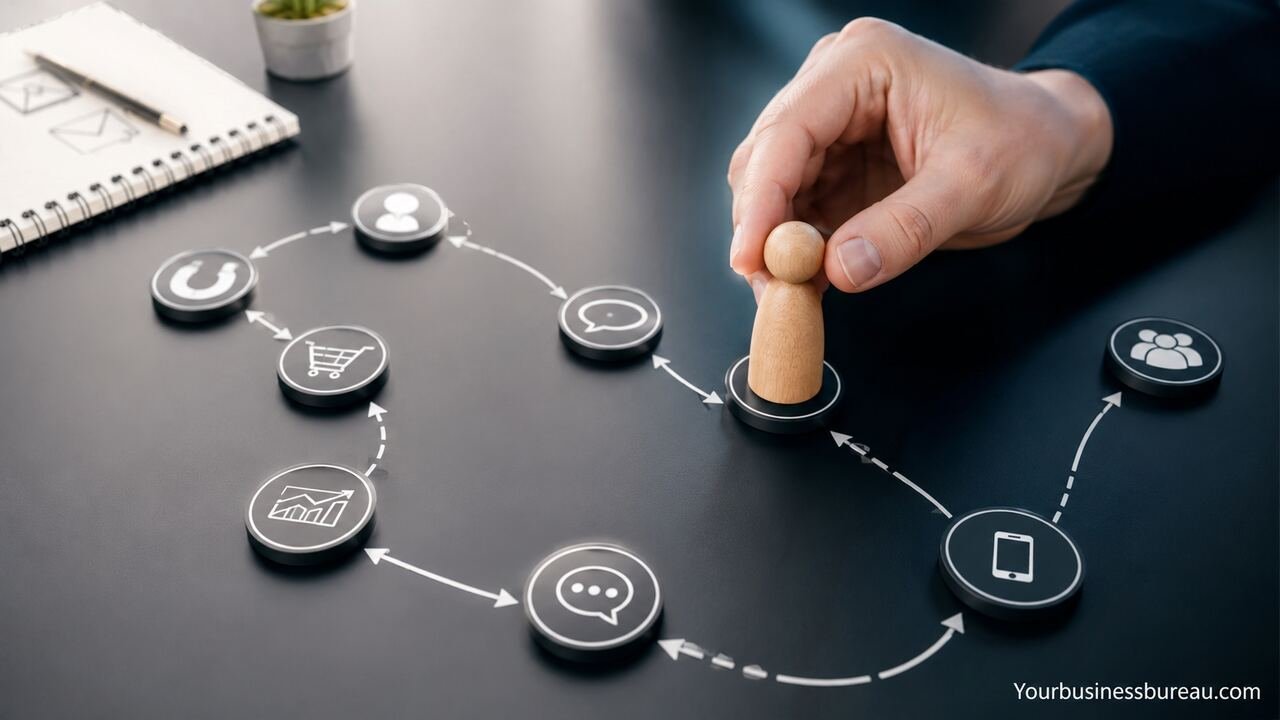
The journey is now a loop. Customers move from awareness through purchase into experience, and that experience either feeds back into advocacy or it feeds churn. There’s no clean exit point. The job of a modern marketing function is to design that loop intentionally, not leave it to chance.
Auditing What You Actually Have Before Building Anything New
Before you can even begin to redesign the customer journey, you need to know what’s actually happening in it. That means pulling data from two places: your analytics platform and your CRM.
Your path exploration report inside Google Analytics 4 will show you the sequence of pages and events users aggregated as a group move through before converting – and more usefully, where they drop off. If a significant percentage of your users land on a confirmation page and then literally just disappear from your data, that’s your best indication that the post-purchase experience has no structure. There’s nothing pulling them back.
Your CRM data tells a different story. Look at the gap between first and second purchase. If that window is stretching out, or if a large segment of your customers never reaches a second purchase at all, you have a retention problem that no acquisition campaign will solve. Map those drop-off points against the touchpoints you currently have in place, and most teams find the answer immediately: there are no touchpoints. Or the ones that do exist are generic, poorly timed, or disconnected from what the customer actually just did.
This audit is the foundation. It turns the customer journey from a whiteboard exercise into something measurable and fixable. For businesses that lack the internal resources to run this kind of cross-channel analysis, an experienced team like Odin Digital can surface friction points that internal teams often overlook – particularly when data is siloed across platforms that don’t talk to each other.
Designing The First 30 Days After Purchase
The month following a buy is not a time for the customer to “cool off”. In fact, it’s the most important time for the customer in their lifecycle, where they may be feeling buyer’s remorse, confused about your product, or simply neglected after they hand over their cash. All of these are silent signals of churn, long before they’ve even had the chance to become a loyal customer.
Post-purchase onboarding is the remedy to this. It doesn’t need to be overly sophisticated. It’s simply a sequence of pre-planned messages that are meant to reassure the customer and give them that “a-ha” moment, so they know how to get the best out of what they just purchased, and feel like they could go back and tell someone “Yes, this was a good decision”.
For a product, this might look like an email shipping notice, followed a few days later by a link to your customer FAQ, an email on day seven asking if everything’s alright, and then a review request email on day 14. For a service or subscription, this might mean emailing them your most popular “how-to” articles, sending them both the “tips and tricks” emails as well as the tutorial ones, and then recognizing their early use of the product.
It doesn’t always need to be emails either. You can use the messaging on your customer account, texts, or even the postal service. Just make sure that it’s in the customer’s hands before they know they’re in need of it.
Using Zero-Party Data To Make Personalization Actually Work
The term “personalization” has become so omnipresent that it’s nearly lost all meaning. The fact of the matter is, most “personalized” marketing simply employs segmentation based on purchase history – which doesn’t equate to actual knowledge about what a customer wants.
This is where zero-party data comes in. Zero-party data is information that customers intentionally share. They do this through things like onboarding questionnaires, preference centers, interactive quizzes, or profile settings. Because it’s given willingly by the customer, it’s more accurate than behavioral data-inferred and doesn’t come with the same privacy concerns as third-party data.
Post-purchase onboarding is the ideal time and place to collect this kind of data. Customers who have just made a purchase are engaged and motivated to share information about themselves. A quick quiz prompting them to share their goals, preferences, or current level only takes a minute and a half to complete. More importantly, it arms your marketing automation system with the information it needs to push out truly relevant content instead of one-size-fits-all emails marketed to the masses.
The brands doing well in this area aren’t sending out the same email newsletter to their entire list. They’re sending one email to one segment with one set of preferences and another to a different segment with different preferences – and the statistics show there’s a big difference in engagement rates.
Omnichannel Alignment: Getting Every Channel To Say The Same Thing
One of the quickest ways to destroy customer trust is to provide them with inconsistent experiences through different channels. For example, a customer who was granted a loyalty discount through an email, but is unable to use it on your app, or a customer who was assured something by a salesperson but was informed about something else by the support team, not only has a negative experience but also loses faith in your brand.
Removing barriers between paid social, email, SMS, and support teams isn’t just a “good to have” step but an operational necessity to ensure that any retention approach works across the board. Every channel must have the same customer information, access to the same current promotions, and use the same brand voice guidelines.
In simple words, it implies that your CRM must be that one source that governs all channels. Your CRM should also be responsible for paid social targeting. Specifics about what is shared on SMS should be part of the details discussed in the email. Support team should already be able to view purchase history or details of the current campaigns before answering a ticket.
Customers can relate to your brand when all the channels are in sync. When they are not, they think they are dealing with four unique companies that surprisingly have the same logo on them.
Automated Triggers That Keep The Relationship Active Without Manual Effort
The retention interactions that gradually grow over time are those that don’t require an individual to keep track and schedule them. Marketing automation does this using behavioral triggers – a series of events that automatically send out a communication when a customer takes specific steps or fails to do so.
Restocking alerts are triggered via typical usage cycles. Anniversary messages are automatically generated from a first purchase date. Loyalty tier updates occur as soon as customers meet a points threshold. A re-engagement series is automatically applied to customers who haven’t made a purchase in 60 days. These aren’t annoyances – they’re timely, contextually precise communications that create the perception of a watchful brand.
You write them once and they keep coming back with interest. A re-engagement series that you set up once will perpetually recapture customers without a click of the send button.
Feedback Loops As Early Warning Systems For Churn
Many businesses don’t realize a customer is dissatisfied until they’ve already taken their money elsewhere. It’s too late to do anything about it at that point. However, if you include feedback checkpoints throughout the journey, you can identify issues earlier. That gives you a chance to correct them while there’s still an opportunity to retain that customer.
A survey to evaluate Net Promoter Score (NPS) sent one week after a product is delivered can help you identify how your customer is feeling when they interacted with your company (rather than with a competitor). A satisfaction survey sent after an interaction with your support team can help you gauge if the resolution solved anything. These are not only ways to gather precious information but signals you are interested in what customers have to say.
If a customer raises a red flag in response to an NPS evaluation, a real human should reach out to them immediately – not a robot, and not a coupon. A real person reaching out with a genuine interest in making amends can often turn a near-guaranteed lost customer into a lifelong fan. According to research conducted by Bain & Company and published in the Harvard Business Review, a 5% increase in retention can boost business profits by anywhere from 25% to 95%. That’s a ridiculously wide range, but it reflects the snowball effect proper retention efforts can cause.
Shifting From Acquisition Metrics To Retention Metrics
Most marketing teams provide reports on KPIs that are focused on customer acquisition. For example, Cost Per Acquisition, Click-Through Rate, conversion volume. These metrics are not necessarily bad. They are simply not sufficient if your goal is to develop a business that grows consistently over time, rather than one where you constantly need to bring in new customers to replace lost ones.
When you shift your focus to retention-based digital marketing, you start measuring metrics like Repeat Purchase Rate, Average Order Value, Customer Retention Rate, and Customer Lifetime Value. These metrics allow you to understand if the customers you acquire are truly valuable, based on the cost of acquiring them. Also, they help you evaluate if your post-purchase process is turning one-time customers into repeat customers.
Businesses that have successfully bridged the gap between customer acquisition and customer retention consider these metrics with the same level of importance. They demand the same level of performance from their customer retention metrics as they do from their advertising. They also invest appropriate resources in the post-purchase process.
You cannot leave customer advocacy to chance. You need a well-designed journey right from the beginning to ensure that your satisfied customers become active brand advocates and recommend your products or services to others. This journey includes all the steps that follow the sale.
The customer acquisition process brings in customers. The customer retention process tells you the true value of those customers. Both processes need to work together, but the latter is the one that has a long-term multiplying effect.
