

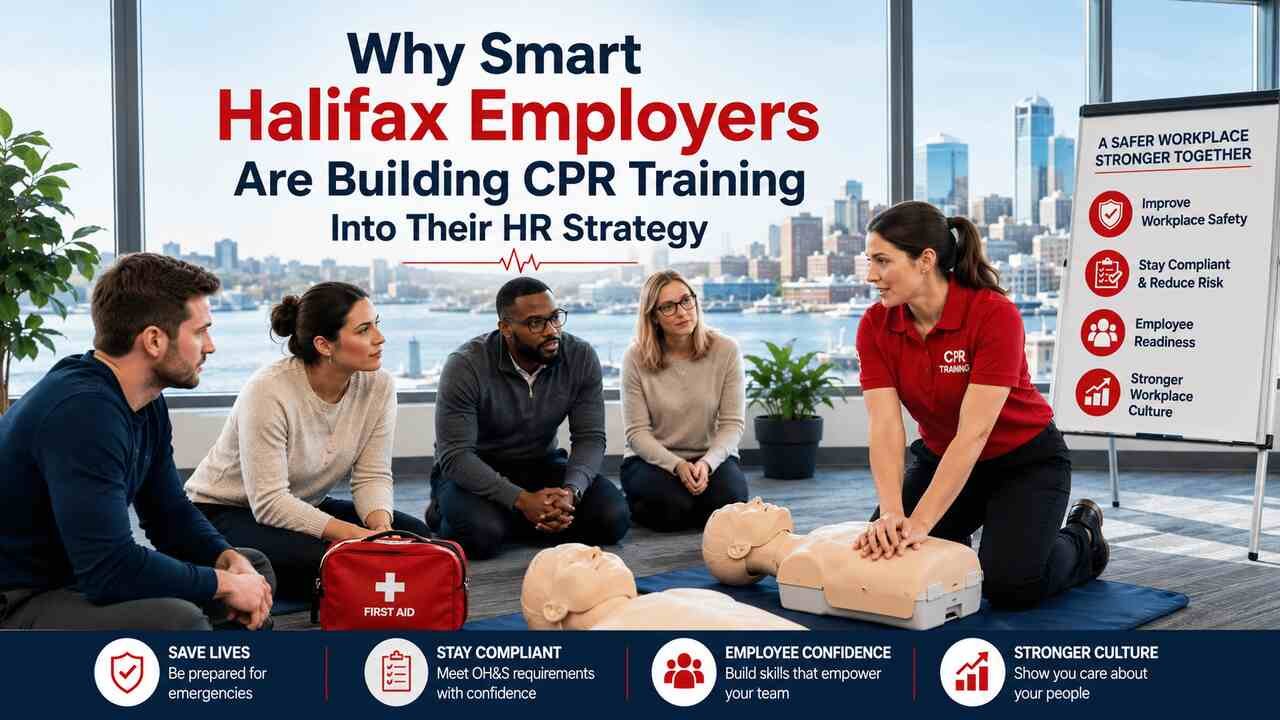
Compliance requirements don’t always arrive with fanfare. Some of the most consequential obligations on a small business owner are the ones that sit quietly in the background of provincial legislation — noticed only after something goes wrong.
Workplace CPR certification is exactly that kind of requirement. Under Nova Scotia’s Occupational Health and Safety Act, employers have a duty to ensure that appropriate first aid resources are available to workers during all working hours. For businesses operating in the Halifax Regional Municipality, meeting that obligation means more than stocking a cabinet with bandages — it means having trained personnel in the building.
For Halifax employers who want a practical solution that’s accessible and locally available, CPR training near Halifax Shopping Centre offers flexible scheduling options that work around business operations without pulling teams off the floor for an entire day.
What Does the NS OHS Act Actually Require of Employers?
Nova Scotia’s OHS Act requires employers to provide first aid services that are appropriate to the workplace — calibrated to workforce size, the type of work being performed, and the distance from emergency medical services. The regulation doesn’t just ask employers to have a kit on hand. It requires trained workers to be present whenever employees are on site.
The specific requirements vary. A small retail operation with five staff members has different obligations than a mid-sized construction crew or a healthcare support facility. But the underlying principle applies across all sectors: workers should be able to access a trained first aid responder without delay in any emergency.
For many Halifax small businesses, particularly those with lean teams or high staff turnover, maintaining continuous CPR coverage is a genuine operational challenge. The most effective approach is to build it into the hiring and onboarding process — rather than managing it reactively when a certification lapses or a trained employee leaves.
Why CPR Certification Is More Than a Compliance Line Item
The business case for CPR training goes well beyond regulatory tick-boxes.
Consider the math. According to the Heart & Stroke Foundation, roughly 40,000 cardiac arrests occur outside of hospital settings in Canada each year. Survival rates decrease by approximately 10% for every minute that passes without CPR. Emergency response times in Halifax, while generally solid, still measure in minutes — and that gap is where bystander CPR determines whether a person survives.
When a medical emergency happens in a workplace, the outcome is shaped by whoever is present in the first two to four minutes. A trained employee who initiates CPR immediately keeps oxygenated blood circulating until paramedics arrive. An untrained one is left hoping the ambulance arrives in time.
Beyond the human stakes, the employer liability dimension is real. A business that fails to meet NS OHS Act first aid requirements faces potential fines and regulatory action. More significantly, an incident where a preventable death or serious injury occurs in the absence of trained personnel creates lasting reputational and legal exposure. Training is cheap. Its absence, when it matters, is not.
What CPR and First Aid Certification Involves
A Standard First Aid and CPR/AED Level C certification course covers:
- CPR technique for adults, children, and infants at a correct rate and depth
- AED operation — step-by-step use of automated external defibrillators, which are increasingly present in commercial properties and public spaces across Halifax
- Choking response for all age groups
- Wound management and bleeding control
- Recognition and response to shock, stroke, and sudden illness
- Scene assessment and safe response protocols
The course is available in a blended learning format — theory completed online at the employee’s own pace, followed by a hands-on in-person skills session. For small businesses, this is a meaningful operational advantage: the in-person component is typically a few hours, meaning minimal disruption to scheduling. The full certification meets NS OHS Act requirements and is recognized across sectors.
CPR/AED certification is renewed annually. Standard First Aid certification is valid for three years. Employers who track these renewal windows proactively — rather than waiting for gaps to emerge — maintain continuous coverage without scrambling.
How to Build CPR Training Into Your HR Calendar
The most common reason Halifax businesses fall behind on first aid compliance is simple: it’s treated as an ad hoc task rather than a scheduled HR function. Here’s a practical approach to changing that.
Step 1: Identify coverage requirements. Determine how many trained first aiders your workplace needs under NS OHS Act regulations based on your workforce size and work type. For most small businesses, one or two trained employees per shift is sufficient.
Step 2: Stagger certification renewals. If multiple employees are certified, schedule their renewals at different points in the calendar year. This eliminates the risk of simultaneous lapses creating a coverage gap.
Step 3: Include certification in onboarding. For roles that carry first aid responsibilities, make certification part of the new hire process — not an afterthought. New employees arrive with the credential, or complete it in the first 30 days.
Step 4: Track expiry dates. Keep a simple register of who is certified, at what level, and when each certification expires. Most HR software allows custom reminders for training renewal milestones.
Coast2Coast First Aid & Aquatics offers flexible course scheduling designed to accommodate the operational realities of small and medium businesses — including options for group bookings and varied session times.
The Employer Who Is Ready
Every Halifax business owner hopes they never face a medical emergency on their premises. But being ready for one isn’t pessimism — it’s the kind of operational discipline that characterizes well-run businesses.
First aid compliance is not the most glamorous part of running a company. It sits alongside fire safety plans, workplace hazard assessments, and incident reporting procedures as the infrastructure of a responsibly managed workplace. Build it in once, maintain it with a simple HR calendar, and it takes care of itself.
If you are looking for CPR certification or first aid training near the Halifax Shopping Centre area, Bayers Road, or surrounding communities in the Halifax Regional Municipality, you may reach out to Coast2Coast First Aid & Aquatics in that area.
FAQS
Q: How many trained first aiders does a Halifax small business need under NS OHS Act? A: The number depends on the size of the workforce and the nature of the work. Nova Scotia’s OHS Act and First Aid Regulations specify minimum requirements based on worker count per shift and workplace risk level. Most small businesses with fewer than 10 employees on site require at least one trained first aider per shift. Employers should review the NS First Aid Regulations directly or consult with their OHS advisor to confirm their specific obligations.
Q: What is the difference between CPR Level C and Standard First Aid for employer compliance purposes
A: CPR Level C is a standalone certification covering CPR and AED use for adults, children, and infants. Standard First Aid is a more comprehensive certification that includes CPR Level C content alongside training in wound management, fractures, shock, choking, and other workplace emergencies. For most NS OHS Act compliance purposes, Standard First Aid is the stronger credential — though the specific requirement depends on the workplace classification.
Q: How long does each certification last for NS OHS Act compliance?
A: CPR/AED Level C certification requires annual renewal. Standard First Aid certification is valid for three years. Employers should maintain a registry of employee certifications with expiry dates to ensure continuous coverage without gaps.
Q: Can employees complete CPR training without taking a full day off work?
A: Yes. Blended learning courses allow employees to complete the theory component online at their own pace — outside working hours if preferred — and then attend a shorter in-person skills session. The in-person component typically takes a few hours, significantly reducing operational disruption compared to traditional full-day classroom training.
Q: Is the employer required to pay for employee CPR certification in Nova Scotia?
A: Where first aid training is required to meet NS OHS Act obligations, it is generally the employer’s responsibility to ensure workers are trained and to cover associated costs. Employers should review the NS OHS Act and any applicable collective agreements for their specific obligations. As a practical matter, employer-sponsored training is also more likely to achieve full compliance, since employees complete it rather than deferring it.
