


Key Takeaways
- Clear training records help workers show they are prepared for jobsite expectations.
- Safety training records support real skills, but they do not replace hands-on instruction or supervision.
- Workers should keep readable digital copies and paper copies of important documents.
- Employers may review course details, trainer information, completion dates, and job-specific requirements.
- State, city, union, project, and employer rules can require more than general safety awareness training.
- A simple record system can prevent avoidable delays during hiring and onboarding.
Starting a new job often involves more than filling out an application. Employers may ask workers to provide proof of completion of safety courses, equipment instruction, site orientations, or emergency response training. Keeping these records organized makes it easier to show what has been completed and identify what still needs to be done.
For workers who have completed outreach training, understanding the difference between a course record and an OSHA card can help prevent confusion during the hiring process. A document can demonstrate course completion, but the employer may still require additional training before assigning a specific task.
Why Safety Records Matter for New Workers
Training records provide workers with a practical way to demonstrate that they have completed a course or orientation. They can also reduce delays when a hiring manager, safety coordinator, or site supervisor needs to confirm basic qualifications before allowing someone onto a project.
Consider a worker who completed a required course months ago but cannot find the card, email, or provider name. Even if the training was completed, the worker may need to spend time contacting the provider or retaking a class before being cleared to start. A saved copy can turn that problem into a quick document upload.
Records are useful, but they are not permission to perform every task. An employer may need to provide instruction, evaluate a worker’s ability, explain site rules, and supervise unfamiliar work. Documentation supports a safety program. It does not replace it.
What Training Records Should Workers Save?
Workers should save more than a single completion card. A complete set of records makes it easier to answer questions about when, where, and from whom training was received.
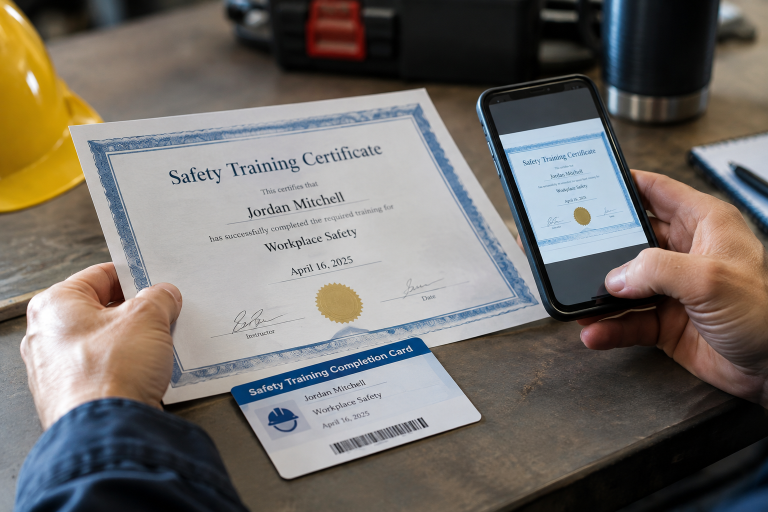
- Course completion cards, certificates, or completion letters.
- The course title and the industry or topic covered.
- The completion date and any card or record number.
- The trainer’s name and the training provider’s contact details.
- Equipment training records, when provided by an employer.
- First-aid, CPR, or emergency-response records.
- Site orientation forms and employer-provided refresher training records.
- Emails, receipts, or enrollment confirmations that may help locate a missing record.
Scan paper documents as soon as possible and save them in a clearly labeled folder. A useful filename includes the worker’s name, the course name, and the completion date, such as “Jordan-Lee-Fall-Protection-2026-04-18.”
How Employers Check Training Documents
Employers commonly compare the name on a record with the application or onboarding form, then review the course title, date, provider, and any available card number. If a document is unclear or incomplete, they may contact the trainer or ask the worker for another form of proof.
When reviewing outreach-related documents, employers can use the program information for OSHA 10-hour and 30-hour training to understand the purpose of these courses. OSHA explains that outreach training provides hazard awareness and does not fulfill training requirements for specific workplace hazards.
Even when a general course record is accepted, an employer may require additional instruction before work begins. This is especially common when a role involves equipment, changing jobsite conditions, hazardous materials, or tasks that need a demonstrated level of competence.
General Training and Job-Specific Training
General safety awareness is an important starting point, but each worksite can present different hazards. Workers may need separate training related to the work they will actually perform.
- Fall hazards, ladders, scaffolds, and elevated work areas.
- Powered industrial trucks and other equipment.
- Hazard communication and chemical handling.
- Personal protective equipment.
- Confined spaces, lockout procedures, and emergency action plans.
- Site traffic plans, communication methods, and restricted areas.
Before beginning an unfamiliar assignment, workers should ask a supervisor which training and authorization requirements apply. A general course may show basic preparation, but it does not automatically authorize equipment operation or specialized work.
Common Record-Keeping Errors to Avoid
- Waiting until the first day of work to search for documents.
- Submitting a blurry photo, cropped image, or incomplete scan.
- Ignoring a misspelled name or incorrect completion date.
- Forgetting the name of the trainer or provider.
- Assuming every certificate is accepted the same way by every jobsite.
- Overlooking local, union, customer, or employer requirements.
- Purchasing training without checking whether the provider is authorized when authorization is required.
- Failing to request a replacement record promptly after it is lost or damaged.
Workers should also be cautious about claims that promise guaranteed employment, instant credentials, or a single course that replaces all workplace training. Legitimate training can be valuable, but no record eliminates the need for employer instruction on job-specific hazards.
How to Build a Simple Training Record System
Step 1: Gather Every Current Record
Collect paper cards, digital files, emails, employer forms, and receipts. Before deleting duplicates, make sure the remaining copy is complete, readable, and easy to access.
Step 2: Create Clear Folders
- Safety Courses
- Equipment Training
- Emergency Response
- Site Orientations
- Renewals and Refresher Courses
Step 3: Track Important Details
Keep a simple note or spreadsheet with the course name, provider, completion date, card number, location, any renewal date, and a note on whether the current employer accepted the record.
Step 4: Keep More Than One Copy
Store records in a secure cloud folder, on a computer, and on a phone when appropriate. Keeping one printed copy can also help when a jobsite has limited internet access.
Step 5: Review Before Applying
Compare available records with the job posting before accepting a position. Ask early whether the employer requires a particular orientation, refresher course, physical card, or job-specific training.
Common Questions About Safety Training Records
Do Workers Need to Carry Paper Copies?
Not always. Some employers accept digital files, while others ask for a physical card or printed record. Confirm the preferred format before reporting to the jobsite.
What Happens If a Record Is Lost?
Contact the original trainer or provider as soon as possible. Be ready to provide your name, course date, class type, and any available identifying details.
Can a Certificate Replace a Training Card?
It depends on the employer, project, and applicable local rules. A certificate may help verify completion, but the jobsite decides what documentation it will accept.
Do All Safety Records Expire?
No. Some records do not list an expiration date, but employers or project owners may still require refresher training. Always check the requirement for the specific role and worksite.
Final Thoughts
Good safety records make the first days at a new job easier. Save every important document, keep clear copies, verify requirements early, and remember that paperwork supports training rather than replacing it. Organized records help workers focus less on avoidable onboarding delays and more on working safely.
For more informative articles visit our blog YourBusinessBureau.
