

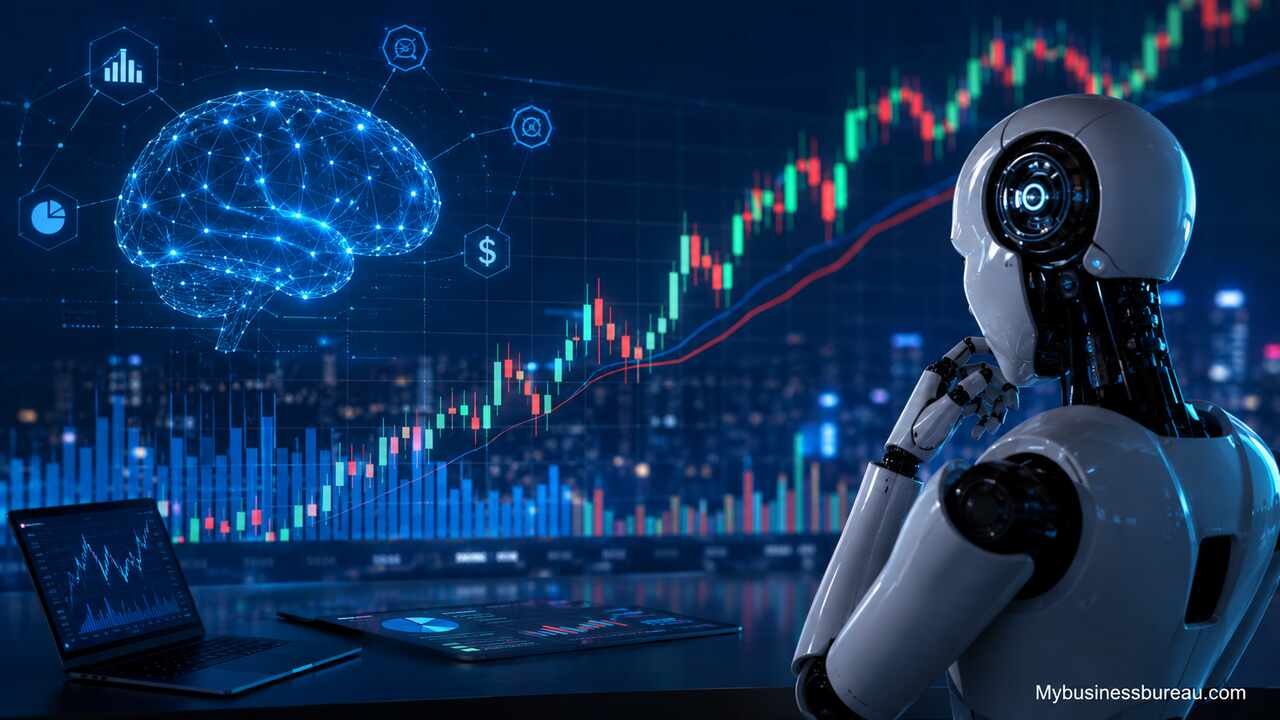
Artificial Intelligence is transforming stock market operations by accelerating data analysis, improving investment decisions, enhancing risk management, and increasing market efficiency. Financial institutions, hedge funds, retail investors, and trading platforms increasingly rely on machine learning models, predictive analytics, and automated trading systems to process massive volumes of financial information in real time. Growing adoption of AI-driven technologies is redefining how market participants identify opportunities, manage portfolios, and respond to changing economic conditions.
How Is Artificial Intelligence Changing Stock Market Analysis?
Artificial Intelligence is improving stock market analysis through advanced data processing capabilities. Traditional research methods often require analysts to evaluate financial statements, economic reports, earnings announcements, and market news manually. AI systems can analyze millions of data points within seconds and identify patterns that may remain invisible to human analysts.
Machine learning algorithms examine historical price movements, trading volume, corporate performance indicators, and macroeconomic variables to generate predictive insights. Predictive insights help investors recognize potential trends before broader market recognition occurs. Faster analysis creates an information advantage that supports more informed investment decisions.
Natural Language Processing further strengthens market analysis by interpreting financial news, analyst reports, central bank statements, and social media discussions. Sentiment analysis tools convert qualitative information into measurable market signals, allowing investors to assess market mood with greater precision.
What Role Does Big Data Play in AI-Powered Investing?
Big Data serves as the foundation of AI-driven investing. Financial markets generate enormous volumes of structured and unstructured information every day. Structured information includes earnings reports, balance sheets, and economic indicators, while unstructured information includes news articles, investor commentary, and social media conversations.
AI systems process diverse datasets simultaneously and establish relationships between market events and asset performance. Data integration allows investors to obtain a broader understanding of market conditions. Enhanced understanding improves forecasting accuracy and supports better portfolio construction.
How Does Sentiment Analysis Influence Investment Decisions?
Sentiment analysis evaluates public and institutional attitudes toward companies, sectors, and broader financial markets. AI models scan news coverage, financial publications, discussion forums, and social platforms to determine whether sentiment is positive, negative, or neutral.
Positive sentiment often contributes to increased investor confidence, while negative sentiment may signal potential volatility. Real-time sentiment monitoring enables traders to react quickly to emerging developments. Faster reactions can create opportunities for risk reduction and profit generation during rapidly changing market conditions.
Why Are AI-Powered Trading Systems Growing Rapidly?
AI-powered trading systems are expanding because financial markets operate continuously and generate large quantities of data every second. Automated systems can monitor multiple markets simultaneously and execute trades without emotional influence.
Algorithmic trading platforms use machine learning to identify recurring patterns and execute transactions at optimal moments. Speed and precision allow AI systems to capitalize on market inefficiencies that may exist only briefly. Institutional investors increasingly depend on automation to maintain competitiveness in highly dynamic markets.
How Does High-Frequency Trading Benefit from AI?
High-frequency trading relies on rapid execution and real-time decision-making. AI enhances high-frequency trading by analyzing market conditions instantly and adjusting strategies according to changing circumstances.
Advanced algorithms evaluate liquidity, volatility, and order flow before placing trades. Faster execution improves efficiency and helps trading firms manage large transaction volumes. Continuous learning capabilities allow algorithms to refine performance based on historical outcomes and evolving market environments.
Can AI Reduce Emotional Trading?
AI reduces emotional decision-making by relying on data-driven analysis rather than psychological reactions. Human investors may respond to fear, greed, uncertainty, or market hype during periods of volatility.
Automated investment systems follow predefined rules and statistical models. Consistent execution minimizes behavioral biases that often contribute to investment mistakes. Greater discipline improves long-term portfolio management and risk control.
How Is AI Improving Risk Management Across Financial Markets?
AI enhances risk management through continuous monitoring and predictive analysis. Financial institutions use machine learning models to identify vulnerabilities before losses occur. Early detection enables faster responses to emerging threats.
Risk assessment systems evaluate market exposure, credit conditions, geopolitical developments, and economic indicators simultaneously. Comprehensive evaluation provides a deeper understanding of potential challenges affecting investment portfolios.
How Does Predictive Analytics Help Prevent Market Losses?
Predictive analytics identifies warning signals associated with declining asset values or rising market instability. AI models compare current conditions with historical scenarios to estimate potential outcomes.
Forecasting capabilities support proactive decision-making rather than reactive responses. Investors can adjust asset allocation, hedge exposures, or reduce risk when indicators suggest unfavorable conditions. Proactive management strengthens portfolio resilience during uncertain periods.
What Impact Does AI Have on Fraud Detection?
Fraud detection represents another critical application of Artificial Intelligence in financial markets. AI systems monitor transactions continuously and identify unusual patterns that may indicate manipulation, insider trading, or suspicious activity.
Machine learning models improve detection accuracy by learning from previous incidents and adapting to new fraud techniques. Enhanced surveillance contributes to greater market transparency and strengthens investor confidence.
What Challenges Accompany AI Adoption in Stock Markets?
AI adoption introduces significant opportunities alongside important challenges. Data quality remains a major concern because inaccurate information can lead to flawed predictions and poor investment outcomes.
Algorithm transparency also presents difficulties. Many advanced models function as complex systems that produce outcomes without providing clear explanations. Regulatory authorities and investors increasingly seek greater transparency to ensure accountability and fairness.
Cybersecurity risks represent another challenge because AI systems depend heavily on digital infrastructure. Strong security frameworks are necessary to protect sensitive financial information and maintain operational integrity.
How Are Regulators Responding to AI Expansion?
Regulatory agencies are developing frameworks to address the growing influence of Artificial Intelligence in financial markets. Oversight efforts focus on transparency, accountability, market fairness, and investor protection.
Regulatory development aims to balance innovation with stability. Effective governance can encourage technological advancement while reducing systemic risks associated with automated decision-making and large-scale algorithmic trading.
What Does the Future of AI in Stock Markets Look Like?
Artificial Intelligence is expected to become increasingly integrated into investment management, market surveillance, portfolio optimization, and financial advisory services. Advances in machine learning, predictive modeling, and computational power will continue expanding analytical capabilities.
Future market participants are likely to rely on AI not only for trade execution but also for strategic planning, personalized investment recommendations, and comprehensive risk assessment. Growing integration between human expertise and intelligent systems may create a more efficient, data-driven, and responsive financial ecosystem.
AI is no longer a supporting technology within financial markets. AI has become a central force shaping how information is analyzed, how risks are measured, and how investment decisions are executed across the global stock market landscape.
