

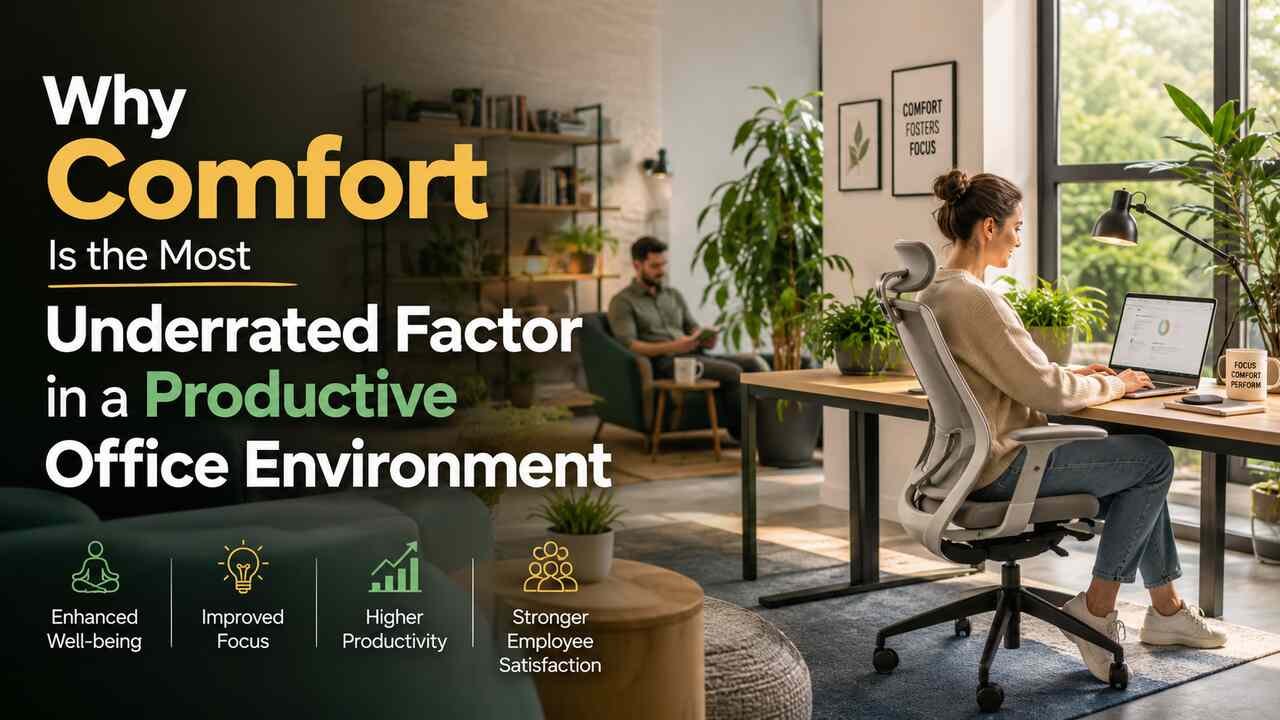
Companies invest huge amounts of money in standing desks, mood lighting, and open-plan workspaces, and then realize that productivity doesn’t necessarily increase. Ironically, the one item that every employee uses to sit for eight hours a day is often overlooked: the chair.
The Problem Hiding In Plain Sight
Presenteeism is not discussed as much as it should be. This happens when a person goes to work but is not really present – physically there but mentally absent. We usually attribute this to stress or lack of motivation, but a major reason is actually physical pain.
If your body is waging a war against a bad sitting position, your brain doesn’t get to rest. It will register the pain as a constant background noise – not enough to make you stop and pay attention, but enough to keep your focus occupied. Your brain becomes tired from a place your boss would never suspect. You start making mistakes. You get slower to reply. An hour-and-a-half is what it takes to do an hour’s work. No one stays at home ill, so it never shows up in sickness absence figures. It’s just a hidden, silent, squandering of performance.
Aesthetic Upgrades Won’t Fix A Physical Problem
Modern offices have undergone several changes in the last decade. These changes include adding plants, exposed brick, collaborative zones, and wellness walls. Although these alterations are not pointless because the environment does matter, they do not change the negative impact on the lumbar spine that occurs after sitting in an ill-fitted chair for six hours.
Poor postural health adds up over time. A chair with insufficient lumbar support doesn’t cause pain right away. Instead, it causes a slow decline: shoulders hunch, the base of the back arches out, the neck sticks out to compensate. By mid-afternoon, the employee isn’t looking at the project ahead of them. They’re squirming, stretching, trying to alleviate an uncomfortable pressure. They can’t quite tell where it’s coming from. That’s not a wellness problem. That’s a seating problem.
The Maintenance Gap Most Offices Ignore
Here’s where the investment logic breaks down in practice. A business buys quality ergonomic chairs, uses them for three or four years, and then starts noticing that the adjustment locks don’t hold, the seat slides are stuck, or the armrests won’t stay in position. The common response is to either live with it or replace the chair entirely.
Both options are wrong. A broken adjustment mechanism doesn’t mean the chair is dead – it means the chair needs servicing. Ergonomic task seating is precision equipment. When the mechanical parts fail, the ergonomic function fails with them. A chair with a jammed height lock is no longer an ergonomic chair; it’s a fixed-height seat at whatever height it froze. Rather than replacing an otherwise sound piece of furniture, businesses can restore their investment by using professional office seat repairs to get the adjustability functioning again at a fraction of replacement cost.
This is also where the ROI argument sharpens. Replacement cycles that run every three to four years are expensive. Maintenance cycles that extend the working life of quality seating to eight or ten years are not.
What A Genuinely Productive Chair Actually Does
Task seating designed for extended computer work does several specific things that standard chairs don’t. It keeps the pelvis tilted forward to maintain that natural curve of the lower spine. It positions the lumbar support at a height that provides active help to that curve, rather than just passively filling the gap behind the back. Armrests that can’t be repositioned force the shoulders into a raised or hunched position. If the seat depth isn’t adjustable then shorter or taller users are either perching or have the seat lip cutting into the back of their knees. Tension control on the recline allows users to shift weight and stay comfortably supported across a long workday – what’s called active sitting, which reduces stiffness and promotes circulation.
A study by Cornell University put the productivity increase seen after introducing ergonomic seating alongside employee training at 17.8%. That number is likely enough to prompt any board to approve the capital expenditure.
Reducing Absence, Not Just Discomfort
Problems related to the musculoskeletal system such as chronic back pain, neck strain, and repetitive stress injuries in the shoulders and wrists are some of the most frequent causes of long-term employee absence. These issues do not occur suddenly. They develop over time due to months of poor posture, lack of support, and by the time they become a medical problem, it’s too late.
Investing in proactive seating helps to avoid this scenario. It’s not a soft approach from HR. It’s about investing in a healthy, well-supported team now, or paying for sickness, absence, and recruitment later.
A chair is not a glamorous part of the office. It won’t appear in fancy photos of the company culture for Linkedin. Nobody will take a selfie with an adjustable armrest and post it on Instagram with #officegoals. But it is the only piece of equipment that almost all employees come into physical contact with, every single day, in a way that every other piece of company property will never get close to. Fix the chair. Then worry about the rest.
