

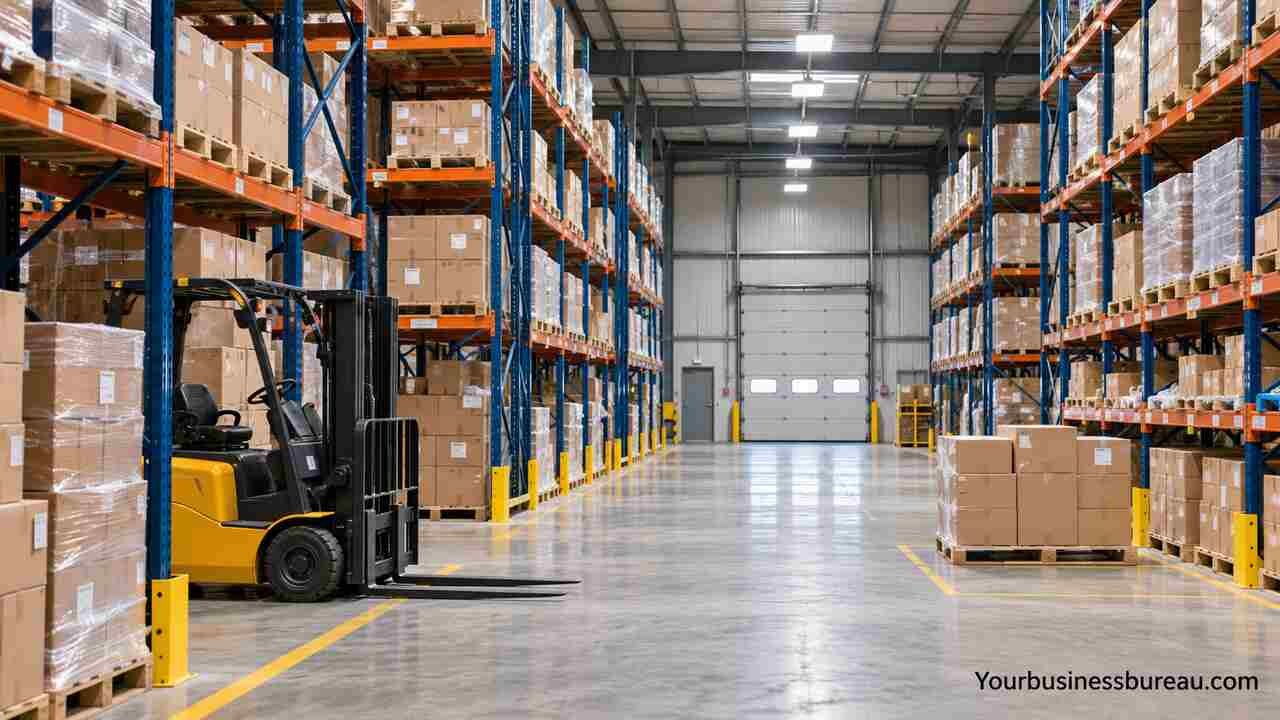
Business warehouse storage gives companies a dedicated place to store inventory, raw materials, equipment, and finished products while supporting receiving, stock handling, and distribution. Businesses can rent commercial warehouse space, use shared facilities, or outsource storage and order fulfillment to a third-party logistics (3PL) provider.
The right solution depends on how much inventory you hold, how frequently products move, and whether your operation requires specialized handling or shipping services. For U.S. small businesses, comparing total costs, usable storage capacity, warehouse location, and contract terms can prevent expensive commitments as inventory requirements change.
What Is Business Warehouse Storage?
Business warehouse storage refers to the commercial facilities and systems used to receive, organize, protect, and hold goods before they are sold, distributed, or used in production. A warehouse may provide pallet storage, industrial shelving, loading docks, inventory tracking, and equipment for moving large shipments.
Unlike a conventional stockroom, a commercial warehouse can support higher inventory volumes and more complex material-handling activities. Some facilities focus primarily on storage, while others provide receiving, order picking, packing, shipping, and returns processing.
For example, a furniture distributor may need a warehouse with loading docks and forklift access to handle large incoming shipments. An ecommerce clothing company might prioritize shelving, barcode tracking, and fast order fulfillment instead.
Warehouse Storage vs. Self-Storage: What’s the Difference?
Commercial warehouses are designed to support inventory movement, freight deliveries, and business operations. Self-storage facilities primarily provide rented storage units and may restrict commercial activities.
Self-storage can work for seasonal supplies, equipment, or overflow merchandise that requires occasional access. However, a business receiving frequent pallet shipments or processing daily customer orders will generally need a facility with more suitable infrastructure.
For broader inventory organization strategies, see our guide to business stock storage, which explains stock handling, organization, and inventory control.
Types of Business Warehouse Storage Solutions
The main warehouse storage options are shared warehousing, dedicated facilities, third-party logistics, on-demand storage, and specialized warehouses. Each offers different levels of flexibility, operational control, and responsibility.
| Warehouse type | Suitable for | Main advantage | Main limitation |
| Shared warehouse | Small businesses and growing retailers | Shared infrastructure and flexible capacity | Limited operational control |
| Dedicated warehouse | Wholesalers and larger distributors | Customized operations | Higher fixed expenses |
| 3PL warehouse | Ecommerce and multichannel sellers | Outsourced storage and fulfillment | Additional service charges |
| On-demand warehouse | Seasonal businesses | Flexible storage commitments | Capacity may be uncertain |
| Climate-controlled warehouse | Temperature-sensitive inventory | More stable environmental conditions | Higher operating expenses |
| Specialized warehouse | Regulated or unusual products | Product-specific storage capabilities | Additional requirements and costs |
Shared and Dedicated Warehousing
Shared warehousing allows several companies to store goods in the same facility. Businesses typically pay according to their assigned storage capacity, pallet positions, or contracted services.
This model can help companies avoid the expense of operating an entire building. However, businesses should confirm inventory access, handling fees, and whether the provider can accommodate seasonal increases.
Dedicated warehousing provides greater control over facility layout, equipment, staffing, and operating procedures. It suits businesses with substantial, predictable inventory volumes.
The disadvantage is greater exposure to fixed costs, including rent, equipment, labor, insurance, and maintenance.
Third-Party Logistics and On-Demand Storage
A 3PL provider stores inventory and may also handle receiving, picking, packing, shipping, and customer returns.
For an ecommerce business, this arrangement can eliminate the need to operate an internal fulfillment team. However, the company remains responsible for monitoring inventory performance and ensuring the provider meets its contractual obligations.
On-demand warehousing is useful when businesses need temporary or seasonal capacity. Rather than committing to a long commercial lease, they can obtain storage for a specific period or volume, subject to provider availability and contract terms.
Climate-Controlled and Specialized Warehouses
Climate-controlled facilities maintain environmental conditions suitable for products affected by temperature or humidity.
Specialized warehouses may offer additional capabilities for refrigerated goods, pharmaceuticals, chemicals, or other products with particular handling requirements.
A climate-controlled building is not automatically approved for regulated inventory. Businesses must confirm that the facility meets applicable product, safety, and regulatory requirements.
How Much Does Business Warehouse Storage Cost?
Warehouse storage costs in the United States depend on location, facility size, product characteristics, storage duration, and handling requirements.
A dedicated warehouse generally involves rent and recurring operating expenses. Shared warehouses and 3PL providers commonly charge according to storage space, inventory movements, and additional services.
Warehouse Storage Pricing and Common Fees
A 2026 U.S. public-rate analysis by 3PL Price Index reported a median pallet storage price of approximately $25 per pallet per month among 22 providers publishing that rate. This is a limited sample of advertised prices, not a guaranteed national rate.
Warehouse providers may also charge the following expenses:
| Expense | Typical billing method |
| Warehouse rent | Monthly or annual lease |
| Pallet storage | Per pallet position per month |
| Receiving | Per pallet, carton, or labor hour |
| Picking and packing | Per order and additional item |
| Outbound handling | Per pallet or shipment |
| Inventory management | Software or account fees |
| Returns processing | Per return or item |
| Climate control | Included in rent or charged separately |
| Insurance | Premiums based on coverage and risk |
Storage invoices can also include minimum monthly charges, setup expenses, packaging materials, and long-term inventory fees.
Ask how the provider measures storage usage. One company may bill according to average daily pallet occupancy, while another charges based on the highest inventory count during a billing period.
These differences can materially change costs even when the advertised storage rate looks identical.
Example: Monthly Warehouse Storage Cost Calculation
Consider a hypothetical online retailer with 65 pallets in storage, 600 customer orders, 40 inbound pallets, and 50 returns during one month.
Using illustrative fees:
| Expense | Calculation | Monthly cost |
| Pallet storage | 65 × $22 | $1,430 |
| Order fulfillment | 600 × $3 | $1,800 |
| Receiving | 40 × $12 | $480 |
| Account management | Fixed fee | $150 |
| Returns processing | 50 × $4 | $200 |
| Total | $4,060 |
The example produces an estimated monthly cost of $4,060 before shipping, packaging, and other charges. These figures are illustrative rather than quotations from a particular warehouse.
If you compare multiple providers, use the same monthly order volume, inventory quantities, and service requirements for each quotation.
Tracking warehousing expenses through reliable small business bookkeeping software can also help identify changes in storage and fulfillment costs.
How Can Businesses Reduce Warehouse Costs?
The most effective starting point is reducing unnecessary storage and inventory handling.
Slow-moving merchandise can occupy valuable space for months while generating little revenue. Reviewing obsolete products and purchasing quantities can reduce storage requirements without affecting customer demand.
Better warehouse layouts may also lower labor costs by reducing employee travel and unnecessary product movements.
Businesses should avoid reducing expenses by overcrowding storage racks or compromising safe equipment access. The savings from additional capacity are unlikely to justify damaged inventory or workplace injuries.
How to Calculate and Plan Warehouse Storage Space
Warehouse space planning begins with inventory volume, peak stock levels, product dimensions, and material-handling requirements. The objective is to provide enough capacity for goods and efficient operations without paying for excessive unused space.
A warehouse must accommodate more than pallets and shelves. Receiving areas, picking stations, loading docks, equipment aisles, and emergency access all use floor space.
Calculate Required Pallet Storage Capacity
Start by estimating the maximum number of pallets your business expects to hold during its busiest period.
Suppose a distributor expects to store 120 pallets at peak demand and chooses to plan around 85% occupancy to preserve operating flexibility.
The calculation is:
Required pallet positions = Peak pallet count ÷ Planned occupancy rate
120 ÷ 0.85 = 141.18
Rounding up, the company would plan for at least 142 pallet positions.
The 85% figure is a hypothetical planning assumption, not a universal warehouse standard. Actual capacity requirements depend on inventory turnover, rack configuration, stock accessibility, and available handling equipment.
Next, determine how many pallet positions can safely fit within the facility. This requires considering rack dimensions, vertical clearance, aisle widths, floor load capacity, and building restrictions.
A warehouse professional or qualified racking designer should review the proposed layout before equipment is purchased or installed.
Select the Right Warehouse Racking System
Storage equipment should match product dimensions, weight, picking frequency, and handling methods.
Selective pallet racks allow individual pallets to be accessed directly, making them useful for warehouses handling many different products.
Drive-in racks can support denser storage for appropriate inventory but provide less direct access to individual pallets.
Cantilever racks accommodate long or awkwardly shaped materials, while bins and shelving generally work well for small products.
Choosing the wrong rack configuration can increase handling time and limit capacity even when the building has sufficient square footage.
Organize Receiving, Storage, and Shipping Areas
Warehouse layouts should support a logical movement of goods from receiving through storage and eventual dispatch.
Place receiving and inspection functions near inbound loading areas. Store frequently picked products where they can be accessed efficiently, and keep packing operations close to outbound shipping where practical.
Assign each storage location a clear identification code. Employees should be able to locate products without relying on personal memory.
Businesses handling multiple product categories can improve accuracy with barcode scanning and warehouse management software.
An organized small business inventory management system also helps connect stock movements with purchasing, sales, and inventory records.
How to Choose the Right Commercial Warehouse Facility
Choosing a warehouse requires evaluating transportation access, building specifications, contractual obligations, and operating expenses together.
A facility with inexpensive rent may become costly if it lacks suitable loading docks or creates unnecessary transportation expenses.
Consider Location and Transportation Access
Warehouse location directly affects freight movement and distribution performance.
Businesses receiving imported merchandise may benefit from proximity to ports or freight terminals. Regional distributors may prefer locations near major highways or customer concentrations.
Compare the complete transportation cost associated with each facility, including inbound deliveries, outgoing shipments, and transfers between locations.
If daily carrier pickups are required, confirm that the warehouse’s operating hours and truck access can support them.
Inspect Building Features and Infrastructure
Before signing a lease, confirm that the building meets your operational requirements.
Important features include floor loading capacity, clear ceiling height, loading dock configuration, power supply, ventilation, lighting, fire protection, and safe equipment access.
A building’s advertised square footage does not guarantee that the entire area can be used for inventory storage.
Also assess whether the facility can accommodate future growth. A warehouse operating at maximum practical capacity from the beginning may create additional costs when inventory increases.
Review Warehouse Lease and Contract Terms
Commercial warehouse leases may include financial responsibilities beyond the advertised base rent.
Depending on the agreement, tenants may pay certain maintenance expenses, property taxes, insurance-related charges, or common-area costs.
For outsourced storage, contracts should clearly explain how inventory is received, stored, counted, accessed, and released.
Before committing, review minimum charges, liability provisions, permitted goods, insurance responsibilities, renewal terms, and termination conditions.
For 3PL services, request written performance expectations covering order accuracy, receiving times, shipping cutoffs, returns, and inventory discrepancies.
Warehouse Safety, Security, and Inventory Protection
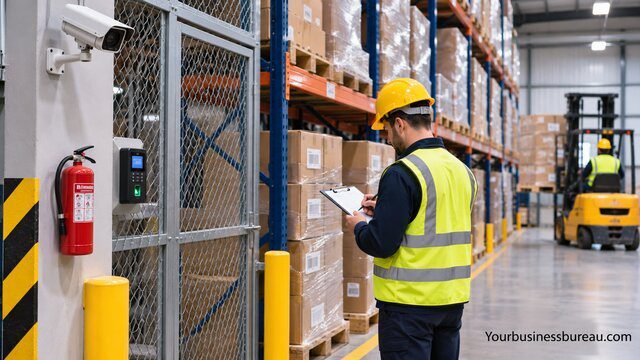
Warehouse safety requires appropriate storage equipment, controlled material handling, clear access routes, and procedures that protect workers and inventory.
Applicable U.S. workplace requirements depend on the operation, equipment, and goods stored.
Follow Warehouse Safety Requirements
The Occupational Safety and Health Administration (OSHA) identifies forklifts, material handling, ergonomic hazards, hazardous chemicals, and slips or falls as significant warehouse risks.
Businesses operating forklifts must ensure operators receive appropriate training and evaluation under applicable OSHA standards.
Warehouse personnel should also inspect equipment, respect rated load capacities, and keep emergency exits unobstructed.
Damaged storage racks require prompt attention because structural failures can endanger employees and destroy inventory.
For additional regulatory information, businesses can consult OSHA’s warehouse safety guidance.
Secure Valuable Business Inventory
Warehouse security should combine physical controls with accurate inventory records.
Access systems, monitored entrances, surveillance cameras, visitor procedures, and periodic stock counts can help businesses detect unauthorized activity and identify discrepancies.
Protection against environmental damage is equally important. Water intrusion, pests, unsuitable temperatures, and improper handling can lead to losses even when theft prevention is strong.
Before storing valuable merchandise off-site, review whether the relevant insurance policy covers inventory at that location.
A qualified business insurance broker can help assess coverage limits, exclusions, and risks associated with warehouse inventory.
Should You Rent Your Own Warehouse or Use a 3PL?
Renting your own warehouse makes sense when inventory and order volumes are sufficiently stable to support fixed operating costs and when direct control provides meaningful operational benefits.
A 3PL may be more suitable when order volumes fluctuate, fulfillment operations are difficult to manage internally, or a business wants access to an established distribution network.
| Decision factor | Own warehouse | 3PL provider |
| Operational control | Greater direct control | Depends on provider and contract |
| Facility expenses | Rent and operating costs | Storage and service fees |
| Warehouse staffing | Managed by your company | Primarily provider-managed |
| Inventory technology | Business selects and maintains | Often provided or integrated |
| Seasonal capacity | Requires advance planning | Depends on provider availability |
| Long-term commitments | May involve commercial leases | Depends on service agreement |
Neither model is automatically cheaper.
An in-house facility may become economical with consistent order volumes and efficient staffing. A 3PL may reduce infrastructure commitments but charge more for activities involving frequent handling, specialized packaging, or returns.
The better decision comes from comparing total annual expenses and service requirements rather than storage rates alone.
Evaluate Warehouse Performance Before Expanding
If your current facility feels overcrowded, first determine whether the problem comes from insufficient capacity or inefficient operations.
Repeatedly misplaced products, delayed receiving, poor rack utilization, and long picking routes can create congestion without the warehouse actually being too small.
Track inventory accuracy, order accuracy, warehouse capacity utilization, and cost per order to identify specific problems.
Before relocating, consider whether better stock placement, removal of obsolete inventory, or changes to material-handling procedures could improve performance.
FAQ’s
Yes. Small businesses can rent shared warehouse space, obtain dedicated commercial facilities, or purchase storage and fulfillment services from a 3PL provider. The most suitable arrangement depends on inventory size, handling requirements, and budget.
Published U.S. 3PL pricing references commonly show pallet storage rates around $15 to $40 per pallet per month, although actual prices can fall outside this range. Location, product requirements, provider contracts, and handling services affect the total cost.
Warehouse rent and ordinary business storage expenses may qualify as deductible business expenses under applicable U.S. tax rules. However, inventory-related costs, capital improvements, and other circumstances can affect their tax treatment. A qualified tax professional can determine how specific expenses should be reported.
A warehouse primarily provides space and infrastructure for storing and moving goods. A fulfillment center focuses on processing customer orders, including picking, packing, and shipping. Some facilities perform both functions.
Many self-storage facilities permit certain types of commercial inventory. However, restrictions may apply to employee activities, deliveries, hazardous products, and daily business operations. Always review the storage agreement before using a unit for commercial purposes.
Ask about total monthly charges, billing methods, inventory access, receiving and shipping services, security, insurance responsibilities, minimum commitments, contract termination, and liability for lost or damaged goods. If fulfillment is included, confirm the provider’s service standards and inventory reporting capabilities.
Conclusion
Choosing the right business warehouse storage solution starts with understanding your inventory requirements and how products move through your operation. Shared warehousing can provide flexibility, dedicated facilities offer greater control, and 3PL providers can manage storage alongside fulfillment.
Before signing a contract, calculate the space you need, compare complete operating costs, inspect facility capabilities, and review inventory protection requirements. A warehouse should support efficient stock movement, reliable deliveries, and sustainable business growth without creating unnecessary financial commitments.
