

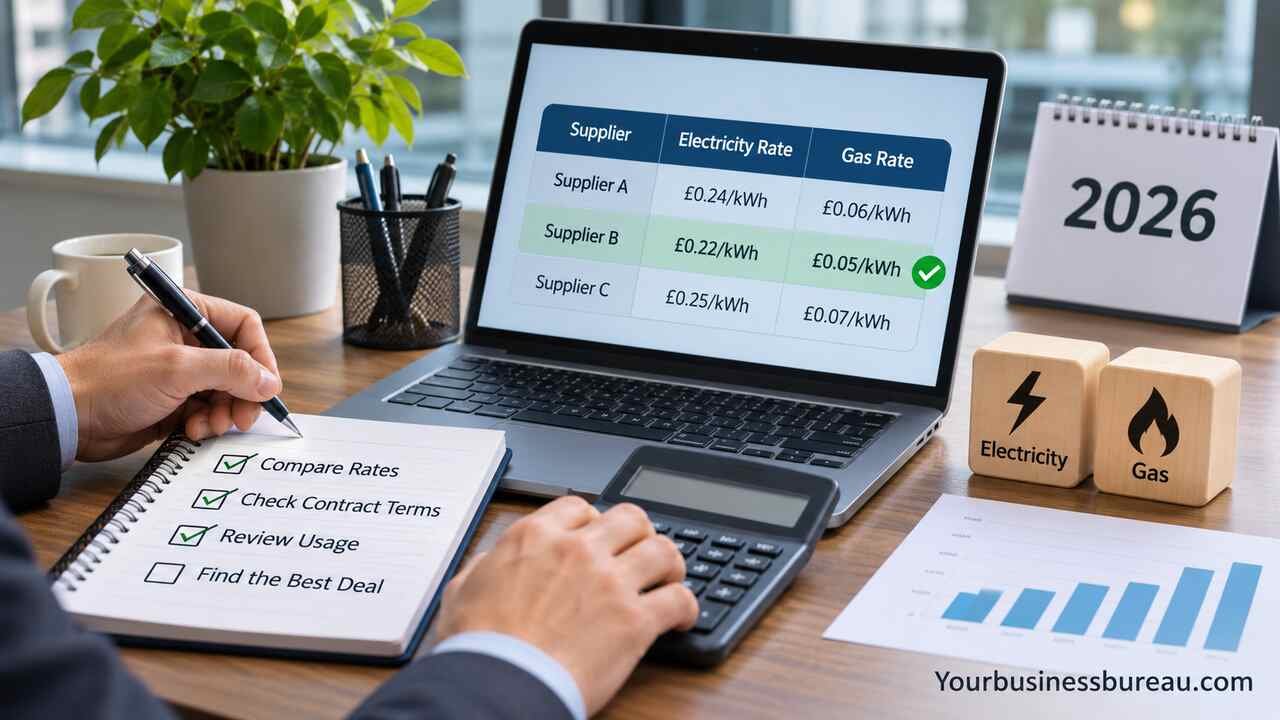
Business energy price comparison helps U.S. companies evaluate electricity and natural gas rates, identify competitive suppliers, and reduce unnecessary utility expenses. Whether you operate a small retail store, restaurant, office, or manufacturing facility, comparing energy plans can help you understand what you’re paying and whether better options are available.
Understanding Business Energy Price Comparison in the U.S.
Business energy price comparison involves reviewing electricity and natural gas pricing from available suppliers to determine which option offers the best overall value for your company. The process considers energy rates, monthly consumption, delivery charges, contract conditions, and potential additional fees.
Unlike residential energy plans, commercial energy pricing can depend heavily on business size, usage patterns, peak demand, and operating hours. A restaurant running refrigeration equipment continuously may have different energy requirements than an office operating only during weekdays.
Energy comparison is particularly important in competitive energy markets, where eligible businesses may choose their electricity or natural gas supplier. However, supplier choice is not available everywhere, and local utilities may remain responsible for delivering energy regardless of the company supplying it.
How Business Electricity Pricing Works
Commercial electricity is commonly measured in kilowatt-hours (kWh). Your electricity bill may include generation or supply charges, transmission and distribution costs, demand charges, taxes, and other applicable fees.
For example, a business consuming 5,000 kWh monthly at an electricity supply rate of $0.12 per kWh would pay $600 for the energy supply portion alone.
Additional delivery charges, demand charges, and taxes could increase the total bill. That’s why comparing only the advertised supply rate can produce misleading results.
How Business Natural Gas Pricing Works
Commercial natural gas is commonly billed using therms, CCF, or MCF, depending on the utility. Pricing can include gas supply costs, distribution charges, transportation fees, and applicable taxes.
Natural gas expenses are especially important for restaurants, hotels, commercial kitchens, and businesses using gas-powered heating systems.
When comparing gas suppliers, check the unit of measurement, contract terms, seasonal pricing exposure, and whether transportation or distribution costs are included in the quoted amount.
How to Compare Business Electricity and Gas Rates
The most effective way to compare business energy rates is to evaluate offers using the same consumption data, billing period, and cost assumptions. This allows you to identify meaningful price differences rather than relying on promotional rates.
Start by reviewing your previous 12 months of utility bills. Look for monthly consumption, seasonal variations, peak demand, supply rates, and additional charges. These details help suppliers prepare quotes that reflect your actual operating requirements.
If you operate multiple locations, compare each location separately. Electricity and natural gas pricing can differ significantly between utility territories, even within the same state.
Step-by-Step Business Energy Comparison Process
Follow these steps when reviewing commercial energy plans:
- Collect 12 months of electricity and gas bills.
- Identify your average monthly and annual consumption.
- Confirm whether your state and utility territory allow competitive supplier choice.
- Request quotes from several licensed or authorized suppliers.
- Compare supply rates, fixed fees, and applicable contract conditions.
- Estimate annual costs using your actual energy consumption.
- Review cancellation fees, renewal provisions, and pricing risks before signing.
Ask suppliers to provide written quotes showing the complete pricing structure. This makes it easier to compare offers consistently.
Comparing Fixed-Rate and Variable-Rate Energy Plans
Business energy contracts generally offer different levels of price stability and flexibility.
| Feature | Fixed-Rate Plan | Variable-Rate Plan |
| Energy supply price | Usually fixed for the agreed term | Changes according to contract conditions |
| Budget predictability | Higher | Lower |
| Market price increases | Supply rate generally protected | May increase |
| Market price decreases | Usually no automatic benefit | May benefit |
| Contract flexibility | Depends on contract | Depends on contract |
| Best suited for | Predictable budgeting | Businesses comfortable with price fluctuations |
A fixed-rate plan can help you control supply-price uncertainty, but it does not necessarily freeze your entire utility bill. Delivery charges, taxes, and consumption may still change.
Variable-rate plans may offer savings when market prices fall, but they expose businesses to unexpected increases.
Business Energy Prices and Factors That Affect Your Costs
Business energy prices vary based on geographic location, electricity demand, natural gas markets, supplier competition, and infrastructure expenses. Two businesses with identical consumption can pay different amounts because of their utility territories and billing structures.
Electricity prices also reflect regional generation resources, transmission constraints, fuel costs, and regulatory conditions. Natural gas prices can fluctuate due to weather, production, storage levels, and seasonal demand.
Rather than relying on a single national average, compare prices available in your specific service territory. National statistics can provide useful context, but they cannot replace an actual commercial energy quote.
How Location Affects Commercial Energy Rates
Your business location determines which utility delivers electricity or natural gas and whether alternative suppliers are available.
States such as Texas, Pennsylvania, Ohio, and Illinois have competitive electricity supply arrangements for many customers, although eligibility and market rules differ. Texas operates under a distinct retail electricity structure in participating areas.
In traditionally regulated markets, customers generally purchase electricity through their assigned utility. In these areas, savings opportunities may focus more on energy efficiency, available rate schedules, and demand management.
How Energy Consumption and Peak Demand Affect Pricing
Energy consumption influences your total costs, but the timing and intensity of electricity use can matter just as much.
Some commercial electricity tariffs include demand charges based on the highest measured power demand during a billing period. These charges are typically measured in kilowatts (kW), rather than kilowatt-hours.
For example, operating several large appliances simultaneously may create a higher demand peak than operating them at different times.
Businesses with significant demand charges may reduce expenses by staggering equipment operation, improving load management, or adjusting energy-intensive processes when operationally practical.
Best Ways to Find and Compare Business Energy Suppliers
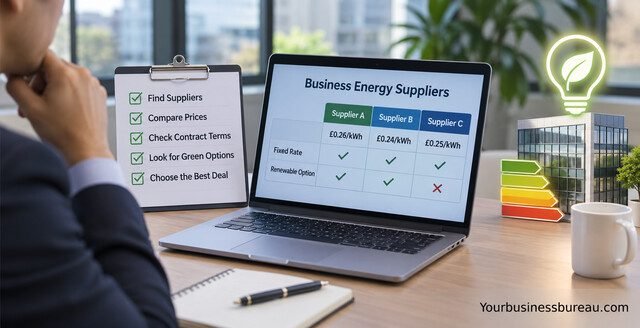
Finding a competitive energy supplier starts with confirming which providers are authorized to serve your business location. State utility commissions, utility websites, and official retail energy shopping resources can help you identify available options.
Commercial energy brokers and comparison services can also collect supplier quotes. However, their compensation arrangements and supplier coverage may influence which offers they present.
A useful business energy price comparison should examine supplier reliability, pricing transparency, customer service, contract flexibility, and estimated annual costs.
Where to Find Business Electricity Suppliers
Several resources can help businesses explore energy options in competitive markets.
| Resource | What It Provides | Important Consideration |
| State public utility commission | Supplier licensing and consumer information | Rules differ by state |
| Power to Choose (Texas) | Retail electricity offers in participating Texas markets | Not all service areas or business plans are covered |
| PA Power Switch | Electricity shopping information and offers in Pennsylvania | Commercial eligibility and available offers vary |
| Energy brokers | Quotes from participating suppliers | Ask about commissions and supplier coverage |
| Direct supplier websites | Contract details and business quotes | Compare multiple providers independently |
Official comparison resources can help you understand market options, but availability and eligibility depend on your location and business account.
What to Check Before Choosing an Energy Provider
Before selecting a supplier, review its authorization status, pricing structure, customer service channels, and contract documentation.
Pay particular attention to automatic renewal clauses, early termination charges, minimum usage provisions, and pass-through fees.
You should also ask whether the quoted rate includes all supply-related charges or whether additional components will appear on your bill.
A supplier offering a slightly higher transparent rate may provide better value than one advertising a lower rate with significant additional fees.
How to Calculate Business Energy Costs and Potential Savings
Calculating potential savings requires comparing the total expected cost of your existing arrangement with the cost of a proposed energy plan.
For electricity, begin by multiplying your annual consumption by the applicable supply rate. Then account for fixed supplier fees, demand-related supply charges, and other costs that would change under the new contract.
Keep utility delivery charges separate when they remain unchanged after switching suppliers. This prevents you from overstating the savings associated with a new energy contract.
Example of a Business Electricity Price Comparison
Consider a business using 60,000 kWh of electricity annually.
Its current supply rate is $0.14 per kWh, while a competing supplier offers $0.115 per kWh.
| Cost Comparison | Current Plan | New Plan |
| Annual consumption | 60,000 kWh | 60,000 kWh |
| Electricity supply rate | $0.140/kWh | $0.115/kWh |
| Annual supply cost | $8,400 | $6,900 |
| Annual supply savings | $1,500 | |
| Percentage supply savings | 17.9% |
This example assumes constant consumption and no additional supplier fees or changes in other supply charges.
The business could save $1,500 annually on electricity supply, but its total utility bill would not necessarily decrease by 17.9% because delivery and other charges may remain.
Common Mistakes to Avoid When Comparing Business Energy Plans
One of the biggest mistakes in business energy comparison is selecting a supplier based only on the lowest advertised rate. A low initial price may come with unfavorable contract conditions or additional charges that reduce expected savings.
Another common problem is comparing quotes that use different pricing structures. One supplier might offer a fixed supply rate, while another quotes a variable rate tied to wholesale market conditions.
Businesses should also avoid signing agreements without checking their existing contracts. Switching before the current agreement expires may trigger termination fees that outweigh the expected savings.
Hidden Fees and Contract Terms to Watch
Commercial energy contracts may contain provisions that materially affect your final costs.
Examples include early termination penalties, automatic renewal provisions, minimum usage requirements, administrative charges, and certain market-related pass-through costs.
Some agreements may also include provisions addressing significant changes in consumption or business operations.
Request the full contract and review how each charge is calculated. If the language is unclear, ask the supplier for a written explanation before committing.
Why the Cheapest Energy Rate Is Not Always Best
The cheapest quoted rate may not deliver the lowest total cost over the contract period.
For example, a supplier offering $0.105 per kWh with a substantial monthly fee could be more expensive for a small business than a supplier charging $0.115 per kWh without that fee.
Likewise, a variable-rate contract may appear inexpensive initially but become costly during periods of high wholesale prices.
Compare projected annual expenses, contract risks, and service requirements rather than treating the advertised rate as the only decision factor.
Practical Strategies to Reduce Business Energy Expenses in 2026
Reducing business energy expenses requires more than switching suppliers. Energy efficiency improvements, equipment scheduling, demand management, and regular bill reviews can produce savings even in markets without competitive supplier choice.
Start by identifying which systems consume the most electricity or natural gas. Heating, ventilation, air conditioning, refrigeration, lighting, and production equipment are common areas worth investigating.
You should also review your utility rate schedule periodically. Depending on your business operations, another eligible tariff or time-of-use arrangement may better match your consumption pattern.
Improve Energy Efficiency Across Your Business
Energy efficiency investments can reduce consumption without requiring changes to your energy supplier.
Consider replacing outdated lighting with LEDs, maintaining HVAC equipment, sealing air leaks, and installing appropriate programmable controls.
Businesses with significant refrigeration or industrial loads may benefit from specialized energy audits and equipment assessments.
Before investing, calculate expected annual savings against installation and maintenance costs. Available utility rebates or incentive programs may improve the financial return.
Monitor Energy Usage and Review Contracts Regularly
Regular monitoring helps identify unusual consumption patterns, billing errors, and opportunities to improve operational efficiency.
Compare monthly electricity and gas usage with previous periods while accounting for weather, business activity, and operating hours.
If your contract has a fixed expiration date, begin reviewing renewal options well before it ends. This gives you time to compare offers and understand any notice requirements.
A simple monthly energy dashboard showing consumption, total costs, average effective rates, and peak demand can help you make better decisions throughout the year.
FAQ’s
Start by reviewing your electricity bills and identifying annual consumption, current supply rates, and utility territory. If competitive supplier choice is available, request quotes from authorized providers. Compare estimated annual supply costs, additional fees, and contract conditions. In regulated markets, evaluate available utility tariffs and energy efficiency opportunities instead.
Yes, some small businesses can choose their electricity supplier in competitive retail energy markets. However, eligibility depends on state regulations, utility territory, and customer classification. In other locations, businesses must purchase electricity from their assigned utility. Check with your state public utility commission to understand the options available to your business.
A fixed-rate contract can be beneficial when predictable supply pricing is important for budgeting. It generally protects the agreed supply rate from market increases during the contract term. However, it may prevent you from benefiting from falling market prices, and other bill components can still change. The best choice depends on your risk tolerance and contract terms.
Savings depend on your current rate, available offers, annual consumption, and contract expenses. For example, reducing an electricity supply rate by $0.02 per kWh on 50,000 kWh of annual usage would save $1,000 in annual supply charges before additional fees. Actual savings may be smaller, and switching does not guarantee a lower total bill.
The best time is generally before your current contract expires, allowing sufficient time to evaluate offers and avoid unfavorable renewal terms. Energy prices can change throughout the year, but no particular month consistently guarantees the lowest rate. Businesses should monitor contract deadlines and compare available quotes rather than attempting to predict market prices perfectly.
Yes. Businesses can lower energy expenses through efficient lighting, HVAC maintenance, equipment upgrades, improved insulation, and better electricity demand management. Reviewing utility tariffs and correcting billing errors may also help. Energy audits can identify practical improvements, especially for businesses with high electricity consumption or substantial heating and cooling requirements.
Conclusion
Business energy price comparison is an effective way to understand electricity and natural gas expenses, evaluate available suppliers, and identify potential savings. However, the best energy plan is not always the one advertising the lowest rate. Contract conditions, delivery charges, consumption patterns, and pricing risks all influence your actual costs.
Businesses in competitive energy markets should compare several written supplier quotes, while companies in regulated markets should focus on available utility rates and efficiency improvements.
