

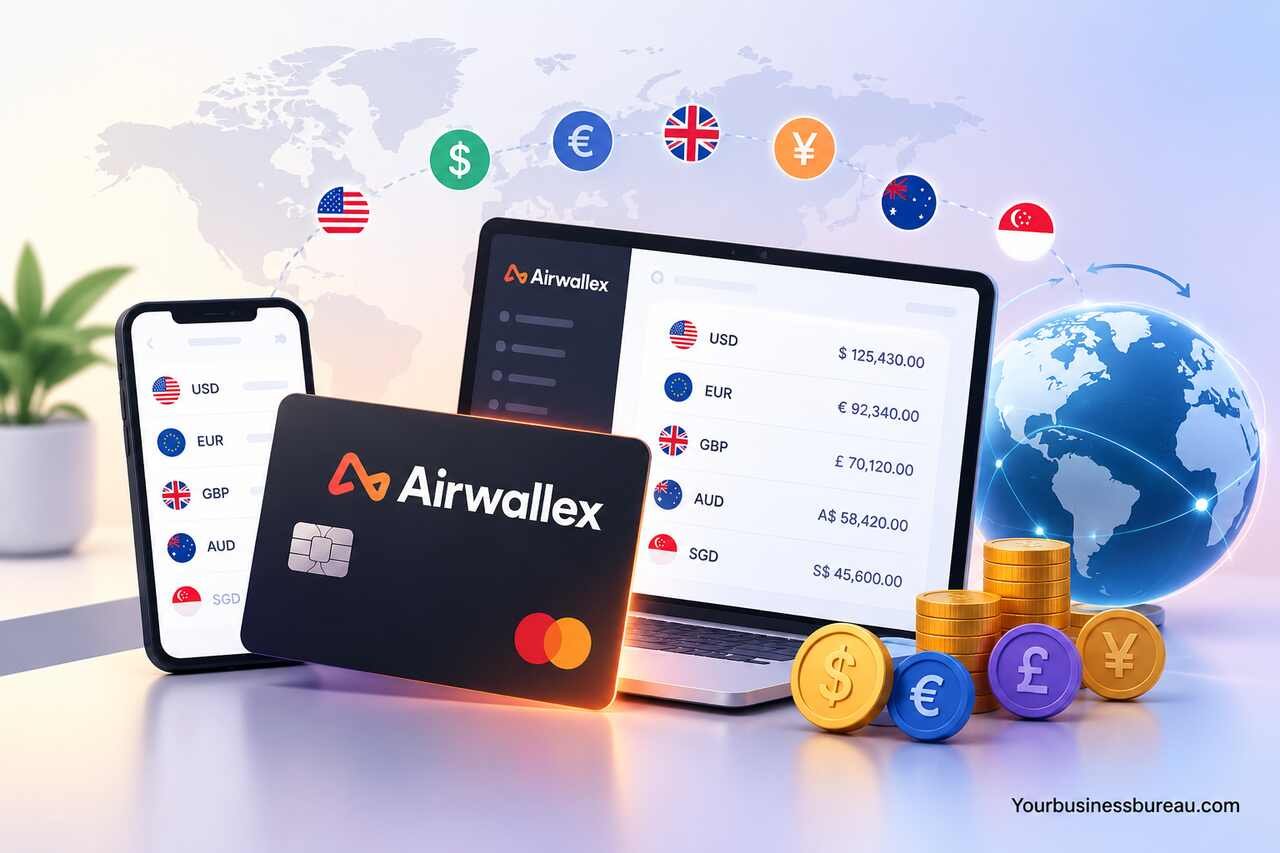
Airwallex multi-currency business account helps businesses receive, hold, convert, and send money in multiple currencies from one platform. It is particularly useful for companies dealing with international customers, suppliers, marketplaces, or operations because it can reduce unnecessary currency conversions and simplify cross-border money management.
What Is an Airwallex Multi-Currency Business Account?
Airwallex’s multi-currency functionality combines Global Accounts with a multi-currency Wallet. Global Accounts provide receiving details for supported regions and currencies, while the Wallet is where balances in different currencies are held.
This distinction matters.
A Global Account effectively acts as a route through which money enters your Airwallex Wallet. Depending on the region and currency, it may include details such as an account number, account name, bank or branch code, routing information, account type, and bank location.
The Wallet then lets the business manage balances in multiple currencies. A company can keep money in its received currency, convert it when necessary, or use available payment and transfer capabilities to move funds onward.
Airwallex currently markets Global Accounts as supporting the collection and holding of funds in 20+ currencies. Its official documentation lists Global Account capabilities across markets including Australia, Canada, Denmark, Estonia, Germany, Hong Kong SAR, Indonesia, Israel, Mexico, the Netherlands, New Zealand, Poland, Singapore, the UAE, the UK, and the US, although the available currencies and payment methods differ by market.
How an Airwallex Multi-Currency Business Account Works
The basic workflow can be understood as four steps.
First, an eligible business opens an Airwallex Business Account and completes the required verification. Business verification requirements vary by jurisdiction and business type and can include business registration information, supporting documents, and identity verification for relevant individuals.
Second, the business creates Global Accounts for the currencies and markets it needs. For example, supported configurations include GBP Global Accounts in the UK, USD accounts in the US, CAD accounts in Canada, AUD accounts in Australia, and various additional currency arrangements in markets such as Hong Kong and Singapore.
Third, the company gives the relevant account details to customers, marketplaces, or other payers. Incoming funds flow through the Global Account and become available in the company’s Airwallex Wallet.
Finally, the company decides what to do with those funds. It may keep the balance in the original currency, convert it, use it for eligible business spending, or transfer funds to recipients.
A simple example
Suppose a UK-based software company sells subscriptions to customers in the US and receives $50,000 in USD.
If the company immediately converted every USD receipt to GBP and later needed USD to pay a US supplier, it could create two unnecessary FX events: USD to GBP, followed by GBP back to USD.
With a multi-currency setup, the company could instead receive eligible USD payments into its USD collection arrangement, maintain the funds as USD in its Wallet, and use USD for its dollar-denominated obligations.
That does not mean every transaction is free. It means the company can potentially avoid converting money when no conversion is economically necessary.
Global Accounts, Wallets, and FX Are Different
Understanding the components prevents one of the most common misconceptions about multi-currency business accounts.
| Component | Primary purpose | What it does |
| Global Account | Receive money | Provides account details for supported regions and currencies |
| Multi-currency Wallet | Hold and manage balances | Maintains available balances across supported currencies |
| FX | Convert money | Exchanges one currency for another |
| Transfers | Send money | Moves funds to suppliers, employees, contractors, or other recipients |
| Corporate cards | Business spending | Allows eligible company spending using Airwallex-issued cards |
Airwallex’s technical documentation explicitly explains that Global Accounts themselves act as conduits for receiving bank transfers or facilitating supported direct debit payouts. Currency balances are held in the multi-currency Wallet.
This architecture means businesses should evaluate the entire money flow, rather than looking only at how many currency account details are available.
Which Currencies Can Businesses Receive?
Currency support depends on where a Global Account is created.
According to Airwallex’s current Global Accounts documentation, examples include:
| Global Account region | Documented receiving currencies |
| Australia | AUD |
| Canada | CAD |
| United Kingdom | GBP |
| United States | USD |
| New Zealand | NZD |
| Mexico | MXN |
| Indonesia | IDR |
| United Arab Emirates | AED |
| Germany | EUR |
| Estonia | EUR |
| Netherlands | EUR |
| Poland | PLN |
| Hong Kong SAR | CNY, EUR, HKD, USD, AUD, GBP, JPY, SGD, CHF, CAD, NZD |
| Singapore | SGD, USD, AUD, CAD, CHF, CNY, EUR, GBP, HKD, JPY, NOK, NZD, SEK |
Some locations support a significantly wider set of currencies. Airwallex’s documentation, for example, lists numerous currencies for Global Accounts created in Denmark.
These capabilities should not be interpreted as universal availability for every Airwallex customer. Airwallex notes that restrictions can depend on the customer’s home market, governing Airwallex entity, account type, currency, and requested functionality.
Businesses should therefore verify their specific country and currency combination before designing their payment process around it.
Local Receiving Details Can Reduce Cross-Border Friction
One of the main reasons to use a multi-currency business account is the ability to collect eligible payments through local payment infrastructure.
Consider a company that has customers in the US and UK.
Rather than asking every customer to make an international wire to one foreign bank account, the business may be able to provide appropriate local receiving details. Airwallex documents support for payment systems such as ACH and Fedwire for USD Global Accounts in the US, and Faster Payments, BACS, and CHAPS for GBP accounts in the UK.
The precise receiving method depends on the Global Account’s location and currency.
This matters because “supports USD” and “provides US local USD receiving details” are not necessarily the same claim. When evaluating any multi-currency provider, businesses should check the actual receiving rails, account location, payment method, and SWIFT support rather than relying solely on a currency list.
Airwallex Multi-Currency Account Fees

Fees depend on the customer’s country, plan, transaction type, currency, and payment route, so businesses should use the pricing page applicable to their registered market.
As one current example, Airwallex’s US pricing lists its Explore plan at $0 per user per month and includes Global Accounts capable of collecting and holding 20+ currencies. The same pricing page lists FX conversions at 0.5% above interbank rates for major currencies and 1.0% for other currencies. It also lists US domestic USD and CAD transfers as free and certain SWIFT transfers at $15 to $25 per transfer.
Those figures should not automatically be applied to businesses registered elsewhere.
Calculate the total cost, not just the account fee
Suppose a business converts $100,000 equivalent each month.
At a hypothetical 0.5% FX margin, the conversion cost attributable to that margin would be approximately:
$100,000 × 0.005 = $500
At 1%:
$100,000 × 0.01 = $1,000
This illustrates why FX usage can matter more than a monthly account fee for businesses moving substantial amounts internationally.
A better cost comparison therefore includes:
- monthly or plan charges;
- incoming transfer costs;
- outgoing local transfer costs;
- SWIFT fees;
- FX margins;
- card-related charges;
- payment acceptance fees, if relevant;
- intermediary or correspondent bank charges where applicable.
A provider with no monthly account fee is not automatically the cheapest option for every transaction pattern.
When Holding Multiple Currencies Can Save Money
The biggest potential saving comes from reducing avoidable FX conversions.
Imagine an e-commerce company receives €80,000 from European customers each month and also pays €50,000 to European suppliers.
If every euro received is immediately converted to the company’s domestic currency, the company may later need to purchase euros again to pay those suppliers.
A multi-currency account creates another option: retain at least part of the €80,000 balance and use €50,000 directly for euro-denominated expenses.
The company would then need to consider converting only the remaining balance according to its cash requirements.
This is sometimes described as natural hedging because incoming and outgoing cash flows in the same currency offset each other. It does not remove exchange-rate risk on balances that remain exposed to currency movements, but it can reduce the volume of unnecessary conversions.
International Transfers Extend Beyond Global Accounts
Receiving currencies and sending currencies are separate capabilities.
Airwallex’s payout documentation states that its network supports local and SWIFT payouts across more than 200 countries and regions and more than 90 currencies. It also says local clearing connections are available in more than 120 countries and regions.
This broader payout coverage matters for businesses with distributed suppliers, contractors, or employees.
For example, a company may collect revenue in several major currencies while making payments to recipients in markets where it does not maintain Global Account details. The transfer network and FX capabilities can handle a different part of that workflow.
Businesses should therefore assess three separate questions:
- Where can we receive money locally?
- Which currencies can we hold?
- Where and in which currencies can we send money?
The answers do not necessarily have identical geographic coverage.
Who Is an Airwallex Multi-Currency Business Account Best Suited For?

The strongest use cases generally involve businesses with recurring international money flows.
E-commerce businesses may collect revenue from international marketplaces or customers while paying overseas suppliers, logistics companies, and advertising platforms.
SaaS and technology companies can invoice customers in several markets and use foreign-currency balances for international contractors, software services, or other operating costs.
Importers and exporters may benefit when sales and supplier payments occur in different currencies. Holding balances can give the treasury team greater control over when conversion takes place.
Agencies and professional-services firms with international clients may prefer receiving funds through supported local account details rather than asking clients to initiate international transfers.
Businesses with international teams can combine multi-currency balances with Airwallex’s broader transfer and spend-management capabilities where those services are available.
The business case is less compelling if virtually all revenue and expenses occur in one domestic currency. In that situation, the added multi-currency functionality may provide little practical value.
Multi-Currency Account vs Traditional Foreign Bank Accounts
Opening bank accounts directly in several countries can give a company local banking relationships, but it can also introduce separate applications, compliance requirements, portals, account administration, and reconciliation processes.
Airwallex takes a centralized approach.
Its Global Accounts provide supported local receiving details while currency balances and transactions can be managed through the wider Airwallex platform. The company also provides API capabilities for businesses that need to create or manage Global Accounts programmatically.
The trade-off is that Airwallex should not simply be treated as identical to having a conventional bank account in every country.
The legal structure and regulatory treatment of Airwallex services differ by jurisdiction. For example, Airwallex states that its UK entity is an FCA-regulated Electronic Money Institution, while its US entity is licensed or authorized as a money transmitter and uses banking partners for some services.
Businesses should check the relevant Airwallex entity and local terms if bank status, deposit protection, safeguarding, or a particular regulatory structure matters to their treasury policy.
Security and Safeguarding
Financial security deserves separate consideration from product convenience.
Airwallex states that it holds customer money with financial institutions and safeguards funds according to the regulations applicable in the markets where it operates. Its US site also identifies PCI DSS, SOC 1, and SOC 2 compliance, while its enterprise security materials additionally reference ISO 27001 and separation of client funds from Airwallex’s own funds.
However, “safeguarded” and “covered by a bank deposit insurance scheme” are not interchangeable concepts.
The regulatory framework depends on the jurisdiction, Airwallex legal entity, and service being used. A company with a policy requiring bank deposits or a specific deposit-protection regime should verify those details before moving substantial treasury balances.
How to Decide Whether Airwallex Fits Your Business
Instead of choosing a multi-currency account based on the number of advertised currencies, map your actual cash flow first.
Start with the currencies in which customers pay you. Then list the currencies used for suppliers, payroll, contractors, software subscriptions, taxes, and other major expenses.
Next, identify where conversion currently occurs.
For example:
Customers pay USD → bank automatically converts to GBP → company later buys USD → supplier receives USD.
That flow contains potentially avoidable conversions.
A multi-currency workflow could instead look like:
Customers pay USD → business retains USD → supplier receives USD → excess USD converted to GBP only when needed.
The second workflow does not guarantee lower total costs because transfer fees, FX pricing, account eligibility, and other charges still matter. It does, however, show where multi-currency cash management can create value.
Before opening an account, compare the following:
| Question | Why it matters |
| Can I receive my main customer currencies locally? | Determines whether local collection improves the payment experience |
| Can I hold the currencies I regularly use? | Helps avoid forced conversion |
| What FX margin applies to my currencies? | Can materially affect high-volume businesses |
| Are local transfers available to my key destinations? | May reduce reliance on SWIFT |
| What does SWIFT cost when local payout is unavailable? | Reveals the cost of harder-to-reach corridors |
| Is my business jurisdiction eligible? | Product availability varies geographically |
| Are my industry and business type supported? | Compliance restrictions can affect onboarding |
| What safeguarding regime applies? | Important for treasury and risk policies |
| Can it integrate with my accounting workflow? | Reduces reconciliation work as transaction volume grows |
Limitations to Consider Before Opening an Account
Airwallex’s international coverage is broad, but it is not identical in every country.
Some Global Accounts have market-specific restrictions. Airwallex’s documentation, for example, notes additional regulatory requirements in certain controlled markets. Indonesia has specific requirements around eligible transactions and supporting order information for local IDR collection.
Global Account capabilities can also vary between local transfers and SWIFT. A currency appearing in a supported-currency table does not necessarily mean every payment method is available for that currency.
FX is another limitation. Keeping the same currency from collection through spending can avoid an unnecessary conversion, but converting between currencies still has a cost.
Finally, businesses should not assume that eligibility for an Airwallex account guarantees access to every feature. Product availability varies by jurisdiction, use case, regulatory framework, and account type.
Conclusion
An Airwallex multi-currency business account is most useful when a company regularly receives and spends money internationally. Global Accounts provide supported receiving details, the multi-currency Wallet centralizes balances, and Airwallex’s FX and transfer infrastructure lets businesses convert or move those funds when necessary.
The main financial opportunity is not simply having access to more currencies. It is designing a better money flow. A business that receives USD and also spends USD, for example, may be able to keep those funds in dollars rather than repeatedly converting them.
Before opening an account, map your customer currencies, supplier currencies, monthly FX volume, payout destinations, and required receiving methods. Then check Airwallex’s current pricing and regional availability for those specific corridors. That approach gives a far more accurate picture of potential costs and benefits than comparing account fees alone.
FAQ’s
Airwallex currently advertises the ability to collect and hold funds in 20+ currencies through its Business Account offering. Exact capabilities vary by the customer’s location and account configuration.
Yes, Global Accounts can provide local account details for supported regions and currencies. Depending on the market, these can include an account number and relevant bank, branch, or routing codes.
FX pricing depends on the customer’s region and plan. As one example, Airwallex’s current US pricing lists FX at 0.5% above interbank rates for major currencies and 1.0% for other currencies. Businesses outside the US should check their applicable local pricing rather than assuming those rates apply.
Yes. Airwallex provides local and SWIFT payout capabilities, with its documentation currently stating support across more than 200 countries and regions and more than 90 currencies. Actual availability depends on the destination, currency, transfer method, and account configuration.
No. Airwallex documentation describes a Global Account as a conduit used to receive bank transfers and support certain direct debit functions. Balances are held in the multi-currency Wallet.
No. Availability varies according to factors such as the business’s registered country, account type, governing Airwallex entity, currency, and product capability. Businesses should confirm current eligibility and currency support for their specific jurisdiction before relying on a particular account setup.
