


Business property insurance protects a company’s physical assets, such as buildings, equipment, furniture, and inventory, against covered events like fire, theft, vandalism, wind, and certain water damage. It may be purchased separately or bundled into a Business Owner’s Policy.
What Does Business Property Insurance Cover?
Business property insurance generally covers physical property a company owns or, in some circumstances, leases or is contractually responsible for insuring.
Commonly insured property includes:
- Commercial buildings
- Office furniture
- Computers and electronics
- Machinery
- Tools and equipment
- Inventory and stock
- Raw materials
- Business supplies
- Fixtures
- Signs
- Certain outdoor property
- Tenant improvements
- Property belonging to others under certain circumstances
The NAIC describes business property insurance as protection against theft or damage to a company’s physical space or equipment. It notes that insured property can include buildings, inventory, furniture, machinery, computers, valuable documents, and other business assets.
Exactly what is covered depends on the declarations, coverage forms, endorsements, exclusions, limits, and deductibles in the individual policy.
Building Coverage
A business that owns its premises may insure the building itself.
Building coverage can include the structure along with permanently installed fixtures and equipment. Depending on the policy, additions under construction and certain property used to maintain the building may also qualify.
A tenant normally does not need to insure a landlord’s entire building, but the lease may require coverage for tenant improvements, installed fixtures, glass, or other property.
Do not assume the landlord’s insurance protects everything inside a leased location. The landlord’s policy primarily protects the property interests specified in that policy, while the tenant may remain responsible for its own equipment, inventory, furnishings, and improvements. The NAIC specifically advises commercial tenants not to rely on their landlord’s insurance to protect business property.
Business Personal Property
Business personal property generally refers to movable assets a company uses to operate.
Examples include:
- Desks and chairs
- Computers
- Printers
- Manufacturing equipment
- Shelving
- Tools
- Point-of-sale systems
- Raw materials
- Finished inventory
For a retailer, inventory may represent one of the largest property exposures. For a manufacturer, expensive production machinery may be the primary concern. A professional office may instead have relatively little physical property beyond computers, furniture, and specialized equipment.
The coverage limit should therefore reflect the actual property profile of the individual business.
Which Events Can Business Property Insurance Cover?
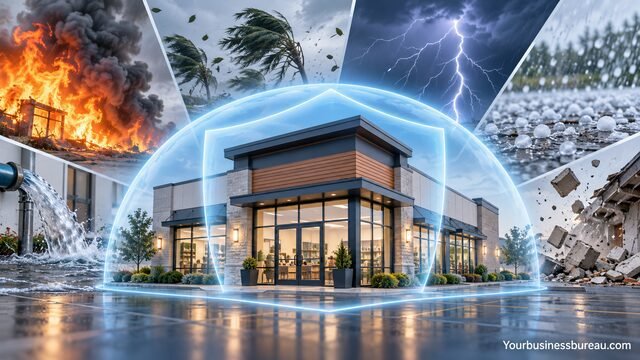
Commercial property insurance does not cover every event that could damage a business.
Coverage depends heavily on the causes-of-loss form used by the policy.
The NAIC describes three general approaches to business property coverage: basic, broad, and special forms. Basic and broad forms identify covered causes of loss, while special-form coverage generally covers direct physical loss unless the cause is specifically excluded or limited by the policy.
A policy may cover events such as:
| Cause of loss | Often covered by commercial property insurance? | Important consideration |
| Fire | Commonly | Subject to policy terms and limits |
| Lightning | Commonly | Check equipment and electrical damage provisions |
| Theft | Often | Limitations may apply to certain property |
| Vandalism | Often | Vacancy provisions can affect coverage |
| Wind or hail | Often | Deductibles or regional restrictions may apply |
| Explosion | Commonly | Subject to the causes-of-loss form |
| Flood | Usually not under standard commercial property coverage | Separate flood insurance may be required |
| Earthquake | Typically requires separate coverage or endorsement | Availability varies by insurer and location |
| Equipment breakdown | May require separate coverage | Particularly relevant for machinery-intensive businesses |
The distinction between covered and excluded events matters because two physically similar losses can produce very different insurance results.
For example, water entering through a damaged roof after a covered windstorm may be treated differently from water rising from a river and entering the same building.
What Business Property Insurance Usually Does Not Cover
Every policy has exclusions, so businesses should review the actual contract rather than relying on a general list.
Some exposures commonly requiring separate insurance, endorsements, or specialized policies include:
Flooding
Standard commercial property coverage generally does not cover flood damage.
Businesses that face flood exposure can consider private flood insurance or coverage through the National Flood Insurance Program where available and appropriate.
For eligible commercial properties, the NFIP currently offers up to $500,000 of building coverage and $500,000 of contents coverage, purchased separately.
NFIP commercial flood coverage also does not replace business interruption insurance. FEMA states that NFIP commercial coverage does not cover financial losses caused by business interruption or loss of use.
Earthquakes and Earth Movement
Earthquake and certain earth-movement losses are frequently excluded from standard commercial property policies. Businesses in exposed areas may need earthquake insurance or an endorsement.
Terms differ substantially by insurer and location.
Commercial Vehicles
Cars, vans, and trucks normally fall under commercial auto insurance rather than ordinary business property coverage.
Employee Injuries
Property insurance protects property. It does not replace workers’ compensation insurance for employee injuries.
Customer Injuries and Liability Claims
If a customer slips inside a store and files a bodily injury claim, that is generally a liability issue rather than a property claim.
General liability insurance is designed for exposures such as third-party bodily injury and property damage.
Professional Mistakes
A consultant, architect, accountant, technology provider, or other professional may face losses arising from alleged errors in its services. Those exposures typically require professional liability or errors and omissions coverage rather than property insurance.
Replacement Cost vs. Actual Cash Value
One of the most consequential decisions in business property insurance is how damaged property will be valued.
Two common approaches are replacement cost value and actual cash value.
Replacement Cost
Replacement cost coverage generally pays the cost of replacing or repairing covered property with property of similar kind and quality, subject to policy terms, without subtracting depreciation.
Suppose equipment originally cost $40,000 and equivalent new equipment would now cost $48,000.
If the equipment is destroyed in a covered loss, replacement cost coverage may use the cost of obtaining comparable replacement equipment as the basis for settlement, subject to the applicable policy provisions, deductible, and limit.
Actual Cash Value
Actual cash value generally reflects depreciation.
Using a simplified hypothetical example, assume:
- New replacement equipment costs $48,000.
- The insurer determines applicable depreciation of $15,000.
- The resulting actual cash value is $33,000 before considering the deductible and other policy provisions.
The difference can materially affect how much money the business must contribute after a loss.
The NAIC recognizes both actual cash value and replacement cost approaches for business property insurance and advises businesses to understand how their policies value damaged property.
How Much Business Property Insurance Do You Need?
The appropriate limit is not simply the original purchase price of the company’s property.
A better approach is to estimate what it could cost to repair or replace the insured assets after a major loss.
A business should inventory:
- Buildings it owns.
- Furniture and fixtures.
- Machinery and equipment.
- Computers and electronics.
- Inventory.
- Raw materials and supplies.
- Tenant improvements.
- Specialty property.
- Property temporarily kept away from the primary location.
- Property of others for which the business may have responsibility.
Consider inflation and changes in construction costs when insuring a building. A building purchased years ago for $700,000 could potentially require substantially more than $700,000 to rebuild, depending on construction costs, design, local requirements, and other factors.
The NAIC recommends assessing business property before buying insurance and periodically afterward. It also recommends keeping receipts, photographs, and records of valuable property to support future claims.
Example of Estimating a Contents Limit
Consider a hypothetical retail business with:
| Property | Estimated replacement value |
| Inventory | $180,000 |
| Shelving and displays | $35,000 |
| Computers and POS equipment | $20,000 |
| Office furniture | $15,000 |
| Security equipment | $10,000 |
| Other equipment and supplies | $15,000 |
| Estimated total | $275,000 |
A $150,000 contents limit could leave a substantial gap if most of the property were destroyed in a covered event.
The calculation should also account for seasonal fluctuations. A retailer carrying $180,000 of inventory for most of the year might temporarily hold $300,000 before its busiest sales season.
Business Property Insurance vs. Business Interruption Insurance
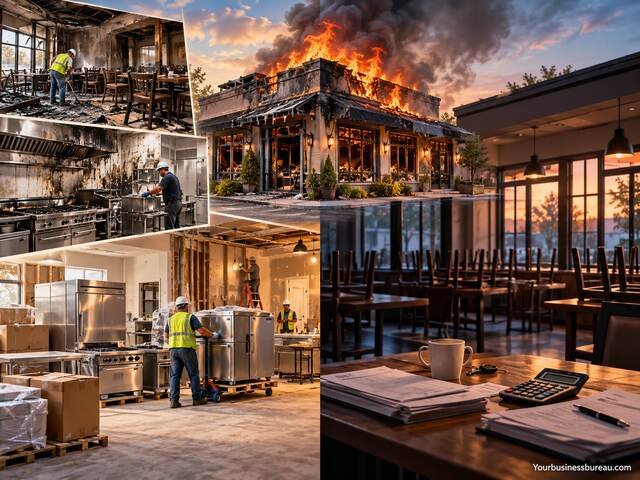
These coverages address different consequences of the same event.
Imagine that a covered fire damages a restaurant.
Commercial property insurance may help pay to repair the building and replace damaged equipment. But the restaurant may also be unable to serve customers for several months.
That lost operating income is a different exposure.
Business interruption insurance, also called business income insurance, can provide coverage for lost income and certain continuing expenses when operations are suspended because of covered physical property damage, subject to the policy’s conditions and waiting periods.
| Coverage | Primary purpose |
| Business property insurance | Repairs or replaces covered physical property |
| Business interruption insurance | Addresses qualifying income loss and continuing expenses during a covered shutdown |
| General liability insurance | Addresses certain third-party injury and property damage claims |
| Commercial flood insurance | Covers qualifying direct physical flood damage |
| Commercial auto insurance | Covers business vehicle exposures |
A business with valuable physical assets but no business income protection could repair its building after a covered fire while still struggling with rent, payroll, debt obligations, and lost revenue during the shutdown.
For this reason, property and business interruption coverage are often evaluated together.
What Is a Business Owner’s Policy?
A Business Owner’s Policy, or BOP, packages multiple types of business insurance into one policy.
A typical BOP includes:
- Commercial property insurance
- General liability insurance
- Business interruption or business income coverage
The NAIC identifies a BOP as a package frequently used by small businesses and notes that buying packaged protection can sometimes cost less than purchasing individual policies separately.
A BOP may work well for businesses that fit an insurer’s eligibility criteria and have relatively straightforward exposures.
More complex companies may instead require a commercial package policy or separate specialized policies.
How Much Does Business Property Insurance Cost?
There is no universal business property insurance price.
Premiums depend on the insurer, property, location, limits, deductible, business activities, loss history, construction characteristics, and the hazards being insured.
Important rating factors can include:
Property Value
A company with $50,000 of office equipment presents a different property exposure from a manufacturer with millions of dollars in machinery and inventory.
Higher insured values generally create greater potential claim severity.
Location
Geographic risks can affect pricing and availability.
Examples include exposure to:
- Hurricanes
- Wildfires
- Tornadoes
- Hail
- Severe wind
- Crime
- Flooding
Some catastrophe exposures may also produce separate deductibles or require standalone coverage.
Building Construction
Construction type, building age, roof characteristics, electrical systems, fire protection, and other physical features can affect risk.
Business Operations
A professional services office generally has different property hazards from a commercial kitchen, woodworking facility, warehouse, or chemical operation.
Fire Protection
Access to fire services, sprinkler systems, alarms, extinguishers, and other loss-control measures can affect how an insurer views a property.
Deductible
The deductible is the portion of a covered loss the policyholder generally must absorb before the insurer’s payment.
Higher deductibles can sometimes reduce premiums, but the business should be able to comfortably fund the deductible after a loss.
Claims History
Prior property claims can affect underwriting and pricing, although the impact varies by insurer and circumstances.
Because of these variables, a business should compare quotes using equivalent limits, deductibles, valuation methods, causes-of-loss forms, and endorsements. Comparing premiums alone can produce a misleading result.
Does a Home-Based Business Need Property Insurance?
Potentially.
Business equipment operated from a home should not automatically be assumed to have the same protection as ordinary household property.
The NAIC notes that personal policies can impose relatively low limits on business property and may not provide the same business liability or business interruption protection as commercial insurance.
A home-based photographer with cameras, lighting, computers, and editing equipment may therefore have a very different insurance need from someone occasionally using a personal laptop for freelance work.
Possible solutions include a business endorsement, in-home business policy, BOP, or other commercial coverage, depending on the insurer and business.
Does a Tenant Need Business Property Insurance?
Usually, a commercial tenant should separately evaluate the property it owns and its contractual obligations under the lease.
The landlord’s building policy should not be treated as a substitute for the tenant’s coverage.
A tenant may need protection for:
- Inventory
- Machinery
- Furniture
- Computers
- Fixtures
- Improvements and betterments
- Signs
- Business income
- Property of customers
- Other assets used in the business
The lease itself also matters. It can allocate responsibility for glass, HVAC equipment, improvements, property damage, liability insurance, deductibles, and restoration obligations.
Businesses should review both the lease and insurance policy so that obligations under one are not inadvertently excluded by the other.
How to Choose Business Property Insurance
The most useful comparison is not simply “Which quote costs less?”
Compare what each policy actually protects.
1. Create a Property Inventory
List major business assets and estimate their current replacement values.
Record:
- Description
- Manufacturer
- Model
- Serial number
- Purchase date
- Original cost
- Current estimated replacement cost
- Location
Photographs and video can supplement written records.
Store copies somewhere that would remain accessible if the insured premises were destroyed. NAIC and FEMA guidance both emphasize maintaining property documentation and records that can support a future claim.
2. Identify Your Largest Loss Scenarios
Consider what could happen after:
- A building fire
- Severe wind
- Theft
- Water damage
- Equipment failure
- Flooding
- Earthquake
- A long shutdown
Then determine which scenarios the proposed policy covers and which require another form of insurance.
3. Check the Valuation Method
Determine whether the quote uses:
- Replacement cost
- Actual cash value
- Another valuation method for particular property
The cheapest policy may be less useful if its valuation provisions leave the business unable to replace critical assets.
4. Check Limits and Sublimits
A large overall property limit does not necessarily mean every type of property receives that entire amount.
Policies may contain separate restrictions for particular property or circumstances.
Review limits applicable to valuable papers, property off premises, outdoor property, property in transit, electronic data, signs, valuable items, or other relevant assets.
5. Understand the Deductible
Consider both ordinary deductibles and any catastrophe-specific deductibles that might apply.
The business should be financially capable of absorbing the deductible immediately following a loss.
6. Review Major Exclusions
At minimum, ask how the policy treats:
- Flood
- Earthquake
- Sewer or drain backup
- Equipment breakdown
- Utility interruption
- Cyber events
- Ordinance or law costs
- Vacancy
- Wear and tear
An exclusion does not automatically mean insurance is unavailable. Some risks can be addressed through endorsements or separate policies.
7. Evaluate Business Income Coverage
Estimate how long the company could survive if its premises became unusable.
Property replacement is only one part of recovery. A long interruption can threaten payroll, loan payments, rent, and other continuing expenses.
Common Business Property Insurance Mistakes
Insuring Property Based on Original Purchase Price
Old purchase prices may not represent present replacement costs.
Construction costs, equipment prices, labor, transportation, and regulatory requirements can change substantially.
Forgetting New Equipment or Inventory
A business may gradually add computers, machinery, furnishings, and inventory without updating its insurance.
An annual insurance review can help keep limits aligned with operations. The NAIC specifically recommends reviewing coverage when inventory, products, employees, buildings, or other business characteristics change.
Assuming Flood Is Included
Flooding is a major gap to investigate separately. FEMA states that most business insurance does not cover flood damage.
Ignoring Business Interruption
Replacing damaged equipment does not reimburse every financial consequence of being unable to operate.
A company should separately determine whether business income coverage is needed and how long the anticipated restoration period could be.
Choosing Coverage Solely by Premium
Two policies with similar names can contain different limits, deductibles, exclusions, causes-of-loss provisions, and endorsements.
The meaningful comparison is the protection obtained for the premium, not the premium alone.
FAQ’s
There is generally no single nationwide U.S. rule requiring every business to carry commercial property insurance. Requirements can instead arise from state or local rules, lenders, landlords, contracts, or other circumstances. A mortgage lender or commercial lease, for example, may require particular property coverage. Requirements should be verified for the business’s jurisdiction and contracts.
Theft may be covered depending on the policy and causes-of-loss form, but exclusions and limitations can apply to particular property and circumstances. Review the policy rather than assuming every theft qualifies.
Commercial property policies can cover business inventory and stock. The business should make sure the applicable limit reflects peak inventory levels, not merely average stock throughout the year.
Business equipment such as machinery, computers, furniture, and other operating assets can fall within commercial property coverage. Mechanical or electrical breakdown, however, may require equipment breakdown coverage depending on the cause of damage and policy terms.
Property coverage primarily addresses covered physical property loss. Lost income during a qualifying shutdown is generally addressed through business interruption or business income coverage. Such protection is often included in a BOP or added to commercial property coverage.
Business property insurance protects the company’s insured physical property against covered loss or damage. General liability insurance addresses certain claims alleging bodily injury, property damage, and other covered third-party liabilities. A business may need both because they protect against fundamentally different risks.
Protect the Property the Business Depends On
Business property insurance can protect the buildings, equipment, inventory, furniture, and other physical assets a company relies on to operate, but the quality of that protection depends on the details.
Start by documenting the assets the company would need to replace after a major loss. Then compare replacement-cost provisions, policy limits, deductibles, causes of loss, exclusions, and relevant endorsements. Businesses should separately evaluate flood, earthquake, equipment breakdown, and business interruption exposures rather than assuming a standard property policy covers every loss.
Insurance contracts and requirements vary by insurer, state, property, and business. Before purchasing coverage, review the actual policy forms and endorsements and discuss material exposures with a licensed insurance professional familiar with the business and its jurisdiction.
