

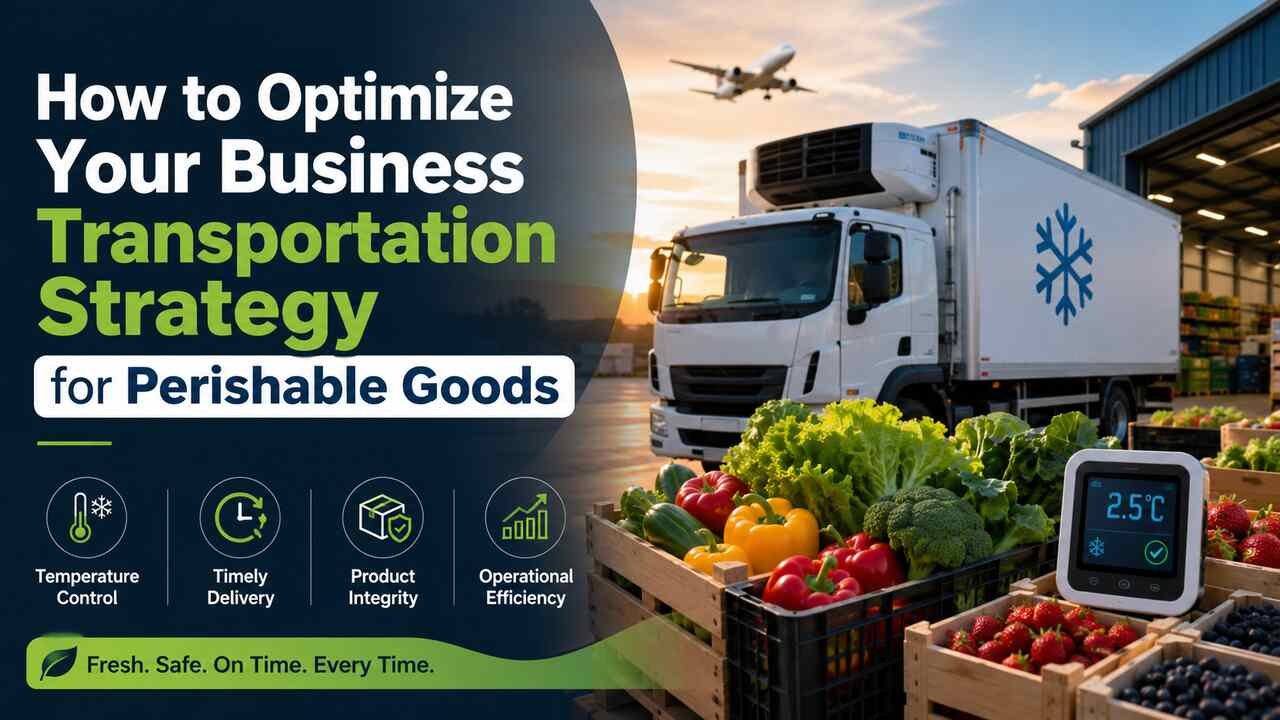
For companies that deal with perishable goods, it’s important to remember that the product’s production process doesn’t end once it leaves the manufacturing site. Every hour that the product is in transit is an opportunity for the cold chain to either uphold your brand or compromise it without you even realizing it. The issue of transportation can not be viewed from a logistics perspective only, as it has a direct impact on the quality of your product.
Why Temperature Control Is A Business Strategy, Not Just A Checklist Item
Many companies view refrigerated transport simply as a way to meet regulations. Just keep it cold, document the temperature, and move the product. However, effective temperature management can be a strategic advantage that manifests in product shelf life, retail acceptance, and returned products.
Reefer units must reach the target temperature before loading. If they are turned on when they leave the yard, your product must absorb the energy it takes to cool down. That can lead to spoilage while your product sits in a trailer that feels cool enough. Onboard telematics allow real-time alerting to tell you how cold your product actually got while en route.
Preventing degradation in your product supply chain is more critical today than ever before. Low margins are a fact of life in consumables, and returns will quickly eat up what little profit you do make. Knowing very quickly that a load is hopelessly spoiled is the first step in the right direction. But if you are using a delay system for monitoring there’s a good chance that by the time you know your load is lost, it’s already well on its way to being returned to you.
Regulatory Compliance As A Floor, Not A Ceiling
The regulatory environment surrounding food transportation, specifically product movement from agricultural facilities to processing plants, poses an actual risk for companies. Liability is brought about by sanitation documentation, temperature logs, and chain of custody documentation. When something goes wrong, these are the things that protect you. When a retailer or governmental agency comes to perform an audit, these are the documents that get reviewed.
Compliance with food safety frameworks needs to be considered the bare minimum, not the objective. Organizations that optimize and build processes based only on the minimum standard are automatically exposed the minute a carrier takes a shortcut, or a system fails and there is no documentation to support the repair. The best protection is building internal standards that account for more than the minimum requirements. This gives you breathing room when things go wrong – and in the logistics of perishables, they always do.
Inventory Management That Accounts For Shelf Life
The default inventory management philosophy for most warehouse and transport operations is FIFO – First In, First Out. Unfortunately, for perishables, it’s often the wrong one. FEFO, First Expired First Out, simply means the product with the shortest remaining shelf life is the one that ships first, regardless of when it arrived. The difference between the two is admittedly subtle but it translates directly into customer reject rates and downstream food waste.
Around one-third of all food produced globally is lost or wasted, with a significant portion of that loss occurring during transportation and distribution (FAO). A portion of that loss is avoidable through the adoption of a better approach to inventory management at the logistics level. Companies that enforce the systematic use of FEFO will consistently see a measurable improvement in the shelf life their products carry at the retail level.
Route Planning And Dwell Time – The Overlooked Spoilage Driver
Time spent at loading docks is among the main reasons for temperature deviations during the commercial transportation of goods. Unfortunately, it is seldom considered in the route-planning process. A truck that loses two hours waiting for loading may not just be losing time; the product it is transporting may also be losing quality.
Predictive software for traffic conditions and loading-dock availability can help lower dock time. More important, however, is that companies see this metric as an indicator of product quality rather than just a logistics KPI. When procurement, logistics, and sales share the same report on dock times, the discussion on carrier selection and customer delivery times becomes a different one.
Cross-docking can also reduce time-related risks since products are moved directly from an incoming to an outgoing transport. There is no or only minimal storage in between, meaning there is less time for temperature to affect quality.
Multi-Modal Transport And The Cost-Speed Equation
Rail combined with road transport is underused in perishable logistics, particularly for longer routes. Rail is slower but significantly more cost-efficient and, in many cases, more temperature-stable over long hauls than truck-only solutions. The tradeoff isn’t always worth it – high-value or extremely short-shelf-life product usually isn’t a candidate – but for commodities like frozen goods or hardier agricultural products, a hybrid approach can reduce cost while maintaining quality standards.
Thermal packaging plays a supporting role here. In mixed-load environments or last-mile delivery where dedicated reefer units aren’t practical, insulated liners and phase-change materials can maintain internal temperatures across handoffs. Last-mile is where temperature control is hardest and monitoring is spottiest, which makes that final leg disproportionately high-risk relative to its length. The companies that win in perishable logistics don’t treat transportation as a cost to minimize. They treat it as part of the product itself – something worth engineering with the same rigor as formulation, packaging, or shelf presentation. That’s the shift that separates brands with consistent retail performance from ones constantly managing spoilage claims.
Read Also: How to Conduct a Successful Internal Audit of Your Information Security Systems
