


Home insurance with business use may cover certain work-from-home activities, but standard policies often exclude business equipment, stock, and liability risks. Whether you work remotely, run a small business, or welcome clients into your home, you should inform your insurer and check whether additional coverage is needed to protect both your property and business.
Does Home Insurance Cover Business Use?
Standard home insurance may cover some types of home-based work, particularly low-risk office activities, but business use is not automatically included in every policy.
Home insurance generally consists of two main types of protection: buildings insurance and contents insurance. Buildings insurance covers insured damage to the property’s structure, while contents insurance protects eligible belongings against specified risks, such as theft, fire, or water damage.
However, insurers may distinguish between ordinary residential use and activities carried out for commercial purposes.
For example, an employee who occasionally works from home using a company laptop may be covered under an existing policy, depending on its terms. A self-employed person who operates a business from the same property may need additional protection for equipment, stock, or business liability.
The key distinction is that insurance for the home itself is not the same as insurance for the business operating inside it.
How Different Business Activities Affect Home Insurance
| Type of home-based work | Typical insurance considerations | Possible additional cover |
| Remote employee working on a laptop | Often treated as low-risk home working, subject to policy terms | Employer-provided equipment cover |
| Freelance writer or graphic designer | Business equipment and professional mistakes may not be covered | Business equipment and professional indemnity |
| Online seller storing products | Stock may be excluded or subject to low limits | Business stock insurance |
| Home hairdresser or beauty therapist | Client visits, treatments, and specialist equipment create additional risks | Public liability and treatment liability |
| Home baker or caterer | Food preparation, equipment, product safety, and customer visits may affect cover | Product liability and business contents |
| Private tutor receiving students | Visitor injuries and business equipment may need separate protection | Public liability insurance |
| Tradesperson using a home office | Tools, stock, and business property may fall outside domestic cover | Tools and business equipment insurance |
These are general examples rather than guarantees of cover. Individual insurers apply different underwriting rules, exclusions, and conditions.
Do You Need to Tell Your Home Insurance Provider About Business Use?

You should tell your home insurance provider about business activities carried out at your property, particularly when starting a business or changing how the property is used.
Insurers assess risks based on information about the property, its occupants, and its use. Business activities can change the likelihood or potential cost of a claim, especially when customers visit, employees work on-site, or valuable stock is stored.
For instance, operating an online consultancy from a spare bedroom may present relatively little additional physical risk. Running a furniture restoration workshop with electrical machinery and flammable materials can introduce considerably greater risks.
Your insurer may respond by confirming that the activity is already acceptable, adding an endorsement to your policy, charging an additional premium, or recommending specialist insurance.
What Happens If You Do Not Declare Business Use?
Failing to disclose relevant business activities can create problems when making an insurance claim.
Depending on the jurisdiction, policy wording, questions asked by the insurer, and circumstances of the nondisclosure, possible consequences include a reduced claim payment, an excluded loss, revised policy terms, or policy cancellation or avoidance.
Not every undisclosed home-working activity automatically invalidates an entire policy. The legal consequences depend on the applicable insurance rules and whether the information was material to the insurer’s decision.
In the UK, for example, the Consumer Insurance (Disclosure and Representations) Act 2012 sets out rules concerning misrepresentations by consumers. The Insurance Act 2015 contains separate provisions relevant to non-consumer insurance contracts.
The practical approach is to obtain written confirmation from your insurer that your specific business activities are acceptable under your policy.
What Types of Insurance Cover a Home-Based Business?
Home-based businesses may need a combination of residential property insurance and commercial insurance. The appropriate combination depends on the value of business property, the services provided, and potential liability to customers or other third parties.
1. Buildings Insurance
Buildings insurance protects the physical structure of a property against insured events. Depending on the policy, this may include damage caused by fire, storms, flooding, or escape of water.
If part of your home is converted into a workshop, salon, or commercial kitchen, your insurer may need to reassess the property’s use and risk.
Business-related alterations can also affect the rebuilding cost. Specialist fittings, additional electrical installations, and structural changes may require updated insurance arrangements.
2. Contents and Business Equipment Insurance
Ordinary contents insurance may cover household belongings but restrict protection for items used primarily for business.
Business equipment insurance can provide additional protection for eligible commercial property, including computers, printers, cameras, specialist tools, furniture, and machinery.
Consider a freelance photographer who stores £8,000 worth of cameras, lenses, and lighting equipment at home. If their domestic policy covers only a small amount of business equipment, a theft could result in a substantial uninsured loss.
Equipment used away from the property may also need portable equipment cover, sometimes called all-risks cover, subject to exclusions and geographical limits.
3. Public Liability Insurance
Public liability insurance protects a business against certain third-party claims involving injury or property damage arising from its activities.
For example, suppose a customer visits a home-based tailoring business, trips over an unsecured cable, and suffers an injury. If the business is legally liable, an appropriate public liability policy may cover eligible compensation and legal defence costs.
Standard household liability insurance may exclude incidents connected with commercial activities.
Businesses that receive customers, delivery personnel, or other business visitors should pay particular attention to this distinction.
4. Professional Indemnity Insurance
Professional indemnity insurance is relevant to businesses that provide professional advice, designs, consultancy, or other services where mistakes could cause clients financial losses.
An accountant working from home might face a claim arising from an alleged professional error. A graphic designer could face a dispute involving the delivery of professional services.
Professional indemnity insurance addresses specified professional liability risks rather than physical damage to the home.
5. Product Liability Insurance
Product liability insurance can protect businesses against covered claims involving injuries or property damage caused by products they manufacture, supply, or sell.
It may be particularly relevant to home bakers, cosmetics sellers, craft manufacturers, and online retailers.
For example, a home-based food business could face a liability claim if a product allegedly causes an allergic reaction because of an error in its preparation or labelling. Whether the claim is covered depends on the policy wording and circumstances.
6. Employers’ Liability Insurance
If your business employs people, employers’ liability insurance may be legally required.
In Great Britain, most businesses with employees must obtain employers’ liability insurance from an authorised insurer, subject to exemptions. The standard statutory minimum is £5 million, although insurers commonly offer higher limits.
The requirement depends on employment arrangements and applicable law. Hiring a worker does not necessarily mean the same rules apply in every country or situation.
7. Business Interruption Insurance
Business interruption insurance can compensate for certain financial losses when an insured event prevents normal business operations.
For example, if a fire damages a home-based printing workshop, an appropriate policy may cover lost gross profit or additional operating expenses during an insured interruption.
However, cover normally depends on a qualifying insured event and the policy’s definitions, indemnity period, waiting period, and exclusions.
Simply being unable to work from home does not automatically trigger a business interruption claim.
Home Insurance With Business Use vs Separate Business Insurance
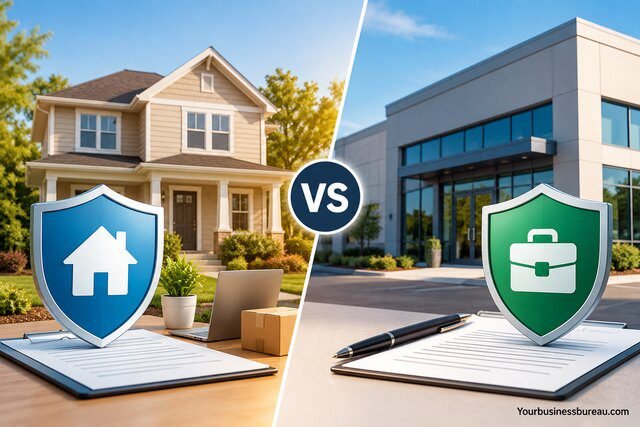
Home insurance with an approved business-use extension and standalone business insurance serve different purposes.
A home insurance extension may be suitable for relatively low-risk activities. Separate business insurance becomes more relevant when commercial operations introduce significant equipment, stock, customer, or liability exposures.
| Feature | Home insurance with business-use extension | Separate business insurance |
| Main purpose | Protect residential property with permitted business activities | Protect commercial operations and associated risks |
| Buildings protection | Usually available under the residential policy | May be available under specialist commercial property arrangements |
| Business equipment | May have restricted limits | Can provide dedicated limits |
| Business stock | May be limited or excluded | Available under suitable policies |
| Customer injuries | Not necessarily included | Public liability can be arranged |
| Professional mistakes | Generally not covered | Professional indemnity can be arranged |
| Business interruption | Usually requires separate specialist cover | May be offered as an optional section |
| Best suited to | Low-risk home working | Businesses with more substantial commercial exposures |
These options are not mutually exclusive. Many home-based business owners maintain ordinary home insurance for their residence and separate commercial insurance for business activities.
The main objective is to avoid uninsured gaps and unnecessary overlap.
How Much Does Home Insurance With Business Use Cost?
The cost of home insurance with business use depends on the property, the nature of the business, the level of cover, and the insurer’s assessment of risk.
There is no reliable universal premium because a home-based administrative business presents different risks from a workshop or food production operation.
Some insurers accept basic clerical work without an additional premium. Others charge for business-use endorsements or require a specialist policy. MoneyHelper advises self-employed people to discuss their home-based activities with their insurer rather than assume domestic insurance provides adequate protection.
Factors That Influence Insurance Premiums
Insurers may consider the type of business, annual turnover, number of employees, customer visits, value of stock and equipment, previous claims, property location, security arrangements, and selected policy limits.
A business that stores expensive equipment or handles potentially hazardous materials may require a more detailed assessment.
The excess also affects the amount you pay following an insured claim. A higher voluntary excess can sometimes reduce the premium, but it increases the amount you must contribute if a claim occurs.
Example: Calculating Business Equipment Cover
Suppose a home-based design business owns the following equipment.
| Business property | Illustrative replacement value |
| Computer and monitor | £2,000 |
| Drawing tablet | £600 |
| Printer and scanner | £500 |
| Office furniture | £900 |
| Cameras and accessories | £1,500 |
| Total | £5,500 |
If the existing home contents policy provides only £2,000 of applicable business equipment cover, the business may have a potential £3,500 shortfall before considering the excess and other conditions.
This does not mean every claim would pay exactly £2,000. Policy limits, valuation methods, exclusions, and underinsurance provisions can affect settlement.
The example shows why calculating replacement values is more useful than choosing an arbitrary insurance limit.
How to Get Home Insurance for Business Use
Getting suitable cover starts with explaining exactly how your property is used. You can then compare the available options against the risks that your existing policy does not cover.
Step 1: Identify Your Business Activities
Describe the business accurately, including whether you work exclusively online, manufacture products, store stock, or receive customers.
Insurers may also ask which rooms are used for business and whether the activity involves specialist equipment, hazardous materials, or alterations to the property.
Step 2: Review Your Existing Home Insurance
Check the policy schedule, wording, endorsements, and exclusions.
Pay particular attention to definitions of business use, business equipment limits, commercial stock exclusions, liability restrictions, and conditions involving customer visits.
Do not assume that a policy covering home working also covers operating a business.
Step 3: Contact Your Insurer
Explain your business activities and ask whether the existing policy remains suitable.
Useful questions include whether the activity is permitted, whether additional premiums apply, what business property is covered, and whether customer visits change the terms.
Request confirmation in writing and retain any revised policy documentation.
Step 4: Compare Specialist Insurance Options
If your insurer cannot provide sufficient protection, compare policies designed for home-based businesses.
Check the scope of cover rather than comparing premiums alone. Two policies with similar prices may offer very different protection for stock, equipment, legal liability, and interruption losses.
Step 5: Check for Gaps and Overlapping Cover
Review which insurer covers each category of property or liability.
For example, employer-owned computer equipment may already be insured under an employer’s policy. Separately insuring it without checking ownership and existing arrangements could create unnecessary complexity.
Likewise, a business package may already include public liability insurance, making a duplicate standalone policy unnecessary.
Step 6: Update Cover When Your Business Changes
Review your insurance when you purchase expensive equipment, employ staff, start receiving customers, increase stock, or introduce new services.
A business that begins as occasional freelance work may eventually require substantially different insurance.
When Does Working From Home Become Business Use?
Working from home and operating a business from home are related but not identical activities.
An employee carrying out ordinary office duties remotely may not create the same insurance risks as a business owner using the property for commercial operations.
The distinction becomes particularly relevant when business activity changes how the premises are occupied, increases the number of visitors, or introduces equipment and materials not normally associated with residential use.
Clerical Work and Remote Employment
Clerical work generally includes administrative tasks such as computer work, telephone calls, bookkeeping, and document preparation.
Some insurers accept these activities under standard home insurance, provided the property remains primarily residential.
However, the definition of permitted clerical work varies. An insurer may treat self-employed administrative work differently from employment-based remote work.
Running a Business With Customers Visiting
Customer visits can introduce liability risks that ordinary home working does not create.
A private tutor, therapist, beauty professional, or music teacher may need public liability cover even if the business occupies only one room.
Insurers may also ask about the frequency of visits, the number of people attending, and the nature of the services provided.
Using a Garage, Shed, or Outbuilding for Business
Operating a business from a garage, garden office, shed, or other outbuilding requires particular attention to property definitions.
An ordinary home insurance policy may cover domestic outbuildings but restrict or exclude business equipment stored inside them.
The business activity itself can also affect eligibility. A garden office used for administrative work presents different risks from a garage containing commercial machinery.
Check whether the structure, its contents, and the business activity are all covered.
Does Business Use Affect Buildings Insurance or a Mortgage?
Business use can affect more than the insurance policy. It may also have implications for mortgage conditions, tenancy agreements, planning rules, and property-related permissions.
In the UK, whether planning permission is needed depends on the nature and intensity of the business activity and whether it causes a material change in the use of the property.
Activities involving regular customer traffic, significant deliveries, noise, or physical alterations may require additional consideration.
If You Own Your Home With a Mortgage
Check your mortgage terms before making significant changes to the property’s use.
Some lenders restrict particular commercial activities or require consent where the business changes the character or use of the property.
A small home office may be treated differently from converting a substantial part of the property into commercial premises.
If You Rent Your Home
Tenants should check their tenancy agreement and obtain any necessary landlord permission.
The landlord’s buildings insurance does not normally replace the tenant’s responsibility for personal belongings or business equipment.
A tenant running a business may therefore need suitable contents insurance and separate commercial liability or equipment protection.
If You Operate From a Leasehold Property
Leasehold properties may be subject to additional restrictions in the lease or building management rules.
These restrictions can apply even when an insurer is willing to cover the business.
Insurance approval does not automatically establish permission to operate a particular business from the property.
Common Home Insurance Exclusions for Business Use
Understanding exclusions is just as important as knowing what a policy covers.
A policy may accept home working while still excluding certain business-related losses.
Common restrictions can involve commercial stock, specialist equipment, professional liability, product liability, employee injuries, and business-related visitors.
Some policies also restrict cover for property taken away from the home or kept in detached outbuildings.
Three Situations That Can Create Unexpected Coverage Gaps
Scenario 1: A stolen laptop belongs to your employer. Your personal contents insurance may not cover employer-owned equipment. The employer’s business insurance may be responsible, depending on its terms.
Scenario 2: A customer is injured at your home. The home insurer may cover certain domestic liability claims but exclude injuries connected with business activities. Public liability insurance may be needed.
Scenario 3: Fire damages products stored for sale. Your buildings policy may cover insured structural damage, but the products themselves could be excluded as commercial stock.
The important lesson is that different losses arising from the same incident can fall under different insurance policies.
How to Choose the Right Cover for Your Home Business
The most suitable insurance arrangement is one that matches your actual exposures without duplicating protection.
A practical way to assess your requirements is to consider three questions: What property could be damaged or stolen? Who could make a claim against the business? What would happen financially if the business could not operate?
These questions help distinguish property insurance, liability insurance, and interruption cover.
For a freelance writer working alone, equipment protection and professional indemnity may be the main considerations. For a home-based beauty business, public liability, treatment-related liability, and specialist equipment cover may be more relevant.
For an online retailer, the value of stock and the possibility of product-related claims may drive the insurance decision.
Before purchasing a policy, compare the exclusions, excesses, limits, territorial scope, claims conditions, and the insurer’s description of permitted business activities.
A cheap policy that excludes your principal business risk may offer less value than a more expensive policy with appropriate protection.
Conclusion
Home insurance with business use can provide suitable protection for people who work from home, but the level of cover depends on the business activity and the insurer’s policy terms.
Low-risk office work may be acceptable under an ordinary home insurance policy. Businesses involving customer visits, commercial stock, specialist equipment, or professional services may need additional or separate insurance.
The safest practical approach is to disclose your activities accurately, obtain written confirmation of permitted business use, and compare the protection offered by home insurance extensions and specialist business policies. Review the arrangement whenever your business changes.
FAQ’s
Yes, some home insurance policies allow certain low-risk business activities, particularly clerical work. However, permission and cover depend on the insurer’s terms. You should confirm that your specific business activities are accepted and arrange additional cover where necessary.
Some home contents policies provide limited protection for business equipment, but limits and exclusions vary. Employer-owned equipment, specialist machinery, stock, and portable equipment may require separate arrangements.
Not necessarily. If you perform ordinary remote office duties, your employer may provide insurance for company equipment and employment-related liabilities. However, you should check your home policy and your employer’s arrangements rather than assume everything is covered.
Yes, some insurers accommodate businesses with customer visits, but they may apply additional conditions or require specialist insurance. Public liability protection is particularly relevant where visitors could suffer injury or property damage connected with business activities.
It can be, but not always. Some insurers accept basic clerical work without additional charges. Businesses involving stock, machinery, customers, or higher-risk activities may face additional premiums or require separate commercial policies.
It may, depending on the policy’s definition of outbuildings, the permitted business activities, and the equipment kept inside. Check the structure and contents separately, including theft limits and security conditions.
