


Business solar panels can lower electricity costs and provide greater long-term control over energy expenses. However, whether solar is financially worthwhile depends on factors such as electricity rates, daytime energy use, available installation space, sunlight, financing, incentives, and system design.
How Business Solar Panels Reduce Electricity Costs
Commercial solar photovoltaic (PV) panels convert sunlight into electricity that can be used by equipment, lighting, HVAC systems, refrigeration, machinery, computers, and other electrical loads.
When solar production and business electricity consumption occur at the same time, the building can consume the solar electricity directly. Every kilowatt-hour used on-site is a kilowatt-hour that generally does not need to be purchased from the utility at that moment.
The economics become more complicated when the solar array produces more electricity than the facility needs. Depending on the location and utility rules, excess generation might be exported to the grid for a credit, compensated at a different rate, curtailed, or stored in batteries for later use.
That makes the company’s load profile particularly important. A warehouse, office, supermarket, factory, hotel, or retail store that consumes substantial electricity during sunny daytime hours can have a very different solar business case from a facility whose largest loads occur at night.
What Does a Commercial Solar System Include?
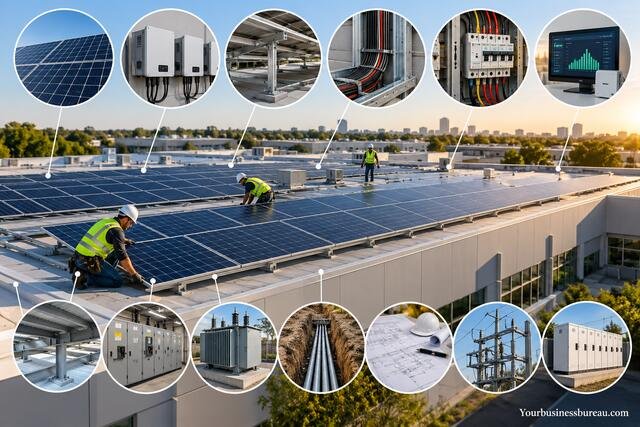
The solar modules are only one component of a business solar installation. A complete system typically includes PV modules, inverters, mounting or racking equipment, electrical wiring and protection equipment, monitoring equipment, and interconnection hardware.
Depending on the project, additional work can include roof reinforcement, switchgear upgrades, transformers, trenching, engineering studies, permitting, utility interconnection work, security measures, or battery storage.
This distinction matters when comparing quotes. A low panel price does not necessarily mean a low installed project price.
Commercial projects can also use several physical configurations.
| Installation type | Often suitable for | Important consideration |
| Rooftop solar | Offices, factories, warehouses, retail buildings | Roof condition, usable area and structural capacity |
| Ground-mounted solar | Businesses with unused land | Land requirements and site preparation |
| Solar carports | Offices, hospitals, campuses and shopping centers | Higher structural complexity but productive use of parking areas |
| Solar plus battery storage | Facilities seeking greater control over when solar energy is used | Higher upfront cost and more complex financial modeling |
A company should therefore evaluate the entire energy system rather than selecting panels based primarily on module wattage or price.
How Much Do Business Solar Panels Cost?
There is no reliable universal price for business solar panels because commercial projects vary considerably in size, engineering requirements, labor costs, electrical infrastructure, roof conditions, permitting, financing, and location.
Historical U.S. National Renewable Energy Laboratory (NREL) benchmarking illustrates this variation. Its 2023 Annual Technology Baseline cited modeled commercial PV system prices of about $1.69 per watt DC for 2021 and $1.84 per watt DC for 2022, while also noting that commercial installations are highly heterogeneous and actual reported prices vary for several reasons. These figures are useful as historical benchmarks, not quotes for a project being purchased today.
A simplified project calculation is:
Estimated project cost = system capacity in watts × installed cost per watt
For example, a hypothetical 250 kW system contains 250,000 watts of capacity. At an illustrative installed price of $1.80 per watt:
250,000 × $1.80 = $450,000
That example should not be treated as a current market quotation. A business should obtain site-specific proposals because even two 250 kW projects can have substantially different costs.
Factors That Change Commercial Solar Installation Costs
System size is only the starting point. Larger installations may achieve economies of scale, but site-specific work can offset those savings.
A commercial proposal should account for:
- Solar panel and inverter specifications
- Roof or ground-mount requirements
- Structural engineering
- Electrical upgrades
- Labor
- Design and engineering
- Permits and inspections
- Utility interconnection
- Monitoring equipment
- Financing costs
- Operations and maintenance
- Battery storage, if included
When comparing proposals, businesses should ask contractors to define exactly which expenses are included rather than comparing headline cost-per-watt figures alone.
How to Determine the Right Solar System Size for a Business
The best system is not automatically the largest array that fits on the roof.
Sizing should start with the company’s electricity consumption. Ideally, the installer or energy consultant should review at least 12 months of utility bills and, where available, interval consumption data showing when electricity is used throughout each day.
The analysis should examine annual electricity use, peak demand, daytime consumption, seasonal variations, utility tariffs, available installation area, shading, building orientation, and future changes in consumption.
Suppose a facility consumes 500,000 kWh annually. Installing enough solar capacity to theoretically generate 500,000 kWh does not automatically mean the company eliminates its electricity bill. Production changes throughout the day and year, while consumption follows a separate pattern.
Solar resources also have a substantial effect. NREL notes that commercial PV capacity factor is affected by factors including solar resource, shading, module technology, downtime, inverter losses, system design, and degradation.
A professional solar model should therefore estimate hourly or sub-hourly production against the facility’s consumption pattern rather than relying exclusively on annual totals.
How Much Money Can a Business Save With Solar Panels?
Solar savings depend on both how much electricity the system produces and what that electricity is worth.
Consider a simplified hypothetical example. Assume a commercial solar system generates 180,000 kWh during its first year and 150,000 kWh is consumed directly by the business. If that electricity would otherwise cost $0.16 per kWh, the gross avoided electricity purchase associated with those 150,000 kWh would be:
150,000 kWh × $0.16 = $24,000
The remaining 30,000 kWh requires separate treatment. Its financial value depends on the utility’s rules for exported electricity.
Real savings calculations can also involve demand charges, time-of-use pricing, tariff changes, degradation, maintenance expenses, financing costs, taxes, incentives, and future electricity-price assumptions.
For this reason, a proposal promising a percentage reduction in the electricity bill is less useful than one showing exactly how the estimate was calculated.
Calculate Solar Payback and Return More Carefully
Simple payback provides a useful first screening metric:
Simple payback = net initial investment ÷ annual net savings
Imagine a business has a net solar investment of $300,000 after applicable incentives and expects $45,000 in first-year electricity savings, while budgeting $5,000 for annual operating costs.
First-year net savings would be approximately:
$45,000 – $5,000 = $40,000
A simplified payback calculation would therefore be:
$300,000 ÷ $40,000 = 7.5 years
The calculation is useful but incomplete. It ignores financing costs, future utility prices, system degradation, tax consequences, equipment replacements, changes in consumption, and the time value of money.
For significant commercial investments, companies should also examine net present value (NPV), internal rate of return (IRR), cash flow by year, levelized cost of electricity, and sensitivity to important assumptions.
A particularly useful stress test is to calculate returns under conservative, expected, and optimistic scenarios rather than relying on a single forecast.
Solar Panel Lifespan and Degradation Matter to the Business Case
Commercial solar should be evaluated as a long-term asset rather than a short-term equipment purchase.
NREL describes PV modules as equipment expected to continue generating electricity for decades. Its research notes that modules gradually lose output over time and cites degradation commonly around 0.5% to 1% annually, although actual performance varies by technology, product, environment, and system.
NREL’s commercial PV modeling similarly accounts for degradation over a 30-year plant lifetime.
This means financial forecasts should not assume that a system will produce exactly the same number of kilowatt-hours every year.
Businesses should examine the manufacturer’s product warranty and performance warranty separately. They should also understand who handles warranty claims if a module, inverter, mounting component, or monitoring system fails.
Maintenance Should Be Included in the Financial Model
Solar systems have relatively few moving parts, but they are not maintenance-free.
The U.S. Department of Energy recommends regular operations and maintenance to support PV performance and reduce problems associated with factors such as soiling, micro-cracking and corrosion. It also points to research showing that better O&M practices can recover otherwise lost production.
Maintenance planning can include performance monitoring, inspections, electrical checks, vegetation management for ground-mounted systems, cleaning when economically justified, troubleshooting, and component replacement.
The appropriate schedule depends heavily on the installation environment. A dusty industrial site may require a different cleaning strategy from a relatively clean location with frequent rainfall.
Businesses should also determine whether monitoring is actively managed. A dashboard that records production provides little value if nobody responds when output unexpectedly falls.
Should a Business Add Battery Storage?
Solar panels and batteries solve related but different problems.
Solar produces electricity when sunlight is available. A battery stores electricity so it can be used later. Combining the two can make sense when the timing of electricity consumption, demand charges, utility tariffs, backup requirements, or export restrictions create additional value for stored energy.
Battery storage does not automatically improve the economics of every solar project. It adds equipment, controls, installation costs, degradation considerations, and eventual replacement requirements.
Businesses should identify the specific financial or operational problem a battery is intended to solve before purchasing one.
For example, a company whose solar production closely follows its daytime electricity demand may already consume most generation on-site. Another facility facing expensive peak-demand periods might potentially gain more from shifting stored energy into those periods.
The value must be modeled against the applicable tariff.
Buying, Financing, Leasing, and Power Purchase Agreements
Businesses do not necessarily have to pay the entire solar installation cost upfront.
The available ownership and financing structures vary by country and market, but common approaches include direct purchase, financed ownership, leases, and power purchase agreements (PPAs).
| Approach | Basic structure | Key issue to evaluate |
| Cash purchase | Business owns the system outright | High initial capital requirement |
| Loan or equipment financing | Business owns the system while repaying financing | Interest and repayment terms |
| Solar lease | Third party typically owns the equipment | Contract length and total payments |
| PPA | Business purchases generated electricity under a contract | Electricity price, escalation terms and contract conditions |
Ownership can provide the business with direct access to more of the project’s economic benefits where tax and incentive rules permit. Third-party arrangements can reduce upfront capital requirements but introduce long-term contractual obligations.
Companies should compare the total lifetime cost, not merely the initial monthly payment.
Check Incentives Before Calculating the Final Return
Solar incentives vary substantially by country, state, province, municipality, utility, project type, ownership structure, and installation date.
They can include tax credits, accelerated depreciation, grants, rebates, renewable-energy certificates, favorable financing, or compensation for exported electricity. Eligibility rules can change, sometimes significantly, while a project is being planned.
Businesses should therefore verify incentives using current government, tax authority, regulator, and utility information before approving an investment.
This is especially important for financial articles about solar because old incentive information can materially change an estimated return. Tax treatment should also be confirmed with a qualified tax professional rather than assumed from a solar sales proposal.
Evaluate the Roof Before Installing Commercial Solar
For rooftop installations, the roof itself can be as important as the panels.
A structural assessment should determine whether the building can safely support the proposed system and whether roof penetrations, wind loading, drainage, fire access, equipment placement, and local building requirements affect the design.
Roof age also deserves attention. Installing a long-lived solar array on a roof likely to require replacement soon can create avoidable costs because panels may need to be removed and reinstalled.
Companies should coordinate the expected roof life with the solar project before construction.
Leased buildings create another complication. The property owner, tenant, lender, insurer, and solar-system owner may have different rights and responsibilities. Lease duration should be considered against the solar contract and expected investment recovery period.
Compare Solar Proposals Using Production, Not Just Panel Wattage
Two proposals offering the same system capacity can produce different amounts of usable electricity.
Module efficiency, orientation, tilt, shading, inverter configuration, temperature, equipment losses, downtime, and system design all influence production. NREL identifies several of these variables as factors affecting commercial PV performance.
Businesses should therefore request estimated first-year energy production in kWh alongside installed capacity in kW.
A strong proposal should also explain the assumptions behind the production model.
Ask what weather dataset was used, what system losses were assumed, whether shading was modeled, what annual degradation rate was used, and whether the production estimate comes with any contractual guarantee.
Questions to Ask a Commercial Solar Installer
The quality of the contractor and financial model can matter as much as the panels themselves. Before signing an agreement, a business should ask:
- How was the recommended system size calculated?
- How much electricity is the system expected to generate in year one?
- What percentage of production is expected to be consumed on-site?
- What happens financially to exported electricity?
- Which utility-rate assumptions were used?
- What degradation rate is included in the forecast?
- What equipment and workmanship warranties apply?
- Who monitors the system after installation?
- What maintenance costs are assumed?
- Does the quote include permitting and utility interconnection?
- Are structural or electrical upgrades included?
- What happens if actual production is below the estimate?
- Who is responsible for removing and reinstalling panels if the roof needs work?
- Which incentives have been assumed, and who has verified eligibility?
- What financing, escalation, termination, or transfer conditions apply?
Getting the assumptions in writing makes competing proposals considerably easier to compare.
When Business Solar Panels May Not Be the Right Investment
Solar can have attractive economics, but some buildings are poor candidates.
A project deserves additional scrutiny when the roof is heavily shaded, the structure needs expensive reinforcement, the roof will soon require replacement, available installation space is limited, the business expects to relocate, or most electricity consumption occurs when solar production has little financial value.
Cheap grid electricity or unfavorable compensation for exported power can also extend the payback period.
Businesses with limited capital should additionally compare solar with other energy-efficiency investments. Improving insulation, replacing inefficient lighting, optimizing HVAC controls, repairing compressed-air leaks, or upgrading inefficient equipment may sometimes deliver attractive savings with less capital.
Reducing unnecessary consumption before sizing solar can also prevent a business from purchasing more generating capacity than it ultimately needs.
A Better Framework for Deciding Whether Business Solar Is Worth It
Instead of asking only for the cheapest solar quote, evaluate a project through four questions.
First, determine technical suitability. Confirm solar resource, usable area, shading, roof condition, structural capacity, and electrical infrastructure.
Second, establish energy fit. Compare expected solar production with when the facility actually consumes electricity.
Third, establish financial value. Model installation cost, avoided electricity purchases, export compensation, incentives, financing, maintenance, degradation, taxes, and equipment replacement.
Finally, assess risk. Stress-test electricity-price assumptions, production forecasts, financing terms, warranty coverage, installer stability, and future changes to the facility.
A project that still produces an acceptable financial result under conservative assumptions is generally more defensible than one whose projected return depends on every assumption working perfectly.
Conclusion
Business solar panels can turn a predictable operating expense into a long-term energy investment, but system economics depend on much more than the cost of the panels. Electricity consumption patterns, utility rates, solar production, installation conditions, financing, incentives, degradation, and maintenance all influence the result.
Before investing, establish the facility’s electricity profile, determine how much solar generation can be consumed on-site, obtain site-specific designs, and compare proposals using consistent financial assumptions. Most importantly, test the numbers under conservative as well as expected conditions. A commercial solar project should make financial sense because its underlying energy and cash-flow assumptions are sound, not simply because the proposal advertises a short payback period.
If you want to explore how we help businesses grow from the ground up, you can visit yourbusinessbureau.com to see what we offer.
FAQ’s
It depends on electricity consumption, available installation space, local solar resource, panel output, shading, and the desired percentage of electricity to be supplied by solar. Twelve months of electricity data provides a better starting point than building size alone.
Solar modules are designed for long-term operation. NREL discusses PV systems over multi-decade lifetimes and notes that modules gradually lose output rather than suddenly reaching zero production after a fixed number of years.
Not necessarily. A business may continue purchasing electricity when solar production is insufficient, particularly at night. Fixed utility charges, demand charges, taxes, and other tariff components may also remain.
Technically, some facilities can obtain a very high share of their energy from solar, but operating independently from the grid generally requires considerably more planning. Storage, backup generation, load management, system oversizing, and seasonal production variations may need to be addressed.
PV systems generally require ongoing monitoring and preventive maintenance rather than constant intervention. Actual costs depend on system size, environment, equipment, cleaning requirements, security, vegetation management, and component failures. DOE recommends planning and budgeting for regular maintenance to maintain effective operation.
Collect at least 12 months of electricity bills, interval usage data if available, building or roof information, expected future changes in electricity consumption, ownership or lease details, and information about planned roof or electrical work. Giving installers the same information also makes competing proposals easier to compare.
