

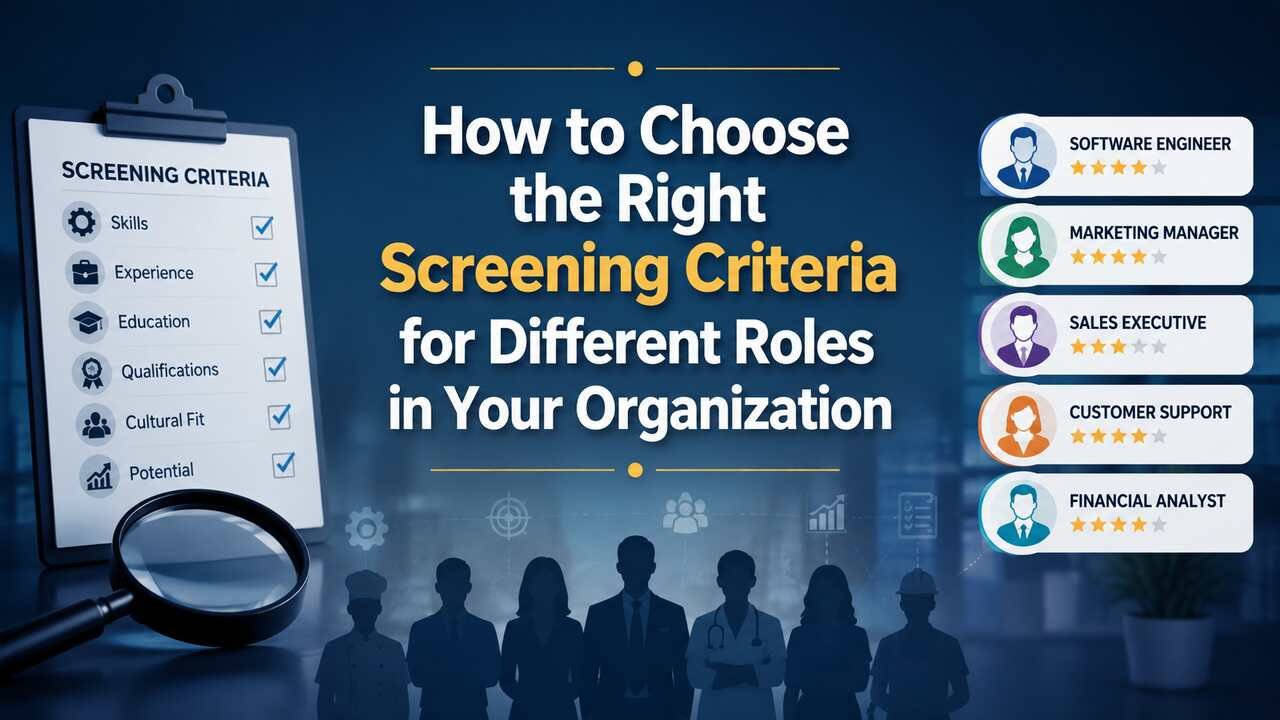
Most hiring teams use the same screening checklist for every open role, then wonder why quality of hire is inconsistent. A structured interview that works well for a sales leader tells you almost nothing about whether a backend engineer can write maintainable code. The fix isn’t a better checklist. It’s matching your screening criteria to what the role actually requires, then backing that choice with evidence instead of habit.
Start With A Job Analysis, Not The Old Job Description
It’s been said that every screening decision should trace back to a job analysis – a clear breakdown of what the role produces and which competencies drive that output. However, most organizations skip this step and simply reuse last year’s job posting, updated with a new title and a slightly longer list of “nice-to-haves.”
That is entirely backward from how it should be. A job analysis begins by asking what the person in this seat needs to be able to do well, then researches which competencies that list can be narrowed down to – to five or seven, that separate strong performers from weak ones. Then everything downstream – your resume filters, your assessments, your interview questions – should map back to that short list. If a screening criterion doesn’t connect to one of those competencies, it’s noise. It slows down your hiring process and gives you no real signal on candidate quality.
This matters, because the business hiring process breaks down in a predictable place: teams add filters because they sound reasonable, not because they predict performance. A degree requirement, a personality test, a vague “culture fit” interview question – these get added by default, not by design.
Calibrate Rigor To The Stakes Of The Role
Not all jobs are the same. Are you hiring for an executive-level finance role or looking for a warehouse worker? The risk and potential loss if the candidate is a bad hire are very different. Time is the most precious thing for both recruiters and candidates. So how long should, and how deep can, your screening process be?
Candidates should earn their way through the hiring process. The most valuable job candidates view themselves as the buyer of a job opportunity, where their most important asset and product is their skillset.
Just like the hiring company sizes up a candidate, your screening process should require candidates to “size you up” by offering increasingly more information as they progress. Remember, a job candidate always wants to “sell” you on their optimal-matched skills that perfectly map to a job description.
Experts argue that the length and depth of candidate screening should roughly match the details of the job, especially if the hiring process spec’d out previous job incumbents. For example, a detailed job description with a long list of responsibilities and requirements should demand a lengthy interview process with the same level of depth and detail.
Build A Funnel Where Every Stage Adds New Signal
A solid hiring pipeline is not redundant. Each phase should evaluate something different from the previous one. If the details you cover in a structured interview overlap with those in a resume, that’s a waste of time for everyone, including the applicant.
Here’s the kind of pipeline that works: resume review for minimum criteria, automated assessment for specific skills related to the role, structured interview for cognitive and communication skills, work sample for job-related skills, and background check along with reference check as the closing stage. Each element should filter candidates based on specific criteria. Running candidates through a partner like Direct Screening at the verification stage keeps that final gate standardized across every role. This matrix helps you keep an eye on fairness as well as the time-to-hire, by throwing every new step at least one new focus.
The candidate should feel catered to during every stage of this pipeline as well. Extended or irrelevant tasks can decrease offer-acceptance likelihood and slowly harm your employer branding. Every part of the hiring process must be proportionate to the role and must feel like part of a selection process, not an obstacle course.
Map Screening Methods To Role Archetypes
Most screening criteria fail not because the screening techniques are botched but because they’re applied to the wrong job. The accumulating knowledge on this is pretty old. Work-sample tests (r=.54) and structured interviews (r=.51) perform the best in Schmidt and Hunter’s classic meta-analysis of personnel selection research as predictors of job performance. General mental ability is a close third at .51. The gap between these and the unstructured interview (.38) reflects a fact that has stayed true for about a half-century: methods resembling the actual job predict the actual job better than a conversation does.
Technical and analytical roles. Work-sample tests and cognitive ability assessments have the highest predictive validity. A coding challenge, a writing sample, a case study that emulates actual work – these will almost always outperform resume-based filters like years of experience or degree pedigree. Real work sample tests, too, are often implicit in our hiring: If you’re hiring a data analyst and they work with actual data during the interview, that’s a work sample test. If you’re evaluating an engineer and you give them a real problem to solve, that is a work sample test. Too often, we just make it an implicit rather than explicit part of the interview process.
Leadership positions. You can use in-depth structured interviews with fixed scoring rubric and situational judgment tests for the heavy screening. Leadership is all about making decisions when you don’t have all the necessary information, and situational judgment tests are the best tools to assess that capacity. Forget about those open-ended conversations about their management style. Describe five real situations that come up a lot in the role and evaluate their responses using the same criteria.
Sales and customer services. Situational judgment tests work with role-play exercises to replicate a real sales or service scenario. Strong candidates must face and solve all sorts of clients’ requests and demands as quickly as possible while remaining cordial and adaptive. That’s exactly what these sort of assessments accomplish.
Entry-level jobs. Here one has to winnow. Sure, cognitive ability tests are still pretty accurate, but if candidates have to go through a multi-stage day-spanning process before jumping through hoops, you’ll handicap yourself. Be cautious, run a short assessment, a short interview and check the references.
Compliance-related tasks. Healthcare, banking, transportation – anything regulated. You need to draft, over and above the standard criteria, a series of vetting processes before you issue an employment letter. License checks, background checks, sometimes drug screening, all before an offer goes out.
Know The Difference Between A Requirement And A Filter That Just Feels Safe
Educational requirements are automatic filters for whatever is outside the gates, but that doesn’t mean they’re valid. Decades of research on the validity of employee selection criteria have shown degree requirements and specific experience to be some of the least defensible filters. A bias for credentials is pervasive, but it systematically screens out great candidates. Skills-based hiring has gained ground precisely because so many of these filters shrink the applicant pool without adding real signal. If you can’t point to performance data connecting a filter to job outcomes, treat it as a nice-to-have, not a must-have.
This distinction also protects you legally. Criteria like broad personality assessments, vague culture-fit judgments, and unnecessary educational requirements have a documented tendency to create adverse impact, screening out qualified candidates from protected groups without evidence the criteria predict performance. The EEOC’s Uniform Guidelines on Employee Selection Procedures require that selection methods be validated and applied consistently. That’s not just a legal box to check. It’s a reason to build your competency framework around what the job requires, not around traits that are easy to assess but hard to justify.
Align Recruiters And Hiring Managers Before The Job Goes Live
A lot of screening problems come down to one thing: the recruiter and the hiring manager are looking for different people.
It happens more than you’d think. The recruiter starts screening based on their own read of the role, the hiring manager starts interviewing based on theirs, and nobody ever actually sat down and agreed on what “good” looks like. By the time anyone notices, you’ve already burned through a dozen candidates.
The fix is simple, if a bit tedious: before the req goes out, get both sides to agree on five to seven core competencies. Write them down. Get sign-off. Skip this step and you’ll feel it later – interviews that wander, feedback that contradicts itself, and a final hiring decision that’s really just a gut call wearing a scorecard.
Consolidate Verification So Criteria Stay Consistent
The final phase of most screening funnels – background checks, education verification, drug screening – is also what can get most inconsistent across managers and departments. One manager runs a full background check, another skips it, a third only checks references informally. That’s the exposure and risk of non-compliance and unequal treatment right there, for candidates to similar roles.
Having these run through a neutral, dedicated partner keeps verification the same on every role and every manager, so the rules you’ve defined operate in real life, not just on paper. The more people you have involved in hiring the more that consistency will pay off as you grow and hire more folks.
Revisit Your Criteria At Least Once A Year
Assessing filters is not a set-it-and-forget-it exercise. Roles change, the talent market changes, and what predicted success two years ago may no longer work today. Take quality-of-hire data, new-hire turnover, and manager feedback at least annually and assess whether your filters are still effective at filtering. If a competency you were screening for hasn’t emerged in performance evaluations or turnover exit interviews, it’s a good sign it’s not impacting success one way or the other and you should consider dropping it. Organizations that get this right treat filters as a dynamic component of the recruiting process, not as a form they created once and ignored after that. That’s the difference between a recruiting process that truly hinders the wrong people from getting in the door and one that creates a lot of unnecessary interviews.
