

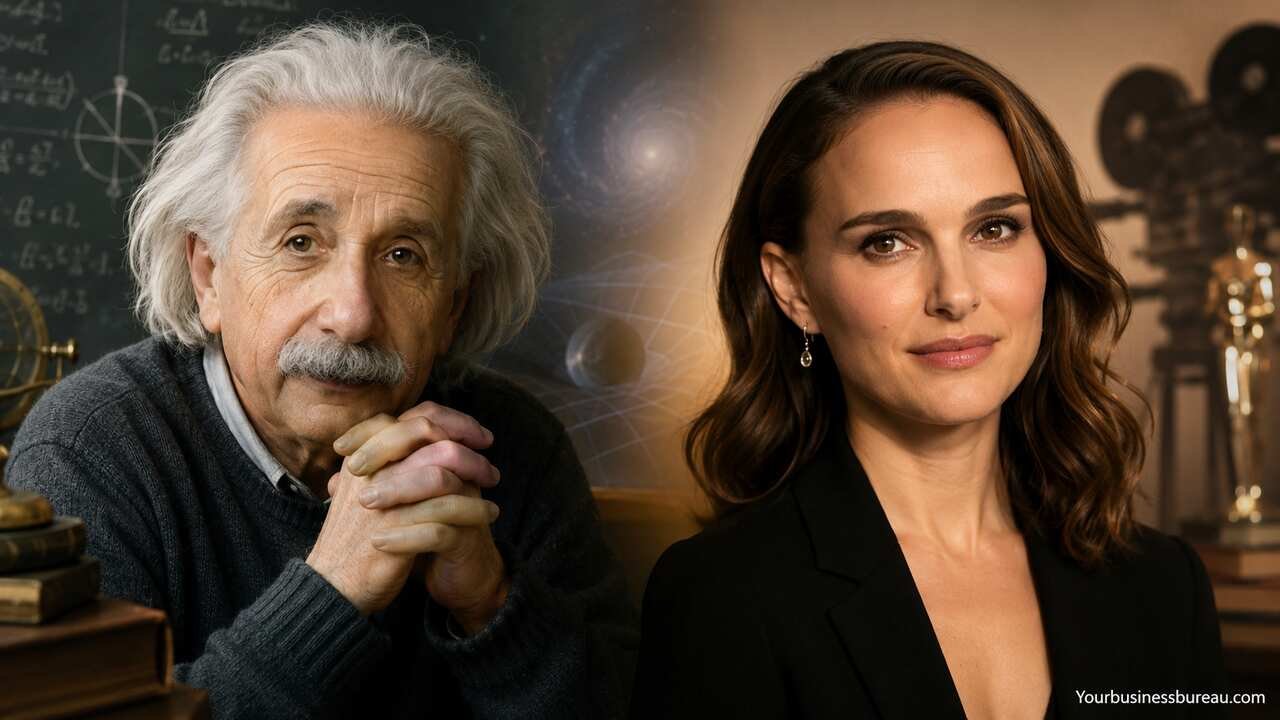
Albert Einstein and Natalie Portman never had a personal connection, but they are often compared because of their intelligence, education, creativity, Jewish heritage, and public influence. Einstein transformed modern physics, while Portman combined a successful acting career with academic achievement, making their lives an interesting comparison of excellence in different fields.
Establish the Factual Connection Between Albert Einstein and Natalie Portman
Begin by separating a genuine historical relationship from a thematic comparison. Albert Einstein and Natalie Portman never met, collaborated, corresponded, or participated in the same intellectual movement. Einstein lived from 1879 to 1955, while Portman was born in Jerusalem in 1981. Any article or discussion linking them should therefore avoid implying a direct personal connection.
The strongest basis for comparison lies in their public association with intelligence and achievement. Einstein became the international symbol of scientific genius through his work in theoretical physics. Portman became known not only for acting but also for completing a psychology degree at Harvard University and contributing to academic research while maintaining a demanding film career. These accomplishments have encouraged media outlets and audiences to place her among performers with serious academic credentials.
The comparison must still preserve differences in scale, discipline, and historical impact. Einstein developed theories that altered foundational scientific understanding. Portman studied established scientific fields and applied intellectual discipline to acting, directing, production, and advocacy. Calling both “smart” may begin the discussion, but it does not make their contributions equivalent. A reliable comparison recognises distinction before exploring common ground.
| Comparison area | Albert Einstein | Natalie Portman |
| Primary profession | Theoretical physicist | Actor, director, and producer |
| Academic focus | Physics and mathematics | Psychology, neuroscience-related research, and languages |
| Signature achievement | Relativity, mass-energy equivalence, and the photoelectric effect | Academy Award-winning acting career and sustained work across film production and directing |
| Educational setting | Swiss Federal Polytechnic and independent scientific work | Harvard University |
| Public image | Scientific genius and moral commentator | Artist associated with academic achievement and social advocacy |
| Direct relationship | None documented | None documented |
Trace Albert Einstein’s Educational and Scientific Development
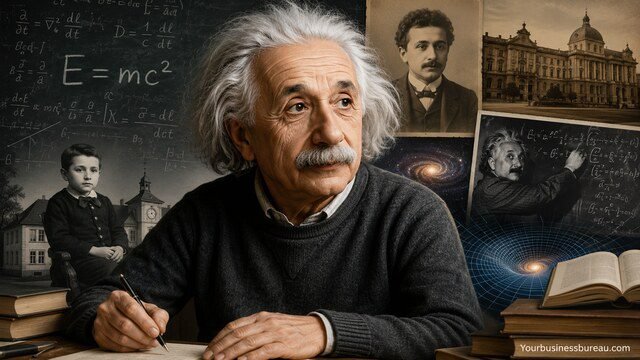
Follow Einstein’s development through formal education, independent thought, professional constraint, and scientific publication. Born in Ulm in the German Empire in 1879, he later studied in Switzerland and graduated from the Swiss Federal Polytechnic in Zurich. His path was not a simple progression from exceptional student to celebrated professor. Early academic employment proved difficult, and he eventually worked at the Swiss Patent Office in Bern.
The patent-office period matters because it corrects a popular assumption that important thinking occurs only inside elite institutions. Einstein evaluated technical applications during working hours and pursued theoretical questions outside his official duties. In 1905, often described as his “annus mirabilis,” he published papers addressing the photoelectric effect, Brownian motion, special relativity, and mass-energy equivalence. These works challenged prevailing assumptions about light, atoms, motion, space, and time.
His career later moved into universities and research institutes, where he developed the general theory of relativity. That theory described gravity not merely as a conventional force but as an effect of curved spacetime. Einstein’s work changed physics because it connected mathematical structure with observable consequences. His intellectual development therefore included at least four essential components: mathematical preparation, independent reasoning, analysis of physical problems, and communication through scientific papers.
Einstein’s Nobel recognition also requires precise explanation. The 1921 Nobel Prize in Physics was awarded to him for his services to theoretical physics, especially his discovery of the law of the photoelectric effect. The award was not formally granted for relativity, even though relativity became his most famous contribution. The distinction shows how scientific reputation and prize recognition can emphasise different parts of the same career.
Examine Natalie Portman’s Education and Research Experience

Review Portman’s education as a serious part of her biography rather than as a decorative detail attached to celebrity. Portman began acting professionally as a child and received international attention through films including Léon: The Professional and the Star Wars prequel trilogy. She later attended Harvard University and earned a bachelor’s degree in psychology in 2003.
Her studies overlapped with an already demanding entertainment career. Instead of leaving education after early film success, she reduced some professional activity and pursued university work. Her coursework included psychology, neurobiology-related study, advanced Hebrew literature, and research activity. She also contributed as a co-author to a scientific paper involving near-infrared spectroscopy and object permanence.
Four parts of Portman’s academic experience deserve attention. First, psychology provided a formal framework for studying cognition, behaviour, memory, and emotion. Second, laboratory exposure introduced the methods of scientific measurement and collaborative research. Third, language study reflected her multilingual background and interest in cultural expression. Fourth, balancing university with film production required sustained planning, selective participation, and resilience under public scrutiny.
Her educational history does not make her a theoretical physicist, nor does it place her scientific work on the same level as Einstein’s discoveries. It does, however, challenge the stereotype that artistic success excludes academic seriousness. Portman’s career shows that performance and scholarship can coexist when each receives genuine effort rather than superficial branding.
Compare Their Approaches to Intelligence and Creativity
Compare Einstein and Portman by examining how each converted knowledge into original work. Einstein approached creativity through conceptual simplification. He asked whether established physical assumptions remained valid when examined from a different frame of reference. Thought experiments, mathematical reasoning, and attention to contradictions allowed him to develop new models of physical reality.
Portman approaches creativity through interpretation and embodiment. An actor receives a script, character, production environment, and directorial framework, then transforms those materials into a psychologically convincing performance. This process requires memory, emotional regulation, observation, physical control, collaboration, and responsiveness. Her psychology education may support this work, but artistic success also depends on craft developed through rehearsal and experience.
Their working methods share four broad features: concentrated preparation, comfort with complexity, willingness to revise, and the ability to connect abstract ideas with human understanding. Einstein translated mathematical relationships into explanations of observable phenomena. Portman translates written characters into visible behaviour and emotional experience. One works through theoretical representation; the other works through dramatic representation.
The difference is equally important. Scientific claims must survive measurement, replication, mathematical consistency, and critical review. Acting choices are evaluated through coherence, emotional effect, aesthetic judgement, and their relationship to a larger production. Creativity operates in both fields, but each field uses different standards to determine whether the work succeeds.
Distinguish Scientific Achievement From Academic Accomplishment
Keep Einstein’s scientific discoveries separate from Portman’s educational achievements. Einstein created original theories that restructured modern physics. Portman completed rigorous university study and participated in research while establishing a major artistic career. Both records are impressive, but they represent different forms of accomplishment.
Einstein’s work addressed fundamental questions about light, matter, energy, time, motion, and gravity. Special relativity changed the relationship between space and time for observers moving at constant speeds. Mass-energy equivalence connected matter with energy through the formula commonly written as E = mc². General relativity extended the analysis to acceleration and gravitation, while his photoelectric work helped establish the quantum nature of light.
Portman’s academic record demonstrates intellectual range and disciplined learning. Psychology required engagement with research design, cognition, behavioural evidence, statistics, and scientific literature. Her participation in published research indicates practical contact with experimental work rather than simple classroom attendance. Her later public career also drew on language ability, literary adaptation, direction, and production.
A fair comparison therefore uses four categories: discovery, study, application, and influence. Einstein ranks among history’s most consequential scientific discoverers. Portman represents high-level academic study combined with artistic application. Their influence overlaps in popular discussions about intelligence, but the substance behind that reputation differs.
Evaluate Their Major Professional Achievements
Assess Einstein’s professional legacy through his contributions to physics rather than through the simplified image of an eccentric genius. His 1905 publications addressed multiple unresolved scientific problems. Special relativity rejected the assumption that time and distance remain identical for all observers. His analysis of Brownian motion supported the physical reality of atoms, and his photoelectric explanation treated light as discrete energy packets.
General relativity deepened this transformation by connecting gravity with spacetime geometry. The theory predicted effects such as the bending of light around massive bodies and later became essential to cosmology, black-hole physics, and precision technologies. Einstein’s work influenced both theoretical research and practical systems, even when the practical consequences appeared decades after publication.
Assess Portman’s professional legacy through acting, production, and direction. She earned wide recognition through roles in independent films and major franchises, including Star Wars, V for Vendetta, Jackie, and Black Swan. Her performance in Black Swan brought her the Academy Award for Best Actress. She also moved behind the camera, directing and adapting A Tale of Love and Darkness.
Portman’s four major professional dimensions include child performance, adult dramatic acting, commercial franchise participation, and creative leadership. She has moved between mainstream entertainment and psychologically demanding independent cinema. That range has allowed her to maintain cultural visibility while pursuing projects centred on identity, ambition, power, memory, and moral conflict.
| Achievement category | Einstein’s contribution | Portman’s contribution |
| Foundational work | Reshaped modern physics | Built a sustained career across acting, directing, and producing |
| Recognised honour | 1921 Nobel Prize in Physics | Academy Award, BAFTA Award, and Golden Globe recognition |
| Intellectual method | Mathematics, theory, and physical evidence | Psychological interpretation, performance, and narrative construction |
| Wider influence | Science, technology, philosophy, and public policy | Cinema, representation, education, and public advocacy |
| Enduring symbol | Scientific genius | Artist-scholar balancing education and celebrity |
Analyse Their Jewish Backgrounds and Cultural Identities
Approach Jewish identity carefully because Einstein and Portman lived in different historical circumstances. Einstein was born into a secular Jewish family in Germany. His relationship with Jewish identity grew more pronounced as antisemitism intensified in Europe. He supported Jewish educational and cultural initiatives, maintained connections with Zionist organisations, and later became a prominent refugee from Nazi persecution.
Einstein left Germany after Adolf Hitler’s rise to power and eventually settled in the United States. His identity was shaped by European antisemitism, forced migration, the destruction of Jewish life during the Holocaust, and debates surrounding nationalism and the future of Jewish communities. These pressures gave his public statements a historical urgency that cannot be transferred directly to later celebrities.
Portman was born in Jerusalem to Jewish parents and moved to the United States as a young child. She grew up with Israeli and American influences, studied Hebrew, and has worked on material connected to Jewish and Israeli history. Her directorial project A Tale of Love and Darkness, adapted from Amos Oz’s autobiographical novel, reflects her engagement with Hebrew-language literature, family memory, and the formation of Israel.
Four points connect their cultural experiences without erasing differences: Jewish heritage, migration, multilingual or international identity, and public engagement with Israel. Einstein’s experience centred on European persecution and twentieth-century political upheaval. Portman’s experience reflects contemporary Israeli-American identity, cinema, education, and public debate. Their shared heritage creates a legitimate area of comparison, but each life requires its own historical frame.
Review Their Relationships With Public Fame
Study how fame affected the public interpretation of both figures. Einstein became famous beyond the scientific community after observations associated with the 1919 solar eclipse were widely presented as confirmation of general relativity. Newspapers turned a theoretical physicist into an international personality. His hairstyle, facial expressions, political opinions, and informal manner became nearly as recognisable as his equations.
This fame simplified Einstein into a universal symbol of intelligence. The symbol created educational value because it made science culturally visible, but it also produced myths. Popular stories sometimes exaggerate his academic difficulties, misattribute quotations to him, or treat solitary inspiration as the entire source of his work. In reality, he relied on education, existing scientific debates, mathematical collaboration, and extensive engagement with other researchers.
Portman encountered fame from childhood. Early visibility created opportunities but also exposed her to commercial expectations, criticism, and intrusive attention. Her decision to attend Harvard while continuing selective film work strengthened her reputation as an academically serious performer. That reputation sometimes produces its own simplification, reducing a complex career to the label of an “intelligent actress.”
Their experiences reveal four effects of fame: public access, symbolic branding, biographical distortion, and pressure to speak beyond one’s profession. Einstein was asked to comment on war, peace, civil rights, education, Zionism, and nuclear weapons. Portman has been invited to address gender, education, animal welfare, environmental responsibility, political questions, and filmmaking. Fame expanded their platforms while increasing the risk that audiences would treat every statement as equally authoritative.
Compare Their Use of Education Beyond the Classroom
Identify how both figures treated learning as an ongoing practice. Einstein did not stop developing after formal graduation. He read widely, discussed philosophy, played music, exchanged ideas with colleagues, and repeatedly revised his scientific positions. His education continued through problems rather than credentials alone.
Portman likewise carried academic habits into creative work. Psychology can support the analysis of motivation, perception, emotional conflict, and social behaviour, all of which matter to acting. Research experience can also strengthen attention to evidence, preparation, and uncertainty. In directing and producing, these habits support the organisation of complex projects involving writers, performers, designers, financiers, and technical teams.
Four transferable learning practices emerge from their careers: questioning assumptions, reading across disciplines, accepting revision, and connecting theory with performance or observation. Einstein tested whether accepted ideas remained logically consistent. Portman prepares characters by integrating text, historical information, movement, voice, and emotional intention. Both approaches depend on sustained inquiry rather than the passive possession of facts.
Their examples also show that formal education and professional expertise serve different purposes. A degree confirms completed study within an academic programme. Professional mastery requires years of applied work and evaluation. Einstein’s authority came from original scientific achievement. Portman’s artistic authority comes from performance and filmmaking, while her academic experience adds analytical depth without replacing professional craft.
Assess Their Public Advocacy and Ethical Positions
Examine advocacy as a separate dimension from scientific or artistic achievement. Einstein spoke publicly about pacifism, militarism, nuclear danger, racism, civil liberties, international government, and Jewish affairs. His political views developed across changing circumstances, particularly the First World War, the rise of Nazism, the Second World War, and the nuclear age.
His role in the history of atomic weapons is frequently oversimplified. Einstein did not work on the Manhattan Project, but he signed the 1939 letter associated with Leó Szilárd that warned President Franklin D. Roosevelt about the possibility of German nuclear research. He later expressed regret about the chain of events and became a prominent advocate for nuclear restraint.
Portman has used her platform for causes including women’s rights, animal welfare, environmental concerns, education, and representation in film. She has discussed veganism and supported projects involving girls’ educational opportunities. Her public interventions operate through speeches, production choices, philanthropy, interviews, and organisational participation.
Four questions should guide evaluation of celebrity advocacy: Does the person possess relevant expertise? Does the statement rely on credible evidence? Does the person support the cause consistently? Does public visibility contribute practical value? Einstein and Portman both used fame to address matters beyond their core professions, but their authority varies by issue. Public attention can amplify an argument; it cannot replace evidence.
Correct Common Myths About Albert Einstein and Natalie Portman
Correct the claim that Einstein failed mathematics. He showed strong mathematical ability from an early age, although he encountered difficulties with some institutional requirements and educational environments. The myth often survives because it offers a comforting story about a struggling student becoming a genius. That message may feel inspirational, but historical accuracy provides a better lesson: intellectual talent still requires discipline, preparation, and persistence.
Correct the claim that Einstein received the Nobel Prize for relativity. His Nobel citation specifically emphasised the photoelectric effect. Relativity contributed greatly to his fame, yet the Nobel Committee selected work that had clearer experimental grounding at the time.
Correct the claim that Portman is a neuroscientist. She earned a psychology degree, studied subjects related to neuroscience, and contributed to research. Those achievements are substantial, but they do not establish a professional career as a neuroscientist. Accurate language protects the value of her real accomplishments instead of inflating them.
Correct the claim that Albert Einstein and Natalie Portman share a family, academic, or professional connection. No credible evidence supports such a relationship. Their names are most productively linked through comparative themes: intellectual discipline, Jewish identity, education, public recognition, creativity, and advocacy.
Apply Their Lessons to Education and Career Planning
Use Einstein’s example to build a problem-centred approach to learning. Instead of memorising information without purpose, begin with a meaningful question. Identify the accepted explanation, locate its weaknesses, review relevant evidence, and test alternative models. This method turns education into active investigation.
Use Portman’s example to avoid false choices between academic and creative ambition. Her biography shows that a person can pursue formal education while developing an artistic profession, although doing both requires sacrifice and careful scheduling. The goal should not be maximum activity in every area. The goal should be deliberate commitment to a limited number of valuable priorities.
Apply four practical principles. Protect concentrated work time, select projects according to long-term value, build expertise through repeated practice, and remain willing to revise plans. Einstein continued theoretical work while employed outside academia. Portman adjusted her acting commitments while attending university. Neither path was effortless, and neither supports the fantasy that talent eliminates workload.
Students should also distinguish public reputation from actual competence. Einstein’s image represents genius, but his work depended on technical mastery. Portman’s academic reputation attracts attention, but her degree required ordinary academic responsibilities such as reading, research, assessment, and deadlines. Achievement becomes durable when identity is supported by repeated action.
Verify Quotations and Claims Before Sharing Them
Check every quotation attributed to Einstein because he is among the most frequently misquoted historical figures. Motivational websites, social posts, advertisements, and unattributed image graphics routinely place modern sayings under his name. A familiar photograph does not establish authenticity.
Begin verification with primary or institutional sources. Search published letters, speeches, essays, interviews, university archives, Nobel materials, or carefully edited collections. Then locate the earliest reliable appearance of the wording. A quotation that appears only on recent aggregation sites should be treated as unverified.
Apply the same standard to Portman. Celebrity quotations are often shortened, translated, paraphrased, or removed from interview context. Confirm the original publication, recording, speech, or transcript before presenting a sentence as her exact words. Distinguish a direct quotation from a journalist’s summary.
Reliable research requires four checks: authorship, date, original source, and surrounding passage. These checks prevent false claims from gaining authority through repetition. They are especially important when comparing Einstein and Portman because both names are used to market ideas about intelligence, education, gender, success, and creativity.
Build a Balanced Interpretation of Their Cultural Legacy
Recognise Einstein’s legacy as both scientific and symbolic. His theories remain part of modern physics, while his name functions as a synonym for extraordinary intelligence. This dual legacy creates an unusual situation in which a historical scientist becomes a cultural character independent of the technical content of his work.
Recognise Portman’s legacy as still developing. Her career includes acclaimed performances, franchise cinema, production, directing, academic achievement, and advocacy. Because she remains professionally active, any final judgement about her long-term influence must remain provisional. Current descriptions should avoid treating an ongoing career as a completed historical record.
Their cultural significance intersects through four ideas: the public performance of intelligence, the relationship between specialised knowledge and mass media, the influence of Jewish experience, and the responsibility attached to fame. Einstein brought scientific thought into global public culture. Portman demonstrates how a contemporary entertainer can combine artistic visibility with university education and issue-based engagement.
The comparison becomes valuable when it resists exaggeration. Einstein should not be reduced to a motivational mascot, and Portman should not be promoted as an “Einstein of Hollywood.” Each deserves evaluation through the standards of the relevant field. Their shared lesson is not that all achievements are interchangeable. It is that disciplined curiosity can shape work across radically different professions.
Conclusion
Albert Einstein and Natalie Portman have no direct personal or professional relationship, but comparing them produces a useful discussion about education, creativity, fame, Jewish identity, public advocacy, and intellectual discipline. Einstein revolutionised theoretical physics through work on relativity, the photoelectric effect, Brownian motion, and mass-energy equivalence. Portman combined a distinguished acting career with a Harvard psychology degree, research participation, directing, production, and civic engagement.
Their differences provide the comparison with its real value. Einstein created foundational scientific theories; Portman applies analytical and creative skills within cinema and public life. One became a twentieth-century symbol of scientific genius, while the other represents the modern artist who refuses to treat education and performance as incompatible.
The most accurate interpretation of Albert Einstein and Natalie Portman therefore avoids invented connections and exaggerated equivalence. Their stories demonstrate that curiosity requires work, education can continue beyond formal institutions, creativity takes multiple forms, and public influence carries a responsibility to communicate carefully.
FAQ’s
No. Einstein died in 1955, and Portman was born in 1981. There is no direct historical relationship between them.
No credible biographical or genealogical evidence indicates that Natalie Portman is related to Albert Einstein.
Portman earned a bachelor’s degree in psychology from Harvard University. She studied neurobiology-related subjects and participated in scientific research, but she did not build a professional career in physics.
No. The 1921 Nobel Prize in Physics recognised his services to theoretical physics, especially his discovery of the law of the photoelectric effect.
Portman was a co-author of research involving near-infrared spectroscopy and object permanence during her academic period. This work forms part of her educational record rather than a continuing career as a research scientist.
Their strongest connection is thematic. Both became public figures associated with intelligence, education, Jewish identity, creativity, and advocacy, although their professional contributions belong to very different fields.
