

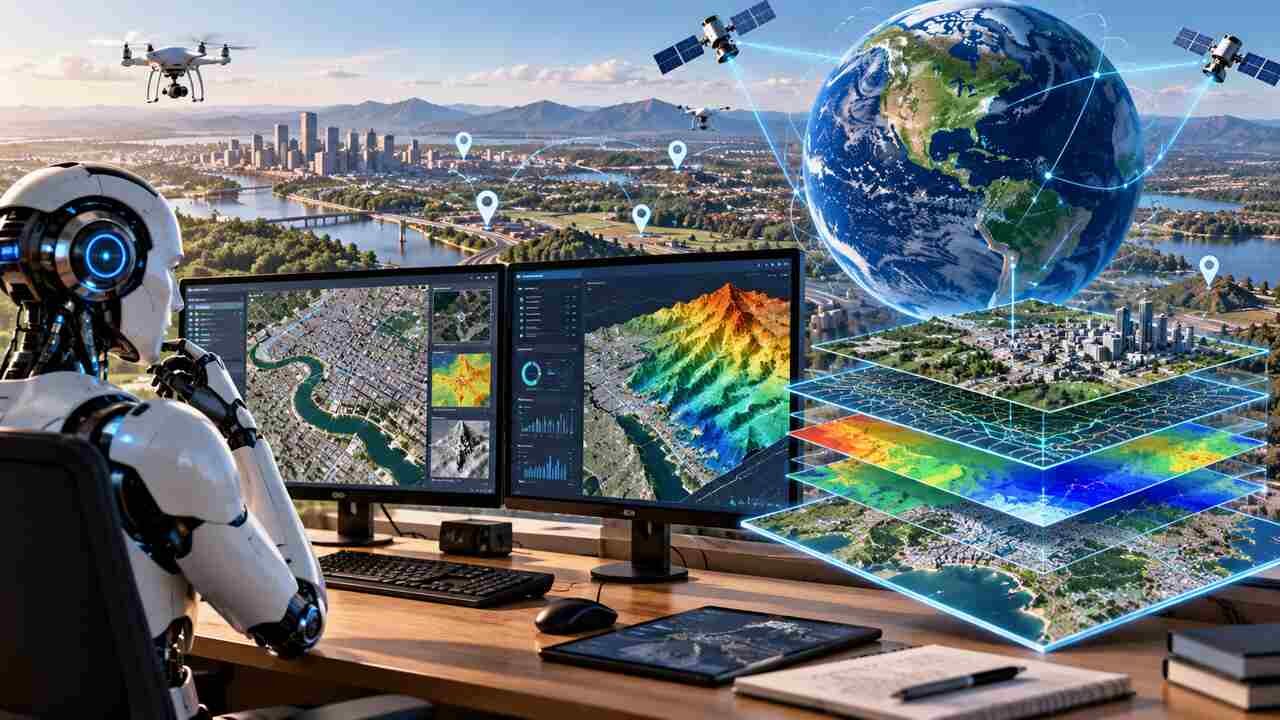
Geospatial data has enormous practical value, but getting from a question to useful information can traditionally involve multiple steps. A business might need to identify an area of interest, locate suitable satellite imagery, compare datasets, and then analyze what has changed on the ground.
Agentic AI offers a different way to approach this process. Instead of relying on users to manually complete every stage, AI agents can interpret goals, work through tasks, and help turn complex geospatial information into something much easier to use.
What Is Agentic AI in Geospatial Technology?
Agentic AI refers to artificial intelligence systems capable of taking actions toward a defined objective rather than simply responding to individual prompts. Give an AI agent a goal, and it can potentially determine which steps, tools, and data are needed to achieve it.
Applied to geospatial data, this could make satellite imagery far more accessible. Rather than requiring specialist knowledge of imagery catalogs or coordinates, users can interact with systems in more natural ways.
For example, a user might want to examine construction activity around a particular site or monitor agricultural land. An AI-powered system could help identify the relevant location, retrieve suitable imagery, and support further investigation.
Platforms developing Agentic space AI demonstrate how this approach can bring AI and Earth observation together, helping users move more efficiently from a question to relevant satellite information.
Turning Questions Into Geospatial Actions
One of the most significant benefits of agentic AI is its potential to reduce the technical barriers surrounding geospatial data.
A conventional workflow can require users to understand coordinates, satellite capabilities, image resolution, collection dates, and other technical details. Agentic systems can sit between the user and this complexity.
Instead of manually configuring every search parameter, a user could describe what they are trying to investigate. The AI can then help translate that objective into geospatial actions.
This approach is particularly valuable for organizations that need satellite data but do not have dedicated geospatial teams.
Supporting Faster Monitoring and Analysis
Agentic AI can also make recurring monitoring more practical. Agriculture companies, infrastructure operators, environmental organizations, and insurers may all need to observe changes across large geographic areas.
AI agents could assist with repetitive elements of these workflows, such as locating relevant imagery, comparing observations, and flagging areas that warrant closer inspection.
The goal is not simply to automate searches. It is to create workflows where AI helps determine what needs to happen next based on the user’s objective and the available information.
Making Geospatial Data More Accessible
Satellite imagery has historically been associated with governments, scientific institutions and organisations with specialist technical expertise. The growing use of satellite imagery in digital platforms is helping make this type of data more accessible to a wider range of users. Easier access to commercial imagery has already begun changing that picture, and agentic AI could push accessibility further.
Natural-language interaction means users may no longer need to think like geospatial analysts before they can benefit from geospatial intelligence. They can begin with a business question and use AI to help bridge the gap between that question and the underlying data.
The Future of Agentic Geospatial Workflows
As AI agents become more capable, geospatial workflows are likely to become increasingly conversational and goal-driven. Users will spend less time navigating complicated processes and more time interpreting the information relevant to their decisions. The combination of agentic AI and geospatial data ultimately creates a more direct route from observation to action. For businesses, that could mean faster investigations, simpler monitoring, and broader access to insights that were previously difficult or time-consuming to obtain.
