


Starting your own business means finding a real customer problem, validating demand, understanding your costs, and creating a clear plan for making sales. You do not always need significant capital to begin, but you do need a viable idea, the right legal setup, and a practical strategy for attracting customers and building a sustainable business.
1. Start With a Problem People Will Pay You to Solve
A promising business idea usually connects three things: a recognizable customer problem, a group of people experiencing that problem, and a solution they are willing and able to buy.
Instead of beginning with, “What business should I start?” ask more specific questions:
- What problems do people repeatedly complain about?
- What products or services are customers already paying for?
- Where are existing solutions expensive, inconvenient, slow, confusing, or poorly served?
- What skills, knowledge, relationships, or resources can I use?
- Can I reach the customers who have this problem?
Suppose you are considering a residential cleaning business. The underlying opportunity is not simply “cleaning houses.” Your target customer might be busy professionals who want a dependable cleaner every two weeks. That distinction affects your pricing, schedule, marketing message, service packages, and customer acquisition strategy.
A good idea does not have to be completely original. In many cases, the opportunity comes from delivering an established product or service to a particular customer group more effectively.
2. Validate Your Business Idea Before Investing Heavily

Validation means finding evidence that potential customers actually want your offer before you commit significant money to it.
Start by talking to prospective customers. Ask about the problem rather than trying to persuade them that your idea is good. Find out how they currently solve it, what frustrates them about existing alternatives, how frequently the problem occurs, and what they currently spend on a solution.
Then examine your competitors. The U.S. Small Business Administration (SBA) recommends combining market research with competitive analysis to understand potential customers and identify a competitive advantage.
Useful validation methods include customer interviews, pre-orders, quotes or proposals, a simple landing page, a small advertising test, a limited service launch, or a minimum viable product.
The strongest validation usually involves customer behavior rather than compliments. Ten people saying “That’s a great idea” provides less evidence than two people actually agreeing to pay for it.
Use a Simple Validation Scorecard
Before investing heavily, answer these questions:
| Question | Positive Signal | Warning Signal |
| Is there a clear customer? | You can describe a specific buyer | “Everyone” is the target |
| Does the customer have a meaningful problem? | It happens frequently or costs them money/time | It is only a minor inconvenience |
| Are people already buying alternatives? | Existing competitors have paying customers | No evidence of spending |
| Can you reach buyers economically? | Clear channels exist | Customer acquisition is unclear |
| Can you deliver profitably? | Price comfortably exceeds delivery costs | Margins are extremely thin |
| Will customers pay? | Tests produce inquiries, deposits, or sales | People praise the idea but will not buy |
A weak result does not always mean abandoning the idea. It may mean changing the target customer, offer, price, delivery model, or marketing channel.
3. Define Exactly What You Will Sell
Turn your idea into an offer a customer can understand quickly.
Your initial offer should answer four questions:
Who is it for?
Identify your target customer.
What result does it provide?
Describe the problem solved or outcome created.
What exactly does the customer receive?
Specify the product, service, package, subscription, or deliverable.
What does it cost?
Establish a starting price or pricing method.
For example, “I provide marketing services” is vague.
A clearer offer would be: “We create and manage monthly email campaigns for independent online retailers that do not have an in-house email marketing team.”
Specificity makes it easier to determine who should buy, how much delivery costs, who your competitors are, and where you can find prospective customers.
Avoid launching with too many products or services. A narrow initial offer gives you a cleaner test of whether the market actually wants what you sell.
4. Research Your Market and Competitors
Market research helps answer a different question from idea generation: Is there enough demand to support this business?
Research both customers and competitors.
For customers, investigate characteristics such as location, purchasing habits, priorities, budget, buying frequency, and the circumstances that trigger a purchase.
For competitors, examine:
- Products and services
- Prices
- Customer segments
- Reviews
- Distribution channels
- Marketing messages
- Guarantees
- Strengths and weaknesses
- Geographic coverage
Do not assume the presence of competitors makes a market unattractive. Established competitors can demonstrate that customers already spend money solving the problem.
The more important question is why a customer would choose you.
Your advantage could come from specialization, convenience, location, faster turnaround, superior service, product quality, a different pricing model, or serving a customer group larger competitors overlook.
5. Create a Lean Business Plan
You do not always need a 40-page document before making your first sale. You do need a clear model for how the business will operate and make money.
The SBA recognizes both traditional and lean startup business plans. Traditional plans are more detailed and are commonly requested by lenders and investors, while lean plans summarize the most important parts of the business.
For an early-stage business, a practical plan can answer:
- Who is the customer?
- What problem are you solving?
- What are you selling?
- Why should customers choose you?
- How will customers discover you?
- What will you charge?
- How much will delivery cost?
- What fixed expenses will you have?
- How much money is required to launch?
- How many sales are needed to break even?
- What are your goals for the first 90 days?
A detailed plan becomes more important when you need external financing, partners, employees, expensive equipment, commercial premises, or regulatory approval.
6. Calculate Your Startup Costs and Cash Requirements
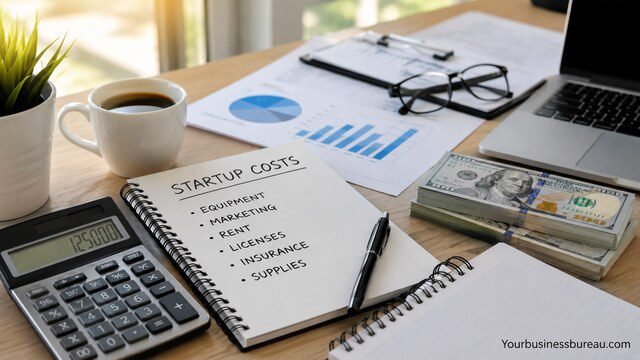
One of the easiest mistakes to make when starting a business is estimating only the obvious setup expenses.
Divide your costs into three categories.
One-time startup costs might include formation fees, equipment, furniture, initial inventory, deposits, website development, professional services, and initial branding.
Recurring fixed costs can include rent, software, insurance, bookkeeping, internet service, salaries, and subscriptions.
Variable costs increase as you make sales, such as packaging, payment-processing fees, materials, shipping, commissions, and certain types of labor.
Then calculate how long you can operate before the business becomes self-sustaining.
Example Startup Budget
Consider a hypothetical home-based service business:
| Expense | Example Amount |
| Registration and permits | $300 |
| Equipment | $1,500 |
| Website and basic branding | $600 |
| Insurance deposit | $400 |
| Initial marketing | $700 |
| Software and setup costs | $200 |
| Three-month operating reserve | $3,000 |
| Estimated initial cash need | $6,700 |
These figures are illustrative, not typical costs. Actual expenses can differ dramatically according to the business, industry, location, and legal requirements.
The operating reserve is particularly easy to overlook. If you spend $3,000 each month and sales take three months to become dependable, you need enough cash to survive that period.
7. Work Out Whether the Business Can Actually Make Money
Revenue alone does not tell you whether a business works.
You need to understand your gross margin, operating expenses, cash flow, and break-even point.
A simple break-even calculation is:
Break-even units = Monthly fixed costs ÷ Contribution margin per sale
Suppose you sell a service for $200. Delivering each service costs $50, leaving a $150 contribution toward fixed costs and profit.
If fixed expenses equal $3,000 per month:
$3,000 ÷ $150 = 20 sales
You therefore need approximately 20 sales per month to cover those fixed expenses, assuming the estimates are accurate.
Now add customer acquisition.
If acquiring each customer costs another $40, the economics change. Understanding these numbers before expanding can prevent you from building a business that generates sales but consistently loses money.
8. Decide How You Will Fund the Business
Your funding strategy should match the amount of capital required and the risk involved.
Common funding sources include personal savings, revenue from early customers, loans, investors, crowdfunding, business partners, and certain grants or development programs.
Bootstrapping can preserve ownership and force disciplined spending, but it may limit how quickly a capital-intensive business can grow. Loans allow owners to retain equity but create repayment obligations. Equity investors provide capital without normal loan repayments but receive ownership and typically expect significant growth.
Before borrowing or raising outside money, determine:
- How much you actually need
- Exactly what the money will fund
- How long it should last
- When the business could become cash-flow positive
- What happens if revenue arrives later than expected
Raising more money does not fix weak unit economics. Validate the underlying business model first whenever practical.
9. Choose the Right Business Structure
Your legal structure affects taxes, paperwork, ownership, fundraising options, and personal liability.
In the United States, common structures include sole proprietorships, partnerships, limited liability companies (LLCs), and corporations. The SBA notes that the structure you choose affects taxes, your ability to raise money, required paperwork, and personal liability.
A sole proprietorship can be straightforward for a one-person operation, while an LLC may provide liability-related advantages and structural flexibility. Corporations may be more appropriate for businesses seeking certain forms of outside investment.
Do not choose a structure solely because it is popular online. The appropriate structure depends on ownership, location, tax circumstances, liability exposure, and future plans.
For significant tax or liability decisions, consult a qualified accountant or attorney familiar with your jurisdiction.
10. Choose and Protect Your Business Name
A strong business name should be easy to remember, relevant enough for customers to understand, and practical to use across legal and digital channels.
Before committing to a name, check:
- Business registry availability
- Trademark conflicts
- Domain availability
- Relevant social media usernames
- Similar businesses in your market
- Spelling and pronunciation
- Whether the name restricts future expansion
Registering a business name does not automatically give you unlimited trademark rights. Business registration, a DBA or trade name, domain registration, and trademark protection serve different purposes.
The SBA notes that requirements for DBAs vary by location and business structure.
11. Register the Business and Obtain Required Tax IDs
Once your structure, location, and name are settled, determine where the business must be registered.
In the United States, registration requirements depend on business structure and location. LLCs, corporations, partnerships, and nonprofit corporations generally need state registration where they conduct qualifying business activities. Local registrations, permits, or DBA filings may also apply.
Your federal tax requirements depend partly on your structure and activities.
An Employer Identification Number (EIN) is a nine-digit federal tax identification number issued by the IRS. Businesses may need one when they hire employees, operate as a corporation or partnership, file certain federal tax returns, or conduct other qualifying activities. Many banks also require an EIN for business accounts. The IRS provides EINs directly at no charge.
If you are forming a U.S. legal entity such as an LLC, partnership, or corporation, the IRS advises forming the entity with the state before applying for its EIN.
State and local tax registration requirements vary, so check the relevant government agencies where the business operates.
12. Check Licenses, Permits, Zoning, and Industry Rules
Registering a company does not necessarily give you permission to conduct every type of business activity.
Licenses and permits can depend on your industry, activities, and location. Federal regulation applies to certain industries, while state and local governments regulate many other activities. Restaurants, construction companies, retail businesses, professional services, transportation operations, and home-based businesses can face very different requirements.
Location matters as well. Zoning rules may restrict what businesses can operate from particular properties, including homes.
Create a compliance checklist before signing a long lease, buying specialized equipment, or accepting customers in a regulated field.
For U.S. businesses, there has also been substantial change surrounding federal beneficial ownership reporting. As of FinCEN’s August 11, 2026 update, U.S. companies are exempt from federal BOI reporting under the finalized rule, while certain foreign companies registered to do business in the United States remain subject to reporting requirements.
Because regulations can change, verify current federal, state, and local requirements rather than relying on an old startup checklist.
13. Separate Your Business and Personal Finances
Open a dedicated business bank account when you begin accepting or spending money through the business.
Separating business transactions makes bookkeeping easier and creates clearer financial records. It can also matter for maintaining the distinction between personal and business finances when operating through certain legal structures.
The SBA recommends opening a business account when you are ready to accept or spend money as the business. Banks commonly request identification and business documentation, and requirements vary by institution and structure.
Build a basic financial system at the same time. Track:
- Revenue
- Expenses
- Accounts receivable
- Accounts payable
- Taxes
- Payroll, if applicable
- Inventory, if applicable
- Cash balance
Do not wait until tax season to reconstruct months of transactions.
14. Get the Insurance Your Business Needs
Legal registration does not eliminate every business risk.
Insurance needs depend heavily on what you do. A consultant working from a laptop faces different risks from a contractor entering customers’ homes, a restaurant serving food, or a company employing delivery drivers.
Potential coverage can include general liability, professional liability, commercial property, product liability, commercial auto, cyber insurance, and workers’ compensation.
Some insurance may be legally required, contractually required, or necessary to lease premises or work with certain clients. Ask an appropriately licensed insurance professional what applies to your industry and jurisdiction rather than simply purchasing the cheapest general policy.
15. Build a Simple System for Getting Your First Customers
Do not spend months perfecting logos, colors, and social media profiles while ignoring sales.
Before launch, identify where prospective customers already spend attention and how they normally choose a provider.
Depending on the business, early acquisition channels might include:
- Direct outreach
- Referrals
- Local search
- Search engine optimization
- Online marketplaces
- Paid advertising
- Industry partnerships
- Community groups
- Events
- Social media
- Email marketing
- Cold calling
- Retail foot traffic
Choose one or two channels initially and measure them.
For example, a local landscaping company might test Google Business Profile visibility, referrals, and neighborhood flyers. A B2B software consultancy might rely more heavily on targeted outreach and professional referrals.
The correct channel depends on where the customer is and how the purchase is normally made.
16. Launch Small and Learn From Real Customers
A launch does not need to be a major public event.
For many businesses, a controlled launch is better. Serve a small number of paying customers, watch how they use the product or service, record recurring questions and complaints, and improve the offer.
Early customers can reveal problems that planning cannot.
You may discover that customers want a different package, your turnaround time is unrealistic, one feature creates most of the value, or buyers care about something completely different from what you emphasized in your marketing.
Treat your first sales as both revenue and research.
17. Track the Numbers That Determine Whether You Are Growing
Once customers begin buying, focus on a small set of meaningful numbers rather than dozens of vanity metrics.
Depending on the business, useful measurements include:
Revenue: Total sales generated.
Gross profit: Revenue minus the direct costs of producing or delivering what was sold.
Operating profit: What remains after operating expenses.
Cash flow: Money actually moving into and out of the business.
Customer acquisition cost: How much you spend to acquire a customer.
Average order value: Average revenue generated per transaction.
Repeat purchase rate: How frequently customers return.
Conversion rate: The percentage of prospects who become customers.
A company can show accounting profit and still face cash problems if customers pay slowly while bills must be paid immediately. That distinction becomes increasingly important as the company grows.
A Practical 30-Day Business Launch Plan
Not every business can launch in 30 days. Regulated, capital-intensive, manufacturing, construction, food-service, and premises-based businesses may require much longer.
For a relatively simple service or online business, however, a 30-day framework can create useful momentum.
| Period | Primary Goal | Actions |
| Days 1-5 | Validate demand | Define customer, interview prospects, research competitors |
| Days 6-10 | Design the offer | Choose service/product, pricing, positioning, delivery process |
| Days 11-15 | Test economics | Calculate costs, margins, startup cash and break-even point |
| Days 16-20 | Set up the business | Select structure, register where required, address tax and licensing requirements |
| Days 21-25 | Prepare for sales | Set up banking, bookkeeping, payment collection and minimum marketing assets |
| Days 26-30 | Sell | Contact prospects, launch initial marketing, close first customers and collect feedback |
Do not treat the timeline as a legal checklist. Registration and licensing requirements vary by jurisdiction and industry.
Common Mistakes to Avoid When Starting a Business
One of the biggest mistakes is building before validating. Months of product development cannot compensate for a lack of demand.
Another is underestimating cash requirements. Even profitable businesses can experience financial pressure when expenses occur before customer payments arrive.
Other costly mistakes include mixing personal and business money, ignoring taxes, choosing a legal structure without understanding its consequences, signing an expensive lease too early, buying excessive inventory, hiring before demand justifies it, and trying too many marketing channels simultaneously.
Pricing deserves particular attention. New owners sometimes price only according to competitors rather than calculating their own costs and required margin. A low price can generate customers while still producing an unsustainable business.
Finally, do not confuse activity with progress. Registering social accounts, designing business cards, changing your logo, and endlessly refining a website can feel productive. Customer conversations, validated demand, profitable sales, repeat purchases, and healthy cash flow provide stronger evidence that the business is working.
How Much Money Do You Need to Start Your Own Business?
There is no universal minimum.
A freelancer or consultant might begin with equipment they already own and relatively small setup costs. An e-commerce business may need money for inventory, packaging, advertising, software, and fulfillment. A physical retail store could require deposits, renovations, fixtures, inventory, insurance, employees, and months of operating cash.
Estimate your own requirement with:
Startup cash needed = One-time setup costs + initial inventory + pre-launch expenses + operating reserve
Then run a downside scenario.
If you expect to reach $10,000 in monthly sales after three months, calculate what happens if reaching that level takes six months instead. That scenario provides a more useful capital estimate than relying entirely on optimistic projections.
When Should You Get Professional Help?
You can handle many early-stage tasks yourself, but professional advice becomes more valuable as the financial and legal consequences increase.
Consider consulting an attorney, accountant, tax professional, insurance professional, or other qualified adviser when you have multiple owners, complex contracts, employees, substantial liability exposure, intellectual property concerns, outside investors, large loans, unusual tax circumstances, or heavily regulated activities.
Paying for targeted professional advice can be cheaper than correcting an unsuitable structure, contract, tax decision, or compliance problem later.
Conclusion
Learning how to start your own business is less about completing a single registration form and more about reducing uncertainty in the right order.
Start by identifying a specific customer problem. Validate demand before committing substantial capital. Turn the idea into a clear offer, calculate your costs and break-even point, and determine how much cash you realistically need. Then choose the appropriate structure, complete registration and licensing requirements, separate your finances, and build a repeatable method for acquiring customers.
Most importantly, seek evidence early. A polished website does not prove that you have a business. Paying customers, sustainable margins, healthy cash flow, and repeatable demand do.
Once those fundamentals begin working, you have something worth scaling.
FAQ’s
Some service businesses can be started with very little additional capital if you already have the necessary skills, equipment, and access to customers. Almost every business still has some economic cost, however, including time, software, transportation, registration, marketing, insurance, or equipment. Start with a low-cost offer and use early revenue to fund expansion when practical.
Not necessarily. Business structures and terminology vary by country, and U.S. entrepreneurs may operate through structures such as sole proprietorships, partnerships, LLCs, or corporations. Your appropriate structure depends on ownership, liability, taxes, location, and future plans.
You need a plan, but you do not always need a lengthy formal document. A lean plan can be sufficient for testing a straightforward early-stage business. Banks, investors, partners, or complex businesses may require substantially more detail.
Not automatically. Keeping employment while validating a business can reduce financial pressure, provided your employment agreement, intellectual property obligations, working hours, and other applicable rules permit it. Consider leaving only after assessing your personal financial runway, business cash flow, workload, and risk tolerance.
Look for evidence rather than enthusiasm. A stronger idea has an identifiable customer, a meaningful problem, accessible buyers, workable economics, and evidence that customers will pay. Small paid tests, deposits, pre-orders, proposals, and initial sales usually provide better evidence than opinions from friends.
Define the customer and problem, then test whether people will pay for your proposed solution. Do this before making large investments in inventory, premises, branding, or product development. Once demand looks credible, calculate the economics and complete the legal, tax, banking, licensing, and operational steps required in your location.
