

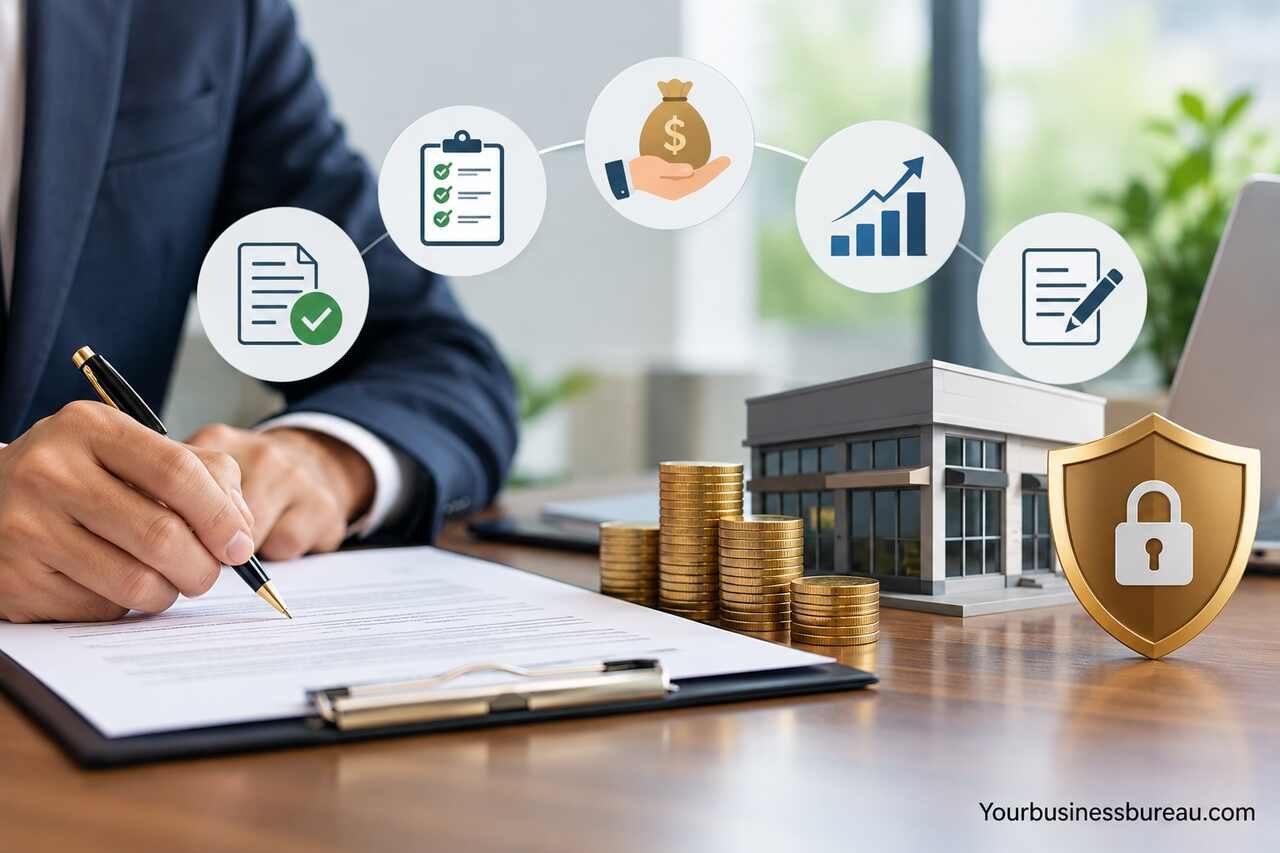
A secured business loan allows businesses to borrow money by using assets such as property, equipment, inventory, or vehicles as collateral. These loans may offer lower interest rates, higher borrowing limits, and longer repayment terms than unsecured loans, depending on the lender and the business’s financial situation.
What Is a Secured Business Loan?
A secured business loan is a financing arrangement in which a business pledges an asset as collateral to obtain funding from a bank, credit union, or alternative lender. The business receives the approved funds and agrees to repay the borrowed amount, plus interest and applicable fees, according to a specified schedule.
Collateral reduces the lender’s potential loss because it provides a legal claim against designated assets if the borrower defaults. Depending on the financing agreement, lenders may accept commercial real estate, machinery, vehicles, inventory, accounts receivable, or cash deposits.
For example, a manufacturing company seeking $150,000 to purchase new machinery might offer existing equipment as collateral. The lender evaluates the equipment’s value alongside the company’s revenue, credit history, outstanding debts, and ability to make repayments.
The presence of collateral does not guarantee approval. Lenders still assess whether the business generates enough income to repay the loan.
How Does a Secured Business Loan Work?
A secured business loan works by connecting a borrowing agreement to an asset that the lender can claim under specified circumstances. The lender evaluates the business, determines the acceptable collateral value, approves financing terms, and establishes repayment obligations.
The process generally involves five stages.
- Loan application: The business submits financial information, its funding requirements, and details of the proposed collateral.
- Collateral valuation: The lender assesses the asset’s market value, condition, ownership, and potential resale value.
- Credit assessment: The lender reviews business income, profitability, existing debt, credit history, and repayment capacity.
- Loan approval and documentation: The lender specifies the loan amount, interest rate, repayment schedule, security arrangements, and other conditions.
- Funding and repayment: After required agreements and security arrangements are completed, the lender releases funds and the business begins making scheduled payments.
The lender may register a lien, charge, mortgage, or other security interest over the collateral, depending on the asset type and local legal requirements.
What Happens to Collateral During Repayment?
In many secured lending arrangements, the borrower continues using the pledged asset while repaying the loan. For example, a transportation company may continue operating vehicles pledged as security.
However, the borrower may face restrictions on selling, transferring, or refinancing those vehicles without the lender’s permission.
Once the debt is fully repaid and all contractual obligations are satisfied, the lender releases its security interest according to the applicable procedures.
If the borrower defaults, the lender may pursue enforcement against the collateral. The timing and procedures depend on the loan agreement and relevant laws.
Types of Secured Business Loans
Secured financing is available in several forms. The appropriate option depends on the business’s funding purpose, available assets, repayment capacity, and preferred financing structure.
Commercial Property Loans
Commercial property loans use business premises, offices, warehouses, industrial buildings, or other eligible real estate as security.
Businesses commonly use these loans to purchase commercial premises, refinance existing property debt, or finance eligible business expenditures against property equity.
Real estate may support substantial borrowing because it can have significant collateral value. However, lenders often require professional valuations, property documentation, insurance, and legal checks.
Equipment Financing
Equipment financing helps businesses purchase machinery, vehicles, technology, or other productive assets.
The financed equipment often serves as collateral, although lenders may require additional security.
For example, a construction company could finance an excavator and repay the cost through monthly installments while using the equipment to generate revenue.
Equipment financing can align borrowing with an asset’s productive life. However, businesses should avoid repayment terms that extend substantially beyond the equipment’s useful economic life.
Inventory Financing
Inventory financing allows eligible businesses to borrow against stock held for resale or production.
Retailers, wholesalers, distributors, and manufacturers may use this arrangement to finance seasonal inventory purchases or replenish stock.
Lenders typically evaluate inventory quality, turnover rates, market demand, and resale potential. Perishable, obsolete, highly specialized, or slow-moving inventory may receive lower collateral valuations.
Accounts Receivable Financing
Accounts receivable financing uses eligible unpaid customer invoices as security for business funding.
It can help companies manage the period between delivering goods or services and receiving customer payments.
Lenders may assess invoice age, customer creditworthiness, payment history, and invoice concentration. Financing against receivables is different from invoice factoring, where receivables are typically sold to a financing provider.
Secured Business Lines of Credit
A secured business line of credit provides access to funds up to an approved credit limit, supported by eligible collateral.
Unlike a traditional term loan, a revolving credit facility generally allows the business to borrow, repay, and borrow again within the agreement’s conditions.
This structure can be useful for managing working capital, seasonal expenses, and temporary cash flow gaps.
Some facilities require periodic borrowing-base calculations to ensure outstanding borrowing remains supported by eligible collateral.
Secured vs. Unsecured Business Loans
The main difference between secured and unsecured business loans is the requirement for specifically pledged collateral.
A secured loan gives the lender rights over identified assets. An unsecured loan does not ordinarily require a specific asset to be pledged, although lenders may still require personal guarantees or other contractual protections.
| Feature | Secured Business Loan | Unsecured Business Loan |
| Collateral | Usually required | Usually not required |
| Interest rates | May be lower due to collateral protection | May be higher, depending on borrower risk |
| Loan amounts | May support larger amounts | Often more dependent on cash flow and credit |
| Approval process | May require asset valuation and legal checks | May involve fewer collateral-related steps |
| Repayment terms | Can be longer for suitable assets | Often shorter, depending on the product |
| Main risk | Loss of pledged assets following default | Collection action, credit damage, and possible guarantee enforcement |
| Suitable borrowers | Businesses with eligible assets and repayment capacity | Businesses with strong financial profiles or limited assets |
An unsecured loan is not risk-free. Borrowers remain legally responsible for repayment, and lenders may pursue available collection remedies following default.
Similarly, a secured loan is not automatically cheaper. The total borrowing cost depends on interest rates, fees, collateral requirements, loan duration, and other contractual conditions.
What Assets Can Be Used as Collateral?
Lenders accept collateral based on its value, ownership, liquidity, legal status, and ability to retain value over the loan period.
An asset’s estimated market price is not necessarily the amount a lender will recognize for financing purposes.
| Collateral Type | Common Examples | Important Lending Considerations |
| Commercial real estate | Offices, shops, warehouses | Valuation, title, existing mortgages, marketability |
| Machinery and equipment | Manufacturing equipment, industrial tools | Age, condition, depreciation, resale demand |
| Business vehicles | Trucks, delivery vans, commercial fleets | Ownership, condition, insurance, depreciation |
| Inventory | Finished goods, raw materials | Stock turnover, quality, storage, resale value |
| Accounts receivable | Eligible unpaid customer invoices | Customer reliability, invoice age, collectability |
| Cash deposits | Savings or fixed deposits | Account ownership, restrictions, currency |
| Other eligible financial assets | Certain securities or investments | Market volatility, liquidity, lender policies |
Additional Fees to Consider
Secured borrowing may involve costs beyond interest, including origination fees, collateral valuation fees, legal charges, security registration costs, insurance, and early repayment penalties.
Some loans also have ongoing administration or facility fees.
Request a complete breakdown of expected charges before accepting an offer.
Advantages of a Secured Business Loan
Secured financing can be particularly useful when a company owns valuable assets but needs additional capital for expansion, equipment purchases, or operational improvements.
Potentially Lower Borrowing Costs
Collateral can reduce the lender’s exposure, which may allow competitive pricing for borrowers who meet credit and affordability requirements.
The actual saving depends on the lender’s terms and all associated costs.
Access to Larger Financing Amounts
Eligible property, equipment, or other substantial assets may support financing amounts that would be difficult to obtain through unsecured borrowing.
This can make secured loans suitable for capital-intensive projects.
Longer Repayment Options
Certain secured products, especially commercial property financing, may offer longer repayment periods.
Longer terms can make individual payments more manageable, although they may increase total interest costs.
Financing for Businesses With Limited Credit History
Collateral may strengthen an application from a business with a limited credit record.
However, lenders may still require reliable cash flow, owner guarantees, or additional evidence of repayment capacity.
Continued Use of Business Assets
Many secured arrangements allow companies to continue operating pledged equipment, vehicles, or property.
This means productive assets can support financing while remaining available for everyday business operations, subject to contractual restrictions.
Risks and Disadvantages of Secured Business Loans
The greatest risk of secured borrowing is the potential loss of valuable assets if the business cannot meet its obligations.
A company should assess this risk before focusing on attractive rates or loan amounts.
Loss of Collateral After Default
If the borrower defaults, the lender may enforce its security rights and recover the debt through the pledged assets, subject to applicable law.
If the collateral sale does not cover the outstanding balance, the borrower may still owe the remaining amount where the law and agreement permit.
Restrictions on Asset Disposal
The lender may restrict the sale, transfer, or additional financing of pledged assets.
These conditions can reduce operational flexibility, particularly when the business needs to replace equipment or sell property.
Valuation and Legal Expenses
Collateral assessments, title checks, legal documentation, and security registration can increase borrowing costs.
Some expenses may be payable even if the loan does not proceed.
Overborrowing Against Valuable Assets
A company may qualify for more funding than it can comfortably repay.
For example, a property-rich business with weak monthly cash flow could receive a substantial financing offer but struggle to meet repayments.
Collateral value should not replace an independent affordability assessment.
Exposure Through Personal Guarantees
Some lenders require owners or directors to provide personal guarantees in addition to business collateral.
Depending on the guarantee, the individual’s personal assets may be exposed if the business fails to meet its obligations.
Business owners should understand the scope of any guarantee before signing.
How to Decide Whether a Secured Business Loan Is Affordable
Loan affordability should be measured against cash available for debt repayment, not just revenue or asset value.
A useful assessment compares expected debt obligations with the company’s ability to generate cash after operating expenses.
Test a Lower-Revenue Scenario
A business should examine whether it could continue repaying the loan if sales decline or major customers delay payment.
For example, if available cash falls from $120,000 to $90,000 while annual debt service remains $90,000, the simplified DSCR falls to 1.0.
At that level, there is no surplus in the measured cash flow to absorb unexpected expenses.
A stress test can reveal repayment vulnerabilities before the business pledges essential assets.
Match Loan Duration to the Investment
Short-lived assets should generally not be financed over unnecessarily long periods.
For instance, using a 15-year loan to finance equipment expected to become obsolete within five years can leave the business repaying debt after the equipment stops producing sufficient value.
Matching repayment duration with the financed asset’s useful life helps reduce this mismatch.
Common Mistakes to Avoid When Taking a Secured Business Loan
Some borrowing decisions create problems even when the initial loan application is approved.
Pledging essential assets without a contingency plan: A business that relies on a single warehouse, production machine, or vehicle fleet should consider how losing that collateral would affect operations.
Comparing only interest rates: Fees, insurance, repayment schedules, and early settlement charges can materially change total financing costs.
Borrowing based on collateral rather than cash flow: Valuable property cannot automatically cover monthly repayments. Debt must normally be serviced through business income or other available funds.
Ignoring variable-rate exposure: Businesses should calculate whether repayments remain affordable if interest rates increase.
Failing to review existing security arrangements: An asset already pledged to another lender may be unavailable or require consent before being used for additional borrowing.
Signing broad guarantees without understanding them: Personal guarantees and cross-default clauses may create obligations beyond the individual loan being requested.
Addressing these issues before signing can help prevent a manageable financing arrangement from becoming a significant financial burden.
Alternatives to Secured Business Loans
A secured loan is not always the most suitable financing option. Businesses should compare alternatives based on funding urgency, available assets, financial strength, and the purpose of borrowing.
Unsecured Business Loans
An unsecured business loan may suit a company with strong credit and cash flow that does not want to pledge specific assets.
However, borrowing costs, repayment periods, and eligibility conditions may be less favorable for some applicants.
Business Credit Cards
Business credit cards can help manage smaller recurring purchases and short-term expenses.
They may offer convenient access to credit, but carrying balances can become expensive, particularly when promotional rates expire.
Invoice Factoring
Invoice factoring involves selling eligible unpaid invoices to a factoring provider, typically at a discount.
It may suit businesses with substantial receivables and long customer payment cycles.
Businesses should compare factoring fees, customer notification requirements, and collection arrangements before proceeding.
Equity Financing
Equity financing involves raising capital in exchange for an ownership interest in the business.
It generally avoids mandatory loan repayments, but existing owners give up a portion of ownership and potentially some control.
Business Grants
Eligible businesses may obtain grants through government programs, industry initiatives, or development organizations.
Grants can reduce borrowing needs, but eligibility is often restricted, competition may be significant, and funds may be limited to approved uses.
When Is a Secured Business Loan the Right Choice?
Secured financing is most appropriate when the business has eligible collateral, predictable repayment capacity, and a clear commercial purpose for the funds.
For example, a profitable logistics company purchasing additional delivery vehicles may benefit from equipment-backed financing if expected operating cash flow can comfortably cover repayments.
Similarly, an established manufacturer may use secured financing to purchase machinery that improves production capacity and supports future revenue.
A secured loan may be less suitable for a business experiencing persistent cash shortages, uncertain revenue, or significant existing debt, particularly if the collateral is essential to continued operations.
The decision should be based on whether the expected business benefit justifies the financing cost and collateral exposure.
Conclusion
A secured business loan can provide access to substantial funding by allowing a company to use eligible assets as collateral. It may offer competitive borrowing costs, flexible financing structures, and longer repayment options for businesses with suitable financial profiles.
However, the potential loss of collateral makes careful planning necessary. Before applying, business owners should assess repayment capacity, compare total financing costs, review security and guarantee provisions, and evaluate how the loan will affect cash flow under less favorable conditions.
The strongest borrowing decision is not necessarily the loan with the largest amount or lowest advertised rate. It is the financing arrangement that meets a genuine business need while keeping repayment obligations and asset exposure within manageable limits.
FAQ’s
It may be possible to obtain a secured business loan with poor credit if the lender accepts the collateral and is satisfied with the business’s repayment capacity. However, weak credit can lead to higher borrowing costs, smaller loan amounts, additional guarantees, or rejection. Collateral does not eliminate credit requirements.
Yes, some startups may qualify for secured financing, particularly when they have acceptable collateral, credible financial projections, and sufficient owner resources. Lenders may impose additional requirements because the business lacks an established operating and repayment history.
Some lenders permit residential property to secure business borrowing, subject to local laws, ownership rights, and lender policies. However, this can put the property at risk if the business defaults. Independent legal and financial advice is particularly valuable before using a family home as security.
Approval timelines depend on the lender, loan amount, collateral type, and documentation requirements. Some straightforward asset-backed products may be processed relatively quickly, while commercial property loans can take substantially longer because of valuation, title verification, and legal procedures.
Many lenders allow early repayment, but some agreements impose prepayment charges, break costs, or minimum interest requirements. Fixed-rate loans may have different early settlement conditions from variable-rate products. Review the agreement to determine whether early repayment produces meaningful savings.
A decline in collateral value does not automatically mean the loan is in default. However, certain agreements require the borrower to maintain a specified collateral coverage level. If that level is breached, the lender may request additional security, partial repayment, or other corrective action. The consequences depend on the financing terms.
