

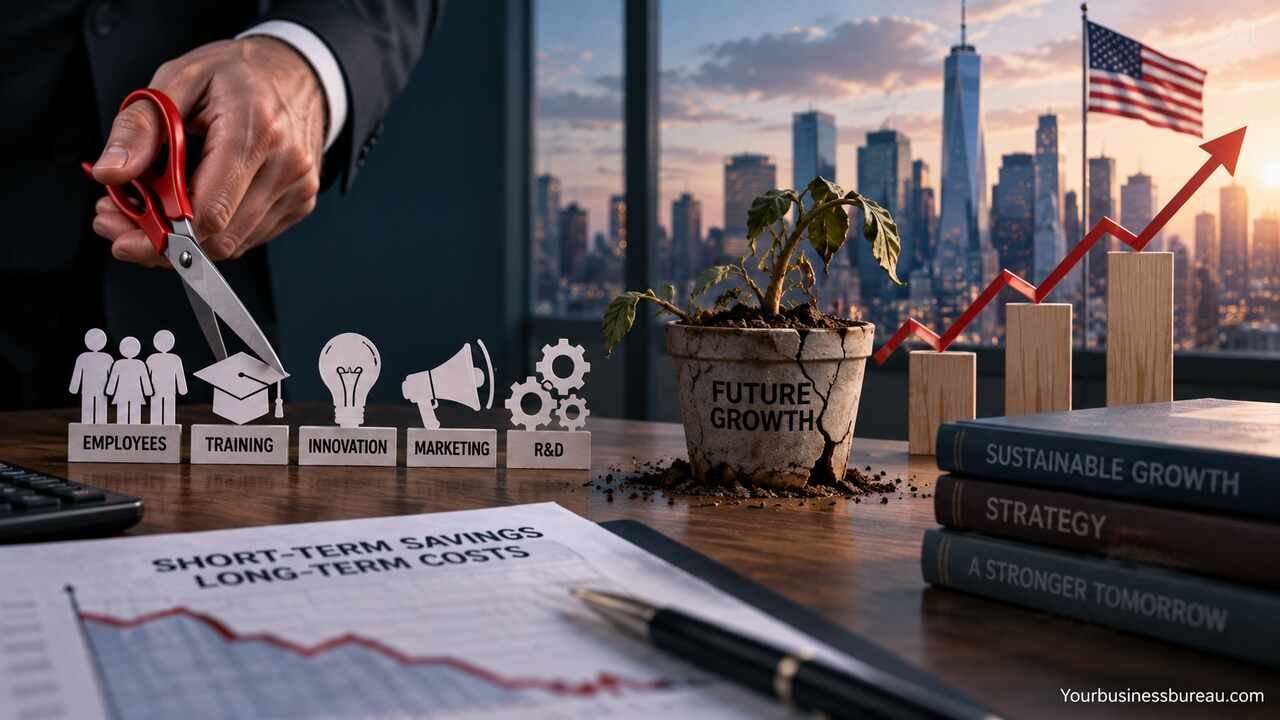
Cost-cutting decisions can hurt long-term US business growth when short-term savings weaken revenue potential, innovation, customer loyalty, and workforce stability. Sustainable growth depends on reducing unnecessary expenses while protecting the people, capabilities, and strategic assets that support future competitiveness.
Why Do Short-Term Cost Reductions Undermine Sustainable Growth?
Short-term cost reductions undermine sustainable growth because financial savings often come at the expense of capability, productivity, and differentiation. Profitability improves temporarily when payroll shrinks or research budgets decline, yet revenue pipelines weaken when innovation slows and service quality declines. Market share declines when customers perceive reduced value.
Business growth depends on reinvestment, talent retention, customer trust, and product advancement. Each of those growth drivers requires capital allocation. When leadership focuses exclusively on expense compression, future earnings potential decreases. Long-term shareholder value correlates with strategic investment discipline rather than extreme austerity.
I have seen companies celebrate cost reductions during earnings calls while employees quietly disengaged and customers shifted to competitors. Communication gaps widen when leadership emphasizes savings over strategy. You may notice similar patterns inside your own organization when morale declines after budget cuts. Sustainable decision-making protects long-term capacity while optimizing operational efficiency.
Workforce Downsizing
Workforce downsizing reduces salary expense but often removes institutional knowledge, cross-functional expertise, and customer relationships. Productivity frequently declines when remaining employees absorb additional responsibilities without support. Talent flight accelerates when high performers interpret layoffs as instability.
Deferred Investment
Deferred investment in technology, infrastructure, or talent delays modernization. Operational bottlenecks increase when outdated systems persist. Competitive positioning weakens when competitors upgrade capabilities while internal systems stagnate.
How Does Cutting Research and Development Limit Competitive Advantage?
Cutting research and development restricts innovation pipelines and reduces future product differentiation. American business leadership historically relied on innovation ecosystems to drive economic expansion. Reduced R&D spending narrows the range of future offerings and slows adaptation to market changes.
Innovation drives pricing power. Pricing power drives margin stability. Margin stability funds reinvestment. When R&D budgets shrink, pricing leverage weakens because products become commoditized. Commoditization increases price competition and compresses margins.
I often tell business leaders that innovation acts as insurance against disruption. When companies cut innovation funding during downturns, recovery becomes harder. You may feel pressure to reduce experimentation when budgets tighten, yet disciplined prioritization works better than blanket elimination. Strategic R&D alignment protects long-term differentiation.
Product Pipeline Contraction
Product pipeline contraction reduces future launch opportunities. Fewer launches mean reduced revenue diversification. Revenue concentration increases risk exposure during demand fluctuations.
Loss of Intellectual Property Momentum
Loss of intellectual property momentum limits patent development and technological leadership. Competitors gain ground when internal discovery slows. Market perception shifts when brand reputation for innovation declines.
What Happens When Companies Reduce Employee Development and Training?

Reduced employee development weakens workforce adaptability. Skills stagnate when training budgets disappear. Performance gaps widen when technology evolves faster than internal capabilities. Growth slows because operational excellence depends on skilled talent.
Human capital represents a primary driver of US economic expansion. Training enhances productivity, leadership depth, and cross-functional agility. Eliminating learning initiatives reduces employee engagement and increases turnover costs. Turnover costs frequently exceed savings from canceled training programs.
From my experience advising business owners, professional development correlates directly with performance resilience. When companies invest in people, those people invest back in the company. You may notice improved collaboration and innovation when learning culture strengthens. Cost discipline should never eliminate strategic talent development.
Leadership Development Cuts
Leadership development cuts reduce succession planning effectiveness. Organizations struggle when senior executives retire without prepared replacements. External hiring increases cost and cultural misalignment risk.
Skill Obsolescence Risk
Skill obsolescence risk grows when emerging technologies require new competencies. Productivity declines when employees rely on outdated methods. Competitive capability erodes without upskilling programs.
Why Does Reducing Marketing Spend Damage Revenue Growth?

Reducing marketing spend decreases brand visibility, customer acquisition, and revenue pipeline expansion. Marketing fuels demand generation. Demand generation supports sales performance. Revenue growth depends on consistent market engagement.
Brand equity develops through sustained communication and positioning. When marketing budgets shrink drastically, customer awareness declines. Competitors capture attention through consistent outreach. Market share gradually shifts away from silent brands.
I have worked with companies that paused marketing during recessions and later struggled to regain visibility. Customers rarely wait for brands to return. You might assume cost savings justify temporary silence, yet long-term recovery costs often exceed short-term savings. Strategic marketing optimization works better than elimination.
Customer Acquisition Decline
Customer acquisition decline reduces future recurring revenue. Sales pipelines weaken when lead generation slows. Revenue forecasting becomes unstable without consistent prospect flow.
Brand Equity Erosion
Brand equity erosion decreases pricing power and trust. Customers associate reduced presence with instability. Market reputation suffers when competitors dominate conversation channels.
How Do Supply Chain Cuts Increase Operational Risk?
Supply chain cost reductions often prioritize lowest-price sourcing over reliability and resilience. Cost minimization strategies can increase vulnerability to disruptions. Operational continuity depends on diversified and stable supplier networks.
Resilience supports growth because uninterrupted operations protect revenue streams. When companies reduce supplier diversity or inventory buffers to save money, vulnerability increases. Disruption costs frequently exceed savings generated by lean sourcing models.
I have seen organizations experience production shutdowns after switching to cheaper suppliers without risk assessment. The immediate savings looked attractive on spreadsheets, yet disruption losses proved far larger. You should evaluate total cost of ownership rather than unit price alone. Sustainable procurement balances efficiency and resilience.
Supplier Consolidation Risk
Supplier consolidation risk increases dependency on limited partners. Negotiation leverage may improve temporarily, yet disruption exposure rises when alternatives disappear.
Inventory Minimization Vulnerability
Inventory minimization vulnerability grows when just-in-time systems lack contingency planning. Demand spikes or transportation delays create revenue loss when stock buffers remain insufficient.
Why Does Cutting Customer Service Harm Long-Term Retention?
Cutting customer service reduces customer satisfaction, loyalty, and lifetime value. Customer experience influences repeat purchasing behavior. Retention contributes more profit than new acquisition in many industries.
Service quality shapes brand perception. When support teams shrink or response times lengthen, frustration increases. Negative experiences spread quickly through digital platforms. Reputation damage impacts sales performance across markets.
I often remind executives that customer service represents revenue protection, not just expense. You may save operational costs by reducing call centers, yet churn rates often increase afterward. Loyal customers generate predictable revenue streams. Protecting service quality protects growth stability.
Reduced Response Capacity
Reduced response capacity increases wait times and complaint escalation. Customer dissatisfaction grows when issues remain unresolved. Resolution delays reduce trust and repeat purchase probability.
Lower Customer Lifetime Value
Lower customer lifetime value results from higher churn rates. Revenue predictability declines when long-term relationships weaken. Profit margins shrink as acquisition costs replace retention efficiency.
How Can Smarter Cost Optimization Support Sustainable US Business Growth?
Smarter cost optimization aligns financial discipline with strategic growth objectives. Cost management should remove inefficiencies rather than core capabilities. Growth-oriented budgeting differentiates between waste reduction and capability reduction.
Strategic allocation prioritizes high-return investments while streamlining non-essential expenses. Data analytics supports precision budgeting. Cross-functional collaboration improves cost transparency. Balanced decision-making strengthens both profitability and resilience.
In my advisory conversations, I encourage leaders to ask whether a cost reduction improves efficiency or damages future capacity. You can conduct internal audits that identify redundant processes instead of cutting strategic functions. Long-term growth requires intelligent trade-offs rather than reactive reductions.
Process Optimization
Process optimization removes bottlenecks, redundancies, and inefficiencies. Automation increases productivity without sacrificing talent investment. Operational excellence strengthens competitive positioning.
Value-Based Budgeting
Value-based budgeting evaluates expenses based on contribution to strategic goals. Departments align spending with measurable outcomes. Financial discipline supports innovation and expansion simultaneously.
Comparative Overview of Harmful vs Strategic Cost Decisions
| Cost Decision Type | Short-Term Impact | Long-Term Impact | Strategic Alternative |
| Workforce Layoffs | Expense reduction | Knowledge loss and morale decline | Productivity enhancement programs |
| R&D Cuts | Immediate savings | Innovation slowdown | Focused innovation prioritization |
| Marketing Reduction | Lower overhead | Revenue decline | Performance-based marketing |
| Supplier Switching | Unit cost decrease | Disruption risk | Diversified sourcing strategy |
| Training Elimination | Budget relief | Skill stagnation | Targeted skill development |
Financial Impact Illustration of Strategic vs Reactive Cost Cutting
| Approach | Revenue Growth Trend | Employee Retention | Brand Strength | Risk Exposure |
| Reactive Cutting | Declining | Low | Weakening | High |
| Strategic Optimization | Stable or Rising | High | Strengthening | Moderate to Low |
Conclusion
Cost-cutting decisions that hurt long-term US business growth typically focus on immediate expense reduction while neglecting capability preservation. Workforce reductions, R&D cuts, marketing withdrawal, supply chain consolidation, and customer service downsizing frequently generate hidden costs that outweigh savings. Sustainable growth requires disciplined optimization, strategic reinvestment, and leadership commitment to long-term value creation. Smart cost management strengthens resilience, protects innovation, and maintains competitive advantage. Leaders who balance efficiency with strategic investment position their organizations for durable expansion in competitive US markets.
FAQ’s
The biggest mistake involves eliminating strategic capabilities such as innovation, talent development, and customer engagement instead of removing operational inefficiencies.
Businesses can focus on process automation, waste elimination, supplier negotiation, and data-driven budgeting while preserving investments in innovation and workforce development.
Workforce downsizing reduces institutional knowledge and productivity, which weakens operational performance and customer relationships.
Marketing maintains brand visibility and customer acquisition. Companies that continue strategic marketing during downturns often gain market share when competitors retreat.
Leadership sets financial priorities and determines whether cost management aligns with long-term strategy. Strategic leaders evaluate both immediate savings and future impact before implementing reductions.
