


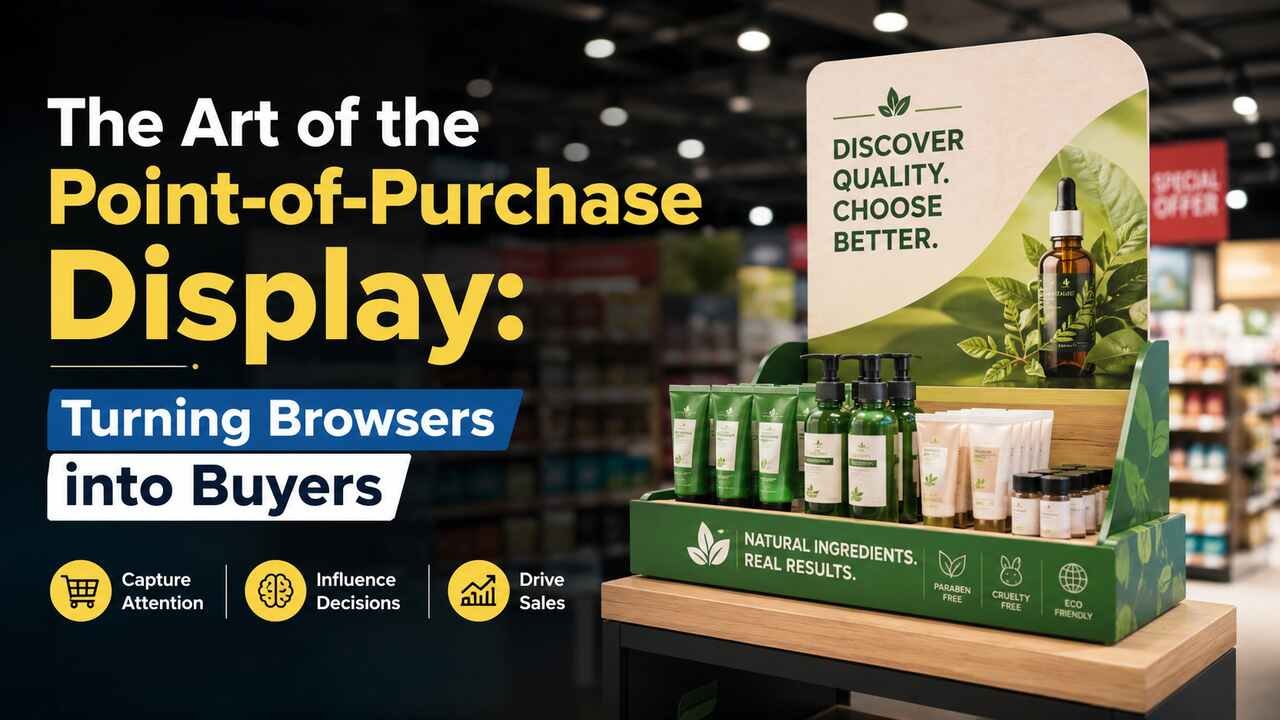
Many individuals enter a shop with no specific items in mind. They are just taking a look around, somewhat distracted, and are willing to make a purchase. The real question for any retail store business is not how to attract customers – it’s about how to break that passive attitude and steer them to make a purchase before they walk out.
This is where the point-of-purchase display comes in. It’s not just for show. It is a sales aid.
The Psychology Behind Where You Put Things
Positioning of products is not random. There is cognitive reasoning applied to that, and overlooking this fact is like losing money that a customer would’ve spent.
Beginning with the entrance. The “decompression zone” – the first 5 to 10 feet inside the door – is where customers are still adjusting. They’re processing the transition from outside. Displays placed here get ignored. Save your best material for 15 feet in, once they’ve settled into shopping mode.
After that, think in terms of foot traffic flow. Where do people naturally walk? High-traffic aisles are where freestanding displays earn their place. A small, well-positioned unit breaks a customer’s walking rhythm and forces a visual check. That moment of pause is where unplanned purchases start.
Eye level is still the most valuable real estate in the store. Products placed at average line-of-sight sell faster than the same products placed lower or higher. It’s one of the oldest principles in visual merchandising and it still holds because it’s based on how people actually move their eyes, not theory.
Grouping, Height, And The Illusion Of Abundance
Rows of similar products rarely grab the customer’s attention. The human eye is drawn to differences and diversity. An attractive display featuring products strategically arranged at different heights (e.g., a tall object placed between two shorter ones) is visually engaging due to the asymmetry it creates which translates to a more carefully curated look.
It’s been reported that around 80% of the final decisions regarding purchases are made by clients directly at the point of sale or during their visit to the store (Shopify). This means that the retail display itself, rather than any advertisements, or even the pre-purchase experience, is mostly responsible for making the final sale for the customer. Thus, the layout and organization of goods are way more crucial to your business success then you might think.
Cross-merchandising can enhance this effect even more. By placing products that are often bought together next to each other (or around the store) you can exploit the so-called “while I’m at it” mechanism. This way, a client reaching for a given product might quickly realize that the one conveniently placed nearby also solves their problem of what to buy which results in two items being put in the shopping basket instead of one.
Protecting High-Value Inventory Without Killing Desire
Security and accessibility are opposing forces in retail. If everything is locked up, your store feels like a fortress. If everything is out in the open, you’re dealing with constant shrink and product loss. For valuable or breakable merchandise, security is the only answer. High-security retail display cases are designed to deter theft and damage while physically protecting valuable inventory. The most effective cases also advertise value. People know that things locked behind glass are valuable – or at least, they perceive them as valuable. It’s an instinctive reaction to the barrier. Jewelry, electronics, collectibles, and high-end accessories almost always increase in perceived value when placed behind glass in a retail setting. Customers see the items in the best possible lighting conditions and, psychologically, associate the protection/enclosure with value and quality.
Signage Does The Talking Your Staff Can’t Always Do
An attractive display that doesn’t have proper signs is a lost opportunity. Customers will not always approach you with a question before leaving; they’ll just leave.
Good sign design can solve most of that problem before it starts, and it starts with the sign hierarchy. An eye-catching header lets them know what they’re looking at as soon as they’re in sight of it. A sub-header checkmates the “why/how does that apply to me” question in their internal dialogue. A price callout closes the loop and brings their focus back to the product. Visible, readable, price – this simplified three-layer structure is the checkmate to “are you interested?” pauses.
If you have multiple sections (or even products) with their own signage, different colors can play into this as well. Warms and reds add a sense of urgency (buy now! Call to action!) while cooler tones like blue or green create the perception of quality and feelings of calm. Using color as a communication tool, not just decoration or brand, can create an atmosphere without changing a single word.
Keeping Displays From Going Invisible
Shoppers who come in often stop noticing things. It takes only a few visits for a display to get tuned out and simply become part of your store’s scenery. Introducing new storytelling and new merchandise every four to six weeks breaks that cycle of getting too comfortable with what you’ve got on the floor. It can also be used to introduce new products, or to feature products that tie into a time of year, either due to the season itself or an event happening in that period. The point is, a new rhythm of rotating displays gives customers and staff a good reason to take a fresh look at what you’re offering. New merchandising themes and stories also give shoppers a way to talk about their great new find for you, spreading the word and creating anticipation for the next rotation.


