



Introduction
Many US businesses publish content without a well-defined strategy, believing volume alone will drive visibility, engagement, and conversions. However, this misguided approach leads to wasted resources, brand inconsistency, and poor search visibility. When content lacks alignment with business goals, user intent, and semantic relevance, it becomes noise rather than a valuable asset. In my experience consulting with small and enterprise-level brands alike, I’ve seen firsthand how content without direction contributes to digital stagnation. Let’s dive into the unseen consequences and how strategic publishing transforms content into a growth engine.
Why Do US Businesses Publish Content Without Strategy?
Many businesses in the US rush to create digital content because of industry pressure, competition, or an urgent desire to improve online presence. The decision often comes from leadership who misunderstand content as a volume game rather than a quality and alignment initiative. Content gets produced rapidly, without context, or mapping to business objectives or customer intent.
In my own work with marketing teams across the US, I’ve noticed that internal silos between departments often lead to fragmented messaging. Sales wants lead-generating content, while SEO wants traffic-focused pages. Without a content strategy that bridges these functions, the outcome becomes chaotic and ineffective. Publishing without alignment results in wasted budget and lower returns on content investment.
Another driver comes from over-reliance on templates or AI tools without human oversight or audience research. Brands may assume that output equals performance. However, publishing random blog posts, product pages, or newsletters without understanding topical authority, relevance, or semantic structuring leads to performance decline over time.
Leadership Misconceptions
Business leaders often treat content as a checkbox instead of a strategic asset. They prioritize speed over structure, pushing teams to produce content without a roadmap.
Departmental Disconnect
Marketing, sales, and SEO teams frequently lack unified goals. This results in misaligned content priorities that confuse readers and fail to convert.
What Happens When Content Is Created Without Clear Objectives?


Content without purpose usually lacks direction and measurable success metrics. Many businesses push out content without deciding what they want that content to achieve: awareness, traffic, leads, or conversions. Without goals, performance becomes impossible to evaluate and improve.
One company I worked with published 100+ blogs over six months but saw no increase in traffic or leads. Why? The articles weren’t mapped to search intent, customer pain points, or product solutions. They ranked poorly and weren’t optimized semantically. Publishing without strategy left them with digital clutter that confused users and frustrated internal teams.
The absence of clear objectives leads to generic messaging, vague calls-to-action, and irrelevant topic selection. Users land on these pages and bounce immediately because the content doesn’t match their journey or expectations. That disconnect damages trust and undermines brand authority in competitive US markets.
Lack of Performance Metrics
Without specific objectives like CTR, bounce rate, or keyword visibility, teams cannot analyze success or failure effectively.
Misaligned Messaging
Content that doesn’t reflect audience needs or business values delivers unclear messages and poor brand perception.
How Does Unstrategic Content Impact SEO in the US Market?
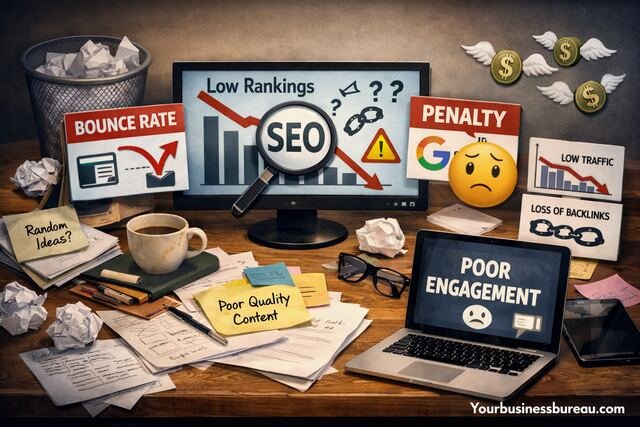
Unstructured content severely damages search performance. Search engines prioritize intent-aligned, topically relevant, semantically enriched content. Publishing disconnected, keyword-stuffed, or thin articles prevents indexing, ranking, and long-term visibility. Without semantic relevance, US businesses lose out to competitors with stronger topical depth.
In my SEO audits, I’ve found that many US companies unknowingly compete against themselves by publishing multiple pages on similar topics without hierarchy. This confuses Google’s indexing and splits ranking power across redundant URLs. A content strategy would consolidate topics, build authority, and drive better rankings across intent stages.
Another major issue lies in metadata, internal linking, and structured data. Content without strategy often lacks schema, fails to target long-tail queries, and remains disconnected from other on-site assets. That not only hurts organic traffic but also erodes dwell time and engagement, key ranking factors in the US digital landscape.
Search Engine Confusion
Unplanned publishing results in keyword cannibalization and indexing conflicts, weakening authority on core topics.
Loss of Semantic Value
Content lacking in semantic connections cannot build topical clusters, lowering visibility in featured snippets, People Also Ask boxes, and SERPs.
What Are the Operational Costs of Publishing Without Strategy?
Producing content without strategic planning drains time, money, and creative energy. US companies often invest in writers, designers, or freelancers to churn out assets that go unused or underperform. These sunk costs add up quickly, especially when no results follow.
I’ve seen marketing teams spend months developing ebooks, blog series, or campaigns that no one reads. When you add up labor hours, design fees, and ad spend for promotion, the loss becomes a financial liability. Strategic planning would have filtered out irrelevant topics, aligned with funnel stages, and maximized content ROI.
Beyond budget waste, content production without direction often leads to burnout and inefficiency among team members. Writers get frustrated when their work doesn’t perform. Stakeholders lose confidence in content as a channel. Without results, upper management cuts content investments entirely, even if the failure lies in strategy, not execution.
Budget Drain
Money spent on ineffective content assets can’t be recovered. Poor ROI damages trust in content marketing as a revenue channel.
Team Inefficiency
Lack of direction leads to duplicated efforts, unclear roles, and demotivated team members who feel their work lacks impact.
How Does Strategic Content Improve User Engagement?
Strategic content aligns with user needs, expectations, and intent. Readers find exactly what they’re looking for, engage longer, and convert at higher rates. When topics match pain points and content structure mirrors their journey, businesses build trust, improve retention, and drive measurable results.
In one project, I helped a B2B SaaS company in the US reorganize its blog around customer use cases and buying stages. Engagement metrics skyrocketed, bounce rates dropped by 45%, and time-on-page nearly doubled. The strategy aligned content to user actions and sales objectives, leading to growth in both traffic and conversions.
Mapping content to user journey stages also enables better personalization. From awareness blogs to decision-level case studies, users find value at every step. That consistency encourages them to return, subscribe, and share, amplifying reach and building a content ecosystem that fuels organic growth.
Journey Mapping
Content that reflects the user journey, from awareness to conversion, drives deeper engagement and nurtures leads effectively.
Behavioral Signals
High engagement triggers positive behavioral signals like scroll depth, lower bounce, and repeat visits, all of which improve SEO and credibility.
What Role Does Topic Authority Play in Content Strategy?
Topic authority determines how well a brand owns and dominates a subject area. Without strategic planning, content remains shallow, scattered, or off-topic, making it difficult to earn authority in competitive US sectors. Businesses that focus on publishing volume without thematic structure weaken their domain’s topical relevance.
During a recent consultation with a legal tech firm, I identified that their blog covered random topics from startup funding to employee wellness with no topical cluster strategy. By focusing content efforts around legal compliance, contract management, and HR law, we elevated their authority and doubled organic traffic in four months.
Topic authority builds naturally when content is published around a defined semantic core with interconnected articles, pillar pages, and keyword variations. This approach signals to search engines and users that the business is a subject matter expert, increasing trust and visibility across platforms.
Thematic Relevance
Organized content around a core theme improves search visibility and builds long-term authority.
Internal Link Ecosystem
Strategic internal linking supports semantic connections, distributes link equity, and improves crawlability.
How Can US Businesses Shift from Chaos to Strategy in Content Publishing?
Businesses can realign content publishing with strategy by first auditing current assets, identifying gaps, and mapping content to customer intent. Every piece should have a goal: inform, attract, convert, or retain. From there, creating a content calendar based on SEO research, business objectives, and buyer personas will guide consistent, high-impact creation.
In my strategy workshops, I walk teams through content inventory audits, user journey mapping, and keyword clustering. Once we organize existing assets and define a roadmap, the transformation is almost immediate. Suddenly, content has purpose. Writers have direction. Metrics improve. Content marketing becomes predictable and powerful.
The key lies in cross-functional collaboration. Marketing must work with sales, product, and customer success teams to build content that reflects real customer needs and business goals. Consistency, relevance, and measurable KPIs ensure that every published asset contributes to business growth.
Content Audit and Mapping
Auditing existing content reveals gaps and duplication. Mapping assets to buyer intent clarifies content purpose and identifies improvement areas.
Collaborative Strategy Design
Creating a shared roadmap across departments ensures that every piece of content supports brand, user, and revenue objectives.
Comparison Between Unstrategic vs. Strategic Content Publishing
| Factor | Without Strategy | With Strategy |
| Topic Focus | Random, inconsistent | Aligned with core themes |
| Audience Relevance | Low, generic | Tailored to user intent |
| SEO Performance | Weak rankings, low traffic | Strong rankings, semantic visibility |
| Team Efficiency | High frustration, duplicated effort | Clear roles, better collaboration |
| Conversion Metrics | Untracked or flat | Tracked and optimized |
Conclusion
Publishing content without strategy exposes US businesses to financial loss, reputational damage, and digital underperformance. While the pressure to publish fast is understandable, quality without direction brings little value. I’ve seen countless brands shift from chaos to clarity once a strategy is in place, resulting in better SEO, more engagement, and real business results. Content should never be a guessing game. When every word has purpose, impact becomes measurable, predictable, and scalable.
If you want to explore how we help businesses grow from the ground up, you can visit yourbusinessbureau.com to see what we offer.
FAQ’s
Many companies underestimate the complexity of content marketing. They believe consistent publishing alone brings results, overlooking the need for alignment with audience intent, business goals, and SEO frameworks.
Signs include poor organic traffic, low engagement, repeated topics, vague messaging, and unclear performance metrics. A content audit will reveal these patterns and help you recalibrate.
Yes. With a proper audit, existing content can be restructured, rewritten, or repurposed to fit strategic themes. Many underperforming assets hold value but need alignment and optimization.
Start with a content inventory. Identify what exists, what’s performing, and what’s redundant. Then create a plan that aligns topics with user intent, sales stages, and SEO clusters.
At least quarterly. Market trends, search behavior, and business priorities shift regularly. Regular reviews keep your content agile, relevant, and high-performing.


