








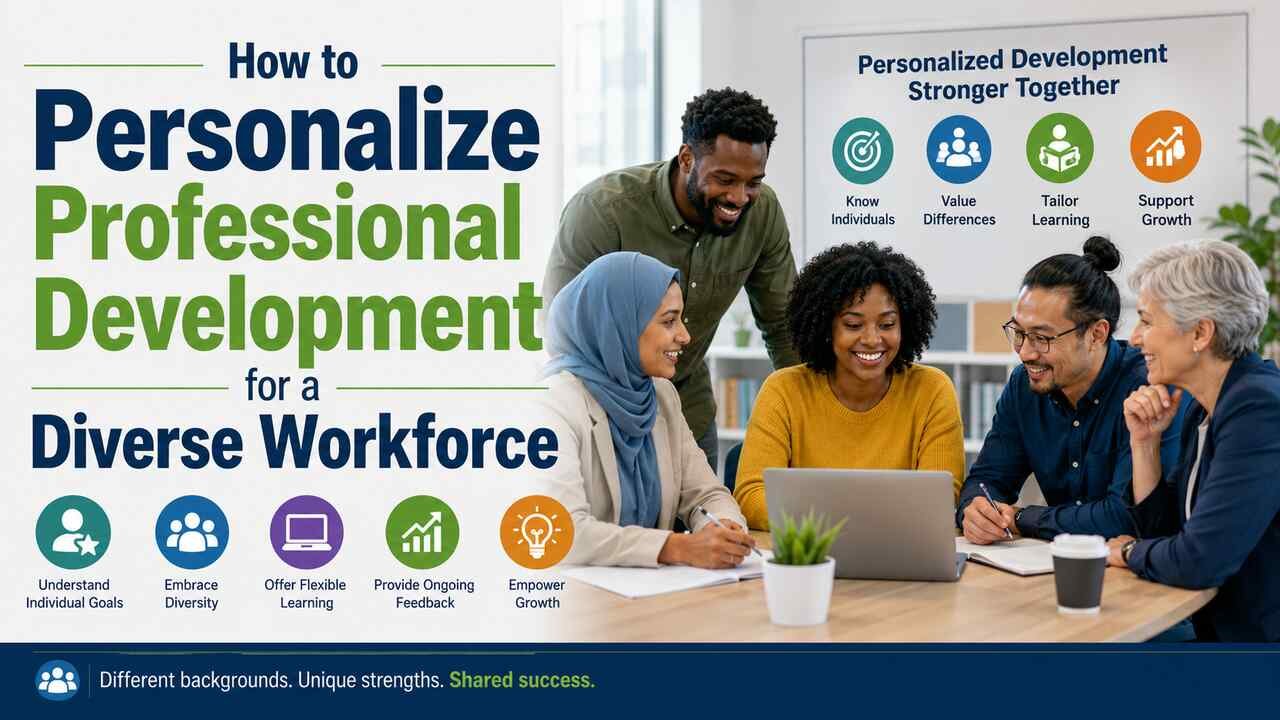
Training programs that are not customized have a problem: they are designed based on a typical employee who does not really exist, considering the diversity in generations, learning methods, culture, and cognitive abilities within a workplace. The solution is to implement personalized training as a standard component for all employees, rather than a costly add-on feature.
Start With A Skills Picture, Not Job Titles
Most organizations provide training based on the role. For instance, all people with the same job title receive the same training modules, regardless of their existing knowledge or specific areas where they are facing challenges. This results in a waste of time for experienced employees and can create stress for those who require additional assistance before being prepared to implement their new skills.
By conducting a skills gap analysis, this situation is improved. In this scenario, employees submit diagnostic assessments that compare their current skills to what is required for their specific role. After that, individual learning pathways are designed based on this real information, rather than general assumptions.
Here is where andragogy plays a role. Teaching adults is different from teaching children as adults have to know the reason why they must learn something before committing to it. If an employee has a good understanding of the topic at hand, listening to a 45-minute lecture will not provide any benefits, they are simply waiting for the info they need. A tailored learning pathway will skip the topics that an individual is already familiar with and instead focus on the areas they still need to develop.
Build Content That Works For Different Minds
A workforce that has many different types of people needs various formats to cater to everyone’s learning styles and needs. Whereas some individuals prefer watching videos, others would rather read the text at their own pace. There are also those who learn best by interacting with the content, such as through simulations or interactive exercises.
Multimodal content, in this context, refers to offering various formats in which the training content is delivered. As mentioned, this approach to learning and training is not just about offering different formats, it is about fairness and access to learning. For example, asynchronous formats allow individuals in different time zones or with diverse work schedules to access training when it suits them. Short microlearning modules are particularly effective for individuals with short attention spans or very limited time to focus on training.
Ultimately, the goal of offering different formats is to ensure that everyone can engage with and learn from the training materials in the most effective way for them. If someone can’t learn because the material is inaccessible to them, the training program has failed that individual.
Use Technology To Make Personalization Scalable
Manual customization does not work when it comes to training a large number of employees. For instance, an L&D manager cannot create a unique curriculum for each of the 500 employees, monitor the areas where each employee is facing difficulties, and update the content delivery in real-time. Adaptive learning systems can do all this for you. They use algorithms to monitor how well each employee is progressing and immediately update their performance based on it.
If someone is unable to comprehend a particular topic and therefore consistently fails, the system will respond to that by providing additional practice questions to strengthen their concept. Similarly, if a person is going through the topics easily and answering all questions correctly then the system can understand that the person has a good grip over the concept and present them with slightly advanced questions. This quick response helps you keep track of the weaknesses and strengths of each employee and alter their learning journey accordingly.
Using AI for employee training can streamline content customization and feedback loops for hundreds of unique learners simultaneously. This is something that will take an entire L&D team weeks to accomplish and they can barely do it for a fraction of the number of employees. It is not just about speeding things up; these systems often catch people’s weakest abilities weeks before a final assessment and, compared to human judgments, they seem pretty good at it.
Also, the insights that the systems generate can help you recognize learning fatigue. This is when teams or departments disengage from training and begin to lose interest. AI can help you recognize such trends when they are just in the nascent stage and are still to affect the overall performance.
Make Learning Part Of The Daily Workflow
Pre-scheduled training sessions are fundamentally flawed in that they occur off the job, so employees must somehow translate what they’ve absorbed and bring it back to the workplace. It’s in that translation that some of the new knowledge can be lost.
Just-in-time learning fills this space. When an employee is confronted with a novel situation, they should pull up the appropriate module right then and there – not store their question for two months. An LMS that plays nicely with the tools employees use every day will present the exact content required at the exact time needed, transforming learning from conceptual to contextual.
This strategy also changes the way training is perceived. It isn’t something an employee is sent to do, but rather something they look up when required.
Peer Knowledge Is An Underused Asset
While technology is good at handling scale – for example, it’s great at sending out courses and prompting employees to complete them – it’s terrible at providing human context. This is why peer mentoring can help. Employees with a certain skill set or experience level can mentor others across teams. This not only shares the “do this” part of training from peer to peer but also the “here’s how I mastered it.” It becomes a two-way conversation, not a one-way order.


