








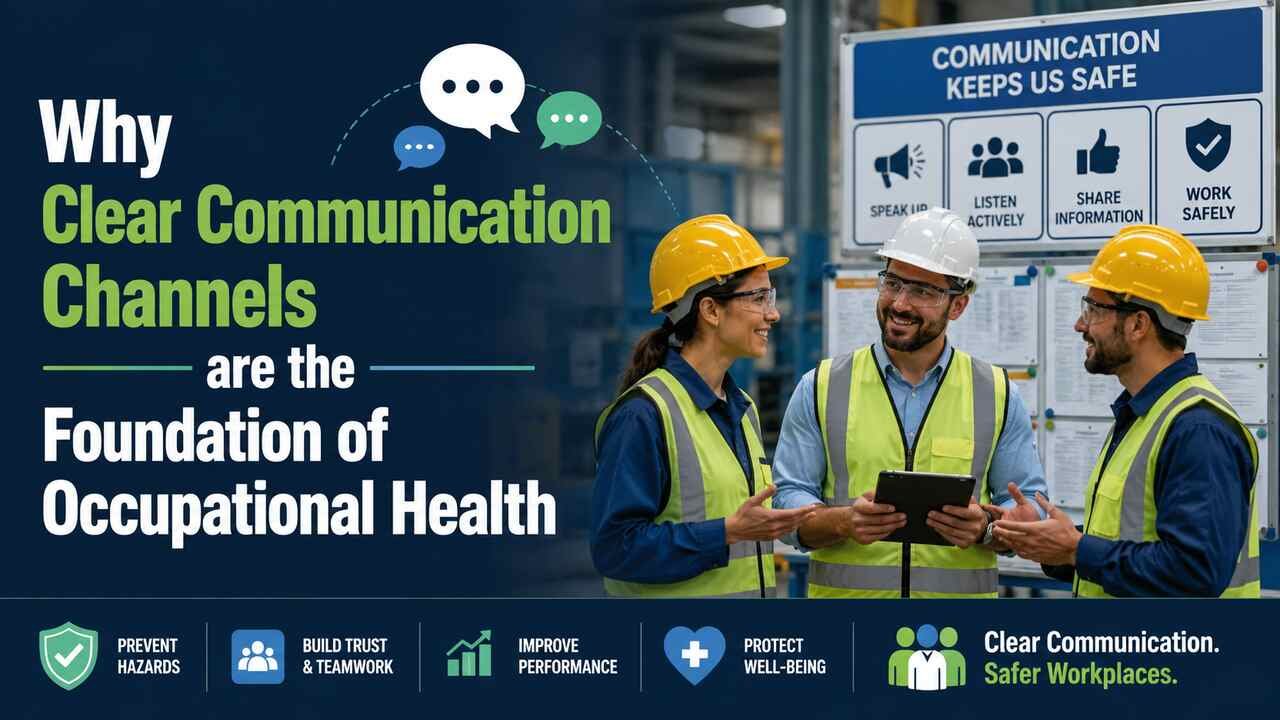
While a hard hat is a vital piece of safety equipment, the real key to worksite safety is effective communication. When mistakes happen, it’s important to be able to warn others quickly and easily. A malfunctioning communication system can put a worksite at unnecessary risk, and can even be the cause of an accident. Are you providing your team with the best safety equipment available?
Information silos are a safety hazard
Many people consider information silos an issue that affects efficiency. However, in the field of occupational health, they represent a risk. If different departments do not share up-to-date information on workplace hazards, employees in one section may be exposed to risks that have been identified by other employees and reported by another team. For example, if the maintenance team is not aware that the chemical handling team reported a ventilation problem, the appropriate people are not given all the necessary information. This is not due to a preference for withholding information from other teams but rather to the lack of a system.
Overcoming this problem involves more than sending a team representative to multiple meetings. It means developing a communication system that ensures safety-critical information is shared horizontally between teams and not merely communicated vertically, from the lower levels of one team to the upper levels of another. When a workplace hazard is reported, this system must automatically notify the correct people without relying on an email sitting in someone’s inbox.
The mechanics of critical alarm management
Alert fatigue poses a real danger. If all notifications have the same priority, people will overlook urgent messages. This is how critical health alerts are not spotted.
Good alarm management involves tiering notifications according to their level of severity, ensuring that they are sent to the most appropriate responders, and preventing important messages from being drowned out by routine ones. Business communications services and solutions that include alarm management across the facility network allow safety teams to implement this level of prioritization. For example, a man-down alert from the panic device of a lone worker automatically sends an alert to a supervisor rather than being scrolled past as part of the general notifications.
This is where you can’t separate your IT infrastructure from health outcomes. Incident response time is a KPI and is directly impacted by the operational design of your communications systems.
Lone workers and mobile-first safety
Field workers, remote staff, and lone workers have a different risk profile compared to office-based employees. Their adherence to safety protocols and access to emergency support relies on mobile connectivity. If the necessary infrastructure and technology is not in place – if there are coverage blackspots, no backup network to kick in during an outage, or no panic button capability – that individual is more at risk than any written safety rule should allow.
A mobile-first workplace communications strategy enables lone workers to raise alerts, contact emergency responders, and confirm their status wherever they are operating. Redundant connectivity, through the use of multiple networks, cellular, radio, and more, ensures that if one network goes down, nobody is left in the dark. Engaged teams that are connected and well informed often see a significant decline in safety incidents. That doesn’t mean just handing out leaflets. It means arming workers with the tools to respond instantly to the information they receive.
Two-way communication and psychological safety
Occupational health is not simply about physical health risks. Mental health results at work are vastly determined by a person’s likelihood of reporting concerns without facing resistance. For this to occur, two-way communication is imperative. Employees must feel able to report a near-miss, raise concerns about burnout, or alert you about a co-worker’s health. This will only occur if there are open, accessible channels for doing so.
Having channels that are easy to access and use is what turns two-way communication into a health metric, rather than an engagement question. If the only way to report a problem is to lodge a formal HR complaint, very few people will come forward. If there is an anonymous, or low-effort mechanism or a direct line to a health contact, more near-misses will be reported. And near-miss reports are exactly what organizations need to pinpoint the sources of risk in their systems before they result in actual injuries.
Communication logs as audit infrastructure
Any message sent during an incident, any alert triggered, any check-in completed – that data is also audit evidence. ISO 45001 and similar frameworks expect organizations to prove their ongoing improvements in safety management. The communication log is the paper trail for that.
When a safety review board asks what occurred in the twenty minutes before an incident, a well-kept communication log can tell them. It shows response times, highlights when information was not available, and can identify common response patterns in team communication in stressful situations. This is easily achieved through workflow automation as long as you remember to set it up to log messages.
Building the infrastructure before you need it
Organizations that manage health emergencies successfully are not the ones who react first and fastest when something happens. They are the ones who, long before anyone was at risk, established redundant, reliable lines of communication. Who created escalation paths, figured out how to make disparate systems talk with each other. None of that can be worked out on the fly when someone’s life is on the line.


