





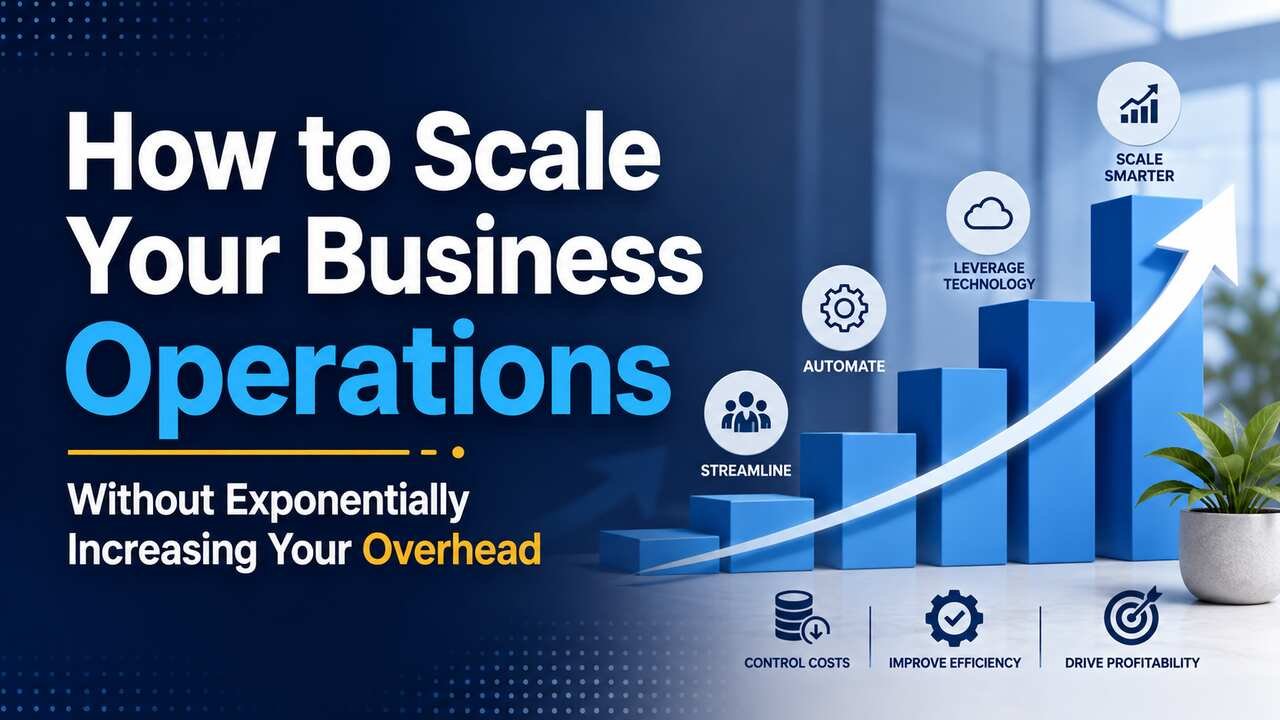
Most businesses don’t fail to grow. They grow in the wrong direction – costs accelerate faster than revenue, margins compress, and what looked like success starts to feel like a trap. The goal isn’t to scale fast. It’s to scale in a way where each new dollar of revenue costs you less to produce than the last one. That’s operating leverage, and building it requires making deliberate structural decisions before the pressure hits.
Shift The Cost Base Before You Need To
The businesses that scale cleanly are the ones that have already moved away from heavy fixed costs before growth demands it. Fixed costs – long-term leases, full-time headcount across every function, owned infrastructure – create a ceiling on how efficiently you can grow. Once those obligations are locked in, every fluctuation in revenue hits your margin directly.
The move is to make as much of your cost base variable as possible. Outsourcing logistics to a 3PL provider means your warehousing and fulfillment costs scale in direct proportion to order volume, not ahead of it. Delegating bookkeeping or first-tier customer support to a business process outsourcing partner means you’re paying for output, not for desk time. These aren’t compromises. They’re structural decisions that protect your margin as you grow.
Rethink Your Physical Footprint
Commercial real estate is where a lot of growing businesses quietly take on risk they don’t fully account for. A five-year lease signed at the right moment can become a serious liability two years later when headcount needs drop or the team goes hybrid. Long-term commitments made on the assumption of continuous linear growth rarely survive contact with reality.
Flexible workspace arrangements, provided by companies like Workit Spaces, can help to solve this. Growing businesses are able to access professional office and warehouse infrastructure on terms that actually match how they operate – with the ability to scale space up or down as team size and inventory needs change, without carrying the liability of a multi-year commercial lease. For e-commerce businesses especially, co-warehousing options mean storage capacity can contract after peak season rather than sitting underutilized at full cost.
Automate Before You Hire
When your business grows, the knee-jerk reaction is to hire more people. While this might be necessary, you should first evaluate whether all your processes are as efficient as they could be. Before you start expanding your team, take a closer look at your workflows and identify any areas where manual work is still being done but could be automated instead. This can include copying data between systems, preparing status update emails, or compiling reports from various systems.
Tools like Zapier or Make can help you automate the transfer of data between systems that don’t have a direct exchange interface. This can save you a lot of time and reduce the number of errors caused by manual data transfers. According to research conducted by McKinsey, companies that consider automation for all their operational workflows can increase their team’s capacity by up to 20%, without having to hire additional employees. More importantly, without spending money on salaries, you’re actually increasing your business productivity.
The principle is simple: exhaust your automation options first. New hires inherit the workflows you have, so if those workflows are inefficient, you’re scaling the inefficiency alongside the headcount.
Build A Hybrid Talent Model
Hiring full-time permanent employees is a good choice for your core strategic leadership team – those who require in-depth understanding, consistency, and decision-making power. However, this might not be the best solution for every role at every phase of your business growth.
Fractional hiring allows you to access the knowledge of senior professionals without the full-time commitment. For example, a fractional CFO or COO can dedicate 10 to 15 hours a week for a fraction of the cost you would pay for a full-time employee with the same qualifications, bringing expertise gained from working with various companies to the table. In addition to this, you can hire a pool of freelancers with specific skills whenever needed for project-based work. This approach ensures you have the resources needed for your business potential while keeping your fixed costs low.
The hard part is distinguishing which aspects should be handled by your core team and which you should outsource. For instance, you might want to keep your customer acquisition strategy within your company but outsource graphic design for your marketing campaign.
Close The Documentation Gap
The additional costs associated with growth are often related to training and ensuring that each new hire or contracted resource becomes productive. In the absence of standardized procedures, everything relies on the know-how of the existing team. Each transition period serves as a training opportunity, and every new employee requires time before they start adding value.
That’s where standard operating procedures step in. Those are actually a centralized database where all essential business processes are recorded. This way, newcomers or external collaborators can begin working autonomously. Moreover, the organization is not left in the lurch whenever an employee decides to leave.
It might not be at the top of your to-do list, but it is precisely the factor that differentiates a company that can grow and delegate responsibilities and a company that cannot. Scaling up without increasing administrative costs is not a matter of working double time. Successful companies approach their current cost structure levels with the same level of cautiousness as they manage their revenue streams. And they implement all necessary administrative measures to support future growth while there’s still time.


