



Schulich School of Business as York University’s business school in Toronto, offering undergraduate, MBA, specialized master’s, executive, and doctoral programs. It highlights the main considerations for prospective students: choosing the right program, understanding admission competitiveness and tuition costs, and evaluating whether Schulich’s career opportunities align with their goals.
Schulich School of Business at a Glance
Schulich is part of York University and is based in Toronto, one of Canada’s largest business and financial centres. Its program portfolio extends beyond a conventional undergraduate business degree and MBA, giving students options in areas such as management, marketing, business analytics, finance, and supply chain management.
The school also has a visible position in international business-school rankings. Schulich reports being in the top 100 worldwide in the 2026 QS Global MBA Ranking. Its Master of Supply Chain Management ranked first in Canada and 25th globally in the QS 2026 ranking, while its Master of Marketing ranked first in Canada and within the global top 50 in the corresponding QS 2026 ranking.
Rankings can be useful for comparing a school’s international visibility, but applicants should not make a decision from a single league table. Program curriculum, total cost, recruiting opportunities, location, specialization choices, and career objectives usually provide a more practical basis for comparing business schools.
What Programs Does Schulich School of Business Offer?

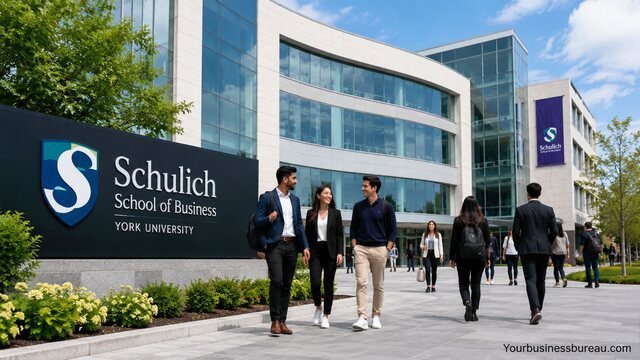
Schulich serves both students entering university and professionals pursuing graduate business education.
One of its best-known undergraduate options is the Bachelor of Business Administration (BBA). Graduate students can pursue the Master of Business Administration (MBA) or choose specialized master’s programs aimed at particular professional fields.
Examples of graduate study options include the Master of Management, Master of Business Analytics, Master of Marketing, and other specialized business degrees. Schulich also offers combined programs for candidates whose career goals cross traditional academic boundaries.
For example, its Hennick JD/MBA combines management and legal education, while the MBA/MFA/MA pathway connects business education with studies in the arts.
This range matters when choosing a degree. A recent graduate without extensive professional experience may find a specialized master’s or management degree more appropriate than an MBA, while someone with several years of post-degree professional experience may benefit more from the MBA.
Schulich BBA: What Undergraduate Applicants Should Know
The Schulich BBA is primarily designed as a direct-entry program for students coming from high school.
Admission is based on two equally weighted components: academic performance and the Schulich supplementary application. This distinction is important because strong grades alone do not guarantee admission.
For Ontario high school applicants, Schulich advises students to aim for grades in the high 80s to low 90s to be academically competitive. Historical minimum cutoffs have been around the low 90s, but a past cutoff should not be interpreted as a guaranteed future admission threshold.
Required Ontario Grade 12 courses include ENG4U, MHF4U, and either MCV4U or MDM4U among the applicant’s top six Grade 12 courses. Minimum grades also apply to specified prerequisite courses.
The supplementary application gives Schulich another way to evaluate candidates. The school looks beyond academic marks to qualities such as leadership potential, teamwork, resilience, and empathy.
Why the Supplementary Application Matters
An applicant with excellent grades should not treat the supplementary component as a formality. Because academics and the supplementary application receive equal weighting, preparation for both parts of the process matters.
Students can strengthen their application by thinking carefully about experiences that demonstrate how they handled responsibility, collaborated with others, solved problems, adapted to setbacks, or contributed to a group. The strongest examples do not necessarily need to come from prestigious internships. School activities, volunteering, employment, sports, community involvement, and meaningful personal responsibilities may provide relevant evidence when presented clearly and truthfully.
Can You Transfer Into the Schulich BBA?
Transfer rules are an area applicants should check before planning their university pathway.
Schulich states that the BBA does not consider external transfer students because of the structure and size of the program. Students who previously attended another postsecondary institution and then enrolled at York are also not eligible through this route.
A limited delayed-entry pathway exists for certain current York University students who entered York directly from high school and satisfy the applicable first-year prerequisites. Schulich describes this route as extremely competitive, with only a small number of successful applicants in a typical year.
That means a student should not enroll elsewhere with the assumption that transferring into Schulich later will be straightforward. Applicants who ultimately want the BBA should understand the direct-entry rules before deciding where to begin their undergraduate studies.
Schulich MBA Admission Requirements
The MBA targets applicants who already have university education and professional experience.
Schulich’s general MBA requirements include an undergraduate degree from a recognized postsecondary institution and at least a B average during the final two full years, or its equivalent. Applicants with three-year degrees may also be considered under specified conditions.
Professional experience is another major requirement. MBA candidates generally need at least two years of relevant post-degree, full-time work experience or life experience.
The application also includes multiple components beyond academic transcripts.
| MBA application component | General requirement |
| Undergraduate education | Recognized degree, normally with at least a B average in the final two full years |
| Professional experience | Minimum two years of relevant post-degree full-time work or life experience |
| GMAT/GRE | Acceptable scores generally required, subject to applicable waiver provisions |
| Essays | Written, timed written, and video components |
| Resume | Current resume required |
| References | Two references |
| English proficiency | Required when previous studies do not meet the applicable English-language conditions |
| Interview | May form part of the admissions process |
Schulich describes MBA admissions as holistic. Meeting minimum requirements therefore establishes eligibility rather than guaranteeing an offer.
GMAT and GRE Requirements
MBA applicants generally submit the GMAT or GRE, although waiver provisions may apply to qualifying candidates in certain circumstances.
Applicants should distinguish the MBA from other Schulich graduate programs. Some specialized master’s degrees do not require the GMAT or GRE. For example, Schulich states that applicants to its Master of Management and Master of Business Analytics are not required to take these tests.
That difference can materially affect application planning. Candidates should always check the requirements for their specific degree rather than assuming every Schulich graduate program follows the MBA’s testing policy.
English-Language Requirements for International Applicants
Applicants whose previous education does not satisfy Schulich’s English-language exemption conditions may need to demonstrate English proficiency.
For the MBA, Schulich lists an IELTS Academic requirement of 7.0 overall, with at least 6.5 in each dimension. TOEFL requirements depend on the applicable test format and date, so applicants should verify the current threshold directly before booking or submitting an examination.
English proficiency is only one part of an international application. International candidates also need to account for immigration requirements, document preparation, tuition differences, funding, housing, and study-permit processing.
Applying early can therefore have practical advantages beyond admissions.
Schulich MBA Tuition and Costs
MBA tuition differs substantially between domestic and international students.
Under Schulich’s Fall 2026 fee framework, the estimated total full-time MBA tuition is approximately:
| Student category | Tuition per term | Estimated full-time MBA program total |
| Domestic | C$18,464 | C$73,858 |
| International | C$31,003 | C$124,011 |
These figures include supplementary fees according to Schulich’s published graduate tuition information and remain subject to change.
The standard full-time MBA takes an average of four terms to complete. Schulich also identifies an accelerated full-time pathway that may be completed in two terms for eligible students.
Tuition should not be treated as the complete cost of an MBA. A realistic budget may also need to include accommodation, food, transportation, health-related expenses, books or educational materials, immigration expenses for international students, and the opportunity cost of reducing or leaving employment while studying.
For an international candidate in particular, the difference between the published tuition figure and the total amount needed to live and study in Toronto can be significant.
Choosing Between the MBA and a Specialized Master’s Degree

Not every prospective graduate business student should automatically pursue an MBA.
The MBA is generally more appropriate for applicants who already have meaningful professional experience and want broader management development, career advancement, leadership preparation, or a career transition.
A specialized master’s degree may be more appropriate when the applicant wants deeper education in a defined discipline.
Consider the decision this way:
| Applicant goal | Program type worth considering |
| Broad management and leadership development | MBA |
| Recent graduate seeking foundational management education | Master of Management |
| Career focused on data-driven business decisions | Master of Business Analytics |
| Specialized marketing career | Master of Marketing |
| Supply chain specialization | Master of Supply Chain Management |
| Combined business and legal career | JD/MBA |
This is a decision framework rather than an admissions guarantee. Academic background, professional experience, prerequisites, career objectives, and current program requirements still need to be checked individually.
A candidate with little professional experience should pay particular attention to this distinction. Choosing a specialized master’s degree simply to avoid the MBA work-experience requirement is not necessarily the right strategy. The better question is which curriculum and recruiting pathway best supports the candidate’s intended career.
How Competitive Is Schulich School of Business?
Admission competitiveness depends heavily on the program.
For the undergraduate BBA, Schulich receives thousands of applications and expects strong academic performance alongside a competitive supplementary application. Historical grade cutoffs can help students understand the academic range, but they should not be treated as fixed admission guarantees.
MBA competitiveness works differently. Graduate admissions evaluate university performance, professional experience, standardized test results where required, essays, references, resume quality, communication, and overall candidate fit.
This makes a simple “Schulich acceptance rate” less useful than it initially appears. Even if a historical overall percentage is available from a third-party website, it may combine applicants with very different profiles or may not reflect the specific program and admission cycle a candidate is targeting.
Applicants can make better decisions by comparing their profile against the official requirements and competitive characteristics of the exact Schulich program they want to enter.
Schulich Rankings: How Much Should They Matter?
Schulich appears in several international business-school rankings, but each ranking measures different factors.
The school reports a top-100 position in the 2026 QS Global MBA Ranking. It also reports strong subject-level results for programs including supply chain management and marketing, as well as placements in other international rankings.
A high ranking can indicate international recognition, but rankings should be interpreted carefully. Methodologies can place different weights on salary outcomes, employer reputation, research, sustainability, entrepreneurship, alumni careers, or other factors.
For prospective students, a useful ranking comparison should therefore answer three questions:
- Is the ranking measuring the specific program you want to study?
- Do its evaluation criteria match what matters to your career?
- Does the program produce opportunities in the geography and industry where you intend to work?
A student interested in Canadian supply-chain careers, for example, may learn more from the performance and curriculum of the supply-chain program than from Schulich’s overall MBA position.
Studying at Schulich as an International Student
International students should evaluate Schulich from both an academic and financial perspective.
Toronto provides access to a large and diverse employment market, but studying there also requires careful financial planning. International tuition can be substantially higher than domestic tuition, as the 2026 MBA fee structure demonstrates.
Applicants should also start immigration planning early. Schulich advises international MBA candidates to apply in earlier rounds, both to improve access to available scholarships and financial aid and to allow sufficient time for study-permit processing.
An international applicant’s planning sequence might therefore look like this:
Program selection → eligibility check → test preparation if required → application documents → early application → funding plan → study-permit process → housing and arrival planning.
Treating immigration and financing as last-minute tasks can create avoidable problems even after an applicant receives an admission offer.
How to Decide Whether Schulich Is Right for You
A business school should be evaluated according to the outcomes you need rather than reputation alone.
Start with your intended career. Identify the industry, job function, and geographic market you hope to enter after graduation. Then examine which Schulich program provides the curriculum and professional development most closely aligned with that target.
Next, calculate the full financial commitment. Include tuition, living expenses, financing costs where applicable, and income you may give up while studying. International candidates should use international tuition rather than domestic figures when estimating the investment.
Finally, compare Schulich with alternative schools using the same criteria.
A useful comparison should include:
- Program curriculum and specialization options
- Admission requirements
- Total tuition and estimated living costs
- Program duration
- Internship or experiential-learning opportunities
- Career services and recruiting relevance
- Alumni presence in your target field
- Location
- International-student considerations
- Scholarships and funding
- Expected career outcomes
This approach produces a much more meaningful decision than choosing whichever institution occupies the highest position in a general ranking.
Common Mistakes Schulich Applicants Should Avoid
One common mistake is assuming that meeting minimum admission requirements makes acceptance likely. Schulich explicitly notes that satisfying minimum MBA requirements does not guarantee admission, and the undergraduate process similarly considers more than grades.
Another is relying on old admission thresholds, tuition figures, or application deadlines found on third-party websites. These details can change between admission cycles.
International students can also underestimate how much planning occurs after admission. Tuition is only part of the financial commitment, while immigration processing can add another important timeline.
Finally, applicants sometimes focus on the school’s overall reputation without investigating their specific degree. The Schulich MBA, BBA, Master of Marketing, and Master of Business Analytics serve different students and career goals. The quality of the match between the applicant and the program matters more than the school name alone.
Conclusion
The Schulich School of Business offers several routes into business education, from the undergraduate BBA to the MBA and specialized master’s programs in fields such as management, analytics, marketing, and supply chain management.
Prospective students should focus on program fit rather than the Schulich name alone. BBA applicants need to prepare for both academic and supplementary admission criteria, while MBA candidates need to consider professional experience, testing, application quality, and the considerably higher financial commitment of graduate study.
Before applying, verify the requirements, tuition, deadlines, and international-student rules for your specific intake directly with Schulich. Those details can change from one admission cycle to the next, while rankings and historical admission thresholds should be used as context rather than guarantees.
Read Also: Business A Level Past Papers: The Complete Guide to Finding, Using, and Mastering Exam Practice
FAQ’s
Yes. Schulich is York University’s business school in Toronto, Canada, offering undergraduate, graduate, executive, and doctoral business education.
Admission is competitive. Schulich considers academic performance and the supplementary application equally, and competitive Ontario applicants have historically needed grades around the low-90s range. Historical thresholds do not guarantee admission in a future cycle.
The general MBA requirement is at least two years of relevant post-degree, full-time work experience or life experience. Applicants should confirm how their particular experience fits the school’s current requirements.
The MBA generally requires acceptable GMAT or GRE scores, although applicable waiver provisions exist for some candidates. Several specialized graduate programs have different policies, and programs such as the Master of Management and Master of Business Analytics do not require GMAT/GRE scores under their current published requirements.
Under the Fall 2026 fee framework, Schulich estimates the full-time MBA program tuition at approximately C$124,011 for international students, compared with approximately C$73,858 for domestic students. Fees are subject to change, and living and other personal costs are additional.
Schulich states that external transfer students are not considered for its BBA. A very limited delayed-entry process exists for eligible York University students who originally entered York directly from high school and meet the applicable requirements.


