



Highlights
- A small business marketing consultant builds a structured growth system that connects business goals with customer needs, which helps you move from random marketing efforts to predictable results.
- A consultant identifies gaps in your current strategy, which means you stop wasting money on ineffective campaigns and start investing in channels that actually generate leads and sales.
- A consultant saves your time by handling marketing complexity, which allows you to focus on running your business while still achieving consistent visibility and growth.
- A consultant improves your return on investment by using data-driven decisions, which ensures every action contributes to measurable outcomes instead of guesswork.
- A consultant strengthens your brand positioning, which helps you stand out in a competitive market and attract the right audience instead of everyone.
- A consultant integrates multiple marketing channels, which creates a system where social media, SEO, and email marketing work together instead of separately.
- A consultant prepares your business for the future through automation and personalization, which helps you scale without increasing workload.
A small business marketing consultant provides strategic planning, execution guidance, and performance optimization for businesses that need structured growth without wasting resources. A consultant bridges the gap between market demand and business visibility by aligning branding, customer acquisition, and retention strategies. Business owners rely on a consultant to turn limited budgets into measurable outcomes through targeted campaigns, data-driven insights, and scalable systems. A consultant does not only promote services; a consultant builds a long-term growth engine that supports consistent revenue and brand authority.
What Does a Small Business Marketing Consultant Actually Do?
A small business marketing consultant analyzes a company’s current position, identifies gaps, and designs a customized marketing strategy that aligns with business goals. A consultant studies audience behavior, competitor positioning, and messaging clarity to ensure every marketing effort produces measurable results. Business growth becomes structured instead of random because every decision connects to a defined objective.
A consultant manages multiple channels such as social media, search engines, email campaigns, and paid advertising. Each channel receives a specific role within the broader strategy, ensuring that customer acquisition, engagement, and retention work together. A consultant also ensures that branding remains consistent across all touchpoints, strengthening trust and recognition.
A consultant tracks performance using key metrics like conversion rates, customer acquisition cost, and return on investment. Data allows continuous improvement, which transforms marketing into an evolving system rather than a one-time effort. When I worked with a consultant for my own project, I realized how small adjustments in messaging and targeting created noticeable improvements in customer response.
Market Research and Audience Targeting
Market research identifies customer needs, preferences, and behavior patterns, which helps businesses create relevant offers. Audience targeting ensures that marketing efforts reach the right people instead of wasting resources on broad, ineffective campaigns.
Strategy Development and Execution
Strategy development defines clear goals and action steps, while execution transforms plans into real campaigns. Consistency in execution ensures that businesses maintain visibility and build long-term relationships with customers.
Why Should a Small Business Hire a Marketing Consultant?


A small business hires a marketing consultant to gain expertise without the cost of a full in-house team. A consultant provides specialized knowledge in branding, advertising, and digital marketing, which helps businesses avoid costly mistakes. Expertise leads to faster results because strategies are based on proven frameworks instead of trial and error.
A consultant also saves time for business owners, allowing them to focus on operations, product development, and customer service. Marketing becomes more efficient because a consultant prioritizes high-impact activities instead of spreading effort across ineffective channels. Time efficiency directly contributes to revenue growth.
A consultant offers an external perspective that identifies blind spots. Business owners often become too close to their work, which makes it difficult to evaluate objectively. When I discussed my marketing challenges with a consultant, I noticed how quickly they identified gaps that I had overlooked for months.
Cost Efficiency and ROI Improvement
Cost efficiency improves because marketing budgets are allocated strategically. Return on investment increases when campaigns are optimized based on performance data.
Access to Advanced Tools and Insights
Advanced tools provide analytics, automation, and tracking capabilities that small businesses may not afford independently. Insights from these tools guide smarter decision-making.
How Does a Marketing Consultant Build a Growth Strategy?
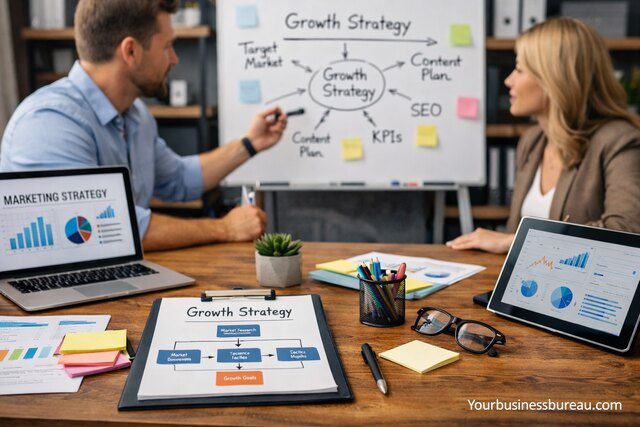
A marketing consultant builds a growth strategy by combining business objectives, customer insights, and channel selection into a unified plan. Strategy begins with defining clear goals such as increasing sales, improving brand awareness, or expanding into new markets. Goals guide every marketing decision.
A consultant then maps the customer journey, identifying key touchpoints from awareness to purchase. Each stage receives specific messaging and tactics to ensure smooth progression. A structured journey reduces friction and increases conversion rates.
A consultant integrates multiple channels into a cohesive system. Social media attracts attention, content marketing builds trust, and email campaigns nurture relationships. When I implemented a structured strategy with guidance, I noticed how each channel supported the others instead of competing for attention.
Customer Journey Mapping
Customer journey mapping visualizes how potential buyers interact with a business. Mapping helps identify gaps and opportunities for improvement.
Channel Integration and Optimization
Channel integration ensures consistent messaging across platforms. Optimization improves performance by adjusting campaigns based on data.
What Skills Define an Effective Marketing Consultant?
An effective marketing consultant combines analytical thinking, creativity, and communication skills. Analytical thinking allows a consultant to interpret data and identify trends. Creativity helps craft compelling messages that attract and engage audiences.
Communication skills ensure that strategies are clearly explained and executed. A consultant must translate complex concepts into actionable steps that business owners can understand and implement. Clear communication prevents misunderstandings and improves collaboration.
Adaptability defines long-term success in marketing. Trends, algorithms, and consumer behavior constantly change, which requires continuous learning. From my experience, consultants who stay updated with industry changes provide significantly better results than those who rely on outdated methods.
Analytical and Data Interpretation Skills
Data interpretation transforms raw numbers into actionable insights. Accurate analysis leads to better decision-making and improved campaign performance.
Creativity and Brand Storytelling
Creativity shapes brand identity and messaging. Storytelling builds emotional connections that encourage customer loyalty.
How Does Digital Marketing Fit Into Small Business Consulting?
Digital marketing forms the core of modern business growth because online platforms provide direct access to target audiences. A marketing consultant uses digital channels such as search engines, social media, and email to create scalable marketing systems. Digital presence increases visibility and accessibility.
Search engine optimization improves organic visibility, allowing businesses to attract customers without paying for every click. Social media marketing builds engagement and brand awareness through consistent interaction. Paid advertising accelerates results by targeting specific audiences.
Email marketing strengthens relationships by delivering personalized content directly to customers. When I applied email strategies suggested by a consultant, customer retention improved because communication became more consistent and relevant.
Search Engine Optimization and Visibility
Search engine optimization improves rankings and drives organic traffic. Higher visibility leads to increased credibility and customer trust.
Social Media and Engagement Strategies
Social media platforms enable direct interaction with customers. Engagement builds relationships and encourages repeat business.
What Challenges Do Small Businesses Face in Marketing?
Small businesses face challenges such as limited budgets, lack of expertise, and intense competition. Limited budgets restrict the ability to test multiple strategies, which increases the risk of ineffective campaigns. A consultant helps prioritize high-impact activities to maximize results.
Lack of expertise leads to inconsistent messaging and poor execution. Without proper knowledge, businesses may invest in channels that do not align with their audience. A consultant provides clarity and direction, ensuring that every effort contributes to growth.
Competition makes differentiation essential. Businesses must communicate unique value propositions to stand out. When I struggled with positioning, a consultant helped refine messaging, which made the brand more distinct and appealing.
Budget Constraints and Resource Allocation
Budget constraints require careful planning and prioritization. Efficient allocation ensures that resources are used effectively.
Competition and Market Differentiation
Market differentiation highlights unique strengths and benefits. Clear positioning helps attract the right audience.
How Can a Business Choose the Right Marketing Consultant?
A business chooses the right marketing consultant by evaluating experience, expertise, and communication style. Experience indicates familiarity with different industries and challenges. A consultant with relevant experience understands specific market dynamics.
Expertise ensures that the consultant possesses the necessary skills to deliver results. Businesses should review case studies, client testimonials, and past performance to assess credibility. Proven results provide confidence in the consultant’s abilities.
Communication style determines how effectively strategies are implemented. A consultant should explain concepts clearly and maintain transparency throughout the process. From my experience, working with someone who communicates openly makes collaboration smoother and more productive.
Evaluating Experience and Portfolio
Experience demonstrates the consultant’s ability to handle diverse challenges. A strong portfolio reflects successful campaigns and measurable outcomes.
Communication and Collaboration Approach
Effective communication ensures alignment between consultant and business goals. Collaboration improves execution and results.
What is the Future of Small Business Marketing Consulting?
The future of small business marketing consulting focuses on data-driven strategies, automation, and personalization. Technology enables consultants to analyze large datasets, which leads to more accurate targeting and improved performance. Data becomes the foundation of decision-making.
Automation tools streamline repetitive tasks such as email campaigns and social media scheduling. Automation increases efficiency while maintaining consistency. Businesses can focus on strategy and creativity instead of manual processes.
Personalization enhances customer experience by delivering relevant content based on individual preferences. Personalized marketing builds stronger relationships and increases loyalty. When I adopted personalized strategies, engagement rates improved significantly, which demonstrated the power of tailored communication.
Role of Artificial Intelligence in Marketing
Artificial intelligence enhances data analysis and automation. AI-driven tools improve targeting, content creation, and performance tracking.
Personalization and Customer Experience Trends
Personalization creates meaningful interactions with customers. Improved experiences lead to higher satisfaction and retention.
Key Marketing Activities and Their Impact
| Marketing Activity | Purpose | Expected Outcome | Business Impact |
| Search Engine Optimization | Improve organic visibility | Higher website traffic | Increased brand credibility |
| Social Media Marketing | Build engagement and awareness | Strong audience interaction | Customer loyalty growth |
| Email Marketing | Nurture leads and retain clients | Repeat purchases | Higher customer lifetime value |
| Paid Advertising | Generate quick traffic | Immediate leads and conversions | Fast revenue growth |
| Content Marketing | Educate and attract audience | Increased trust and authority | Long-term brand positioning |
Consultant Skills and Business Benefits Comparison
| Consultant Skill | Function in Marketing | Benefit for Business | Long-Term Advantage |
| Data Analysis | Interpret performance metrics | Better decision-making | Continuous improvement |
| Strategic Planning | Define goals and campaigns | Clear direction | Sustainable growth |
| Communication | Explain and implement strategies | Smooth collaboration | Efficient execution |
| Creativity | Develop engaging content | Strong brand identity | Competitive differentiation |
| Adaptability | Adjust to market changes | Updated strategies | Future readiness |
Conclusion
A small business marketing consultant plays a crucial role in transforming scattered marketing efforts into a structured growth system. A consultant combines strategy, execution, and analysis to deliver measurable results while optimizing resources. Businesses benefit from expertise, efficiency, and improved decision-making, which leads to sustainable growth. Personal experience shows that working with a consultant brings clarity, direction, and confidence in marketing efforts. Future trends indicate that data, automation, and personalization will continue to shape marketing strategies, making consultants even more valuable for small businesses aiming to compete effectively.
If you want to explore how we help businesses grow from the ground up, you can visit yourbusinessbureau.com to see what we offer.
FAQ’s
A consultant develops and executes marketing strategies that improve visibility, attract customers, and increase revenue.
Cost varies based on experience, project scope, and services offered, ranging from hourly rates to monthly retainers.
A business can succeed without a consultant, but a consultant accelerates growth and reduces costly mistakes.
Results depend on strategy and industry, but noticeable improvements often appear within a few months.
Retail, service-based businesses, startups, and local businesses benefit significantly due to competition and visibility challenges.


