


Highlights
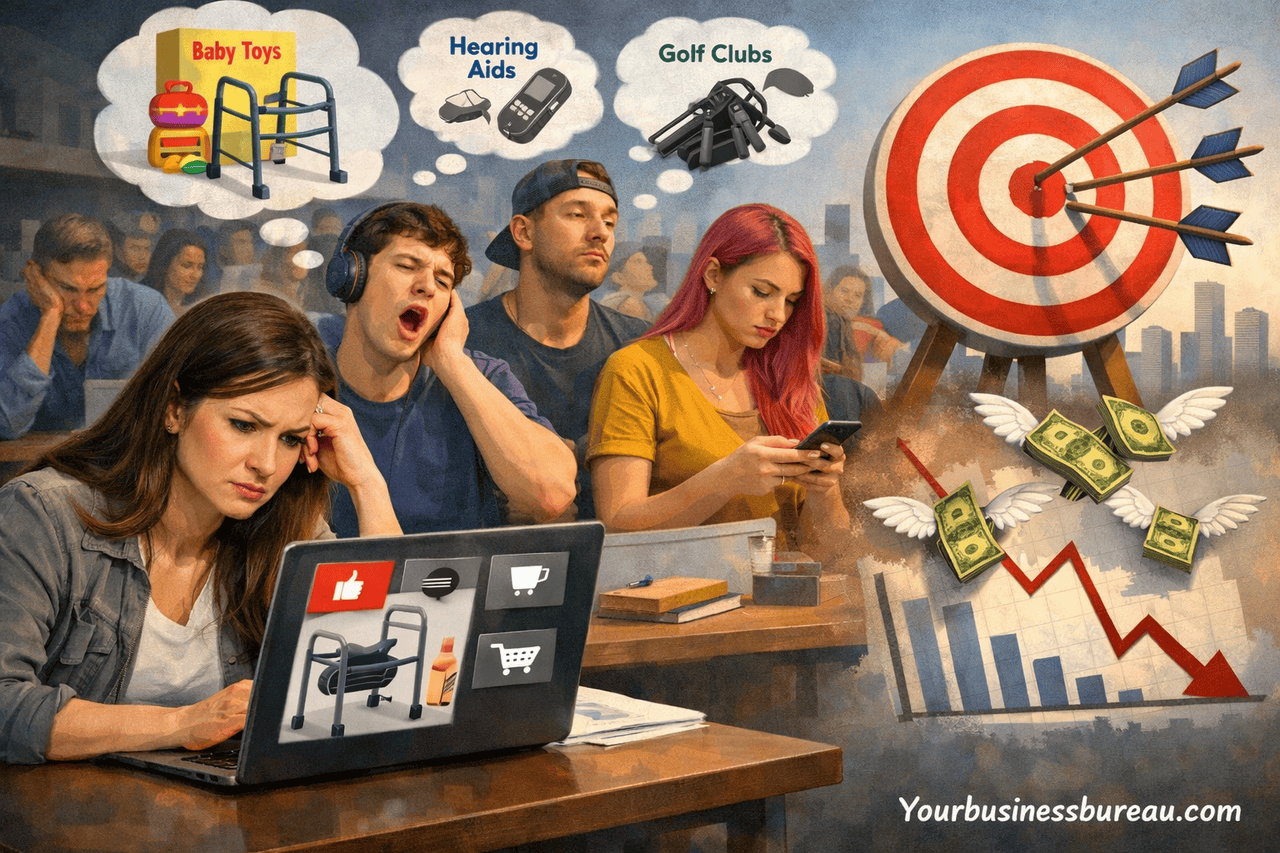
- Misaligned Campaign Goals: Many US online campaigns fail by targeting users who are not in the right stage of the buying journey, resulting in confusion and low conversions.
- Wasted Ad Spend: Advertisers lose thousands in budget due to irrelevant clicks and poor engagement from mismatched audiences.
- Overreliance on Demographics: Relying solely on age, gender, or location without intent data leads to poor campaign performance.
- Lack of Behavioral Insights: Ignoring user behavior such as page visits, dwell time, or previous purchases prevents accurate targeting.
- High Bounce and Low ROI: Poor audience targeting often results in high bounce rates, low conversion, and negative ROI across campaigns.
- First-Party Data is Underused: Most marketers miss the opportunity to leverage their own customer data for accurate segmentation.
- Platform Algorithms Penalize Mistakes: Repeated targeting errors lower ad relevance scores, increase CPC, and decrease campaign visibility.
- Sustainable Targeting Requires Feedback Loops: Continuous optimization and feedback-driven targeting strategies are crucial for long-term success.
- Dynamic Segmentation Works Best: Updating audience lists in real-time based on actions and behavior dramatically improves ad relevance.
- Cross-Channel Messaging Builds Trust: Consistency across platforms helps users recognize and trust the brand, improving overall campaign performance.
Introduction
Online campaigns in the United States often fall short due to a fundamental issue: poor audience targeting. Despite access to advanced data analytics, many advertisers still waste budgets by directing ads to irrelevant or uninterested users. Campaigns without accurate audience alignment suffer from low click-through rates, poor conversions, and negative returns on investment. In my experience working with various businesses trying to scale their digital reach, I’ve noticed that poor audience targeting not only affects immediate campaign results but also damages brand credibility and long-term customer relationships. This article addresses the causes, signs, consequences, and effective solutions to audience targeting failures in US online advertising.
Why Do Online Campaigns in the US Miss the Right Audience?


Failure to reach the right audience in digital campaigns usually stems from misunderstanding customer personas, over-reliance on broad targeting tools, and neglecting real-time behavioral data. Most marketers aim for volume instead of precision, assuming that more impressions equal better chances. But impressions without relevance lead to wasted ad spend.
Targeting strategies often default to demographic assumptions such as age, gender, or location without validating user intent or recent behavior. While these attributes can help narrow down groups, they lack the specificity needed to generate meaningful engagement. Over-segmentation is also a problem, where marketers try to slice audiences so thin that they miss the larger patterns driving buying decisions.
In conversations I’ve had with marketing managers, many admitted that they relied heavily on platform recommendations without refining their custom audiences. Automated systems can be helpful, but they often guess based on generalized user activity rather than brand-specific behavior. This creates a significant mismatch between content and audience needs.
Misalignment Between Buyer Journey and Campaign Strategy
Most campaigns do not align their messaging with the actual stage of the buyer journey. Top-of-funnel users get bottom-funnel offers, and vice versa. This confuses potential customers and decreases campaign trust.
Lack of Intent-Based Targeting
Relying on demographic filters without factoring in search intent or browsing behavior leads to wasted impressions. Reaching users based on what they do, not just who they are, is critical.
What Are the Common Signs of Poor Targeting in Online Campaigns?
Identifying weak targeting early in a campaign can save budget and time. Low conversion rates, high bounce rates, and short session durations are direct signals of irrelevant targeting. These metrics indicate that users do not find the content or offer appealing or useful.
When reviewing campaign analytics, I often see click-through rates under 1%, especially in cold campaigns with generalized targeting. Such numbers clearly show that the audience wasn’t interested or didn’t understand the value proposition. High frequency with low engagement is another telltale sign. It means users are repeatedly seeing ads they ignore.
Repeated ad exposure without engagement also damages brand image. Users begin to associate the brand with spammy or irrelevant content, which affects future targeting and remarketing attempts. Fixing poor targeting requires careful monitoring of these indicators and quick adjustments.
High Bounce Rates with Irrelevant Traffic Sources
Traffic sources that deliver large quantities of users but very few interactions indicate that targeting is too broad or misaligned with the platform’s audience behavior.
Low Conversion Despite High Click Volume
When ads get clicks but no action is taken on landing pages, targeting might be attracting the wrong type of interest curiosity instead of intent.
How Does Poor Audience Targeting Affect Ad Spend and ROI?
Inaccurate targeting drives ad costs up while diminishing the return on each dollar spent. Each irrelevant click is a cost that delivers no value, and over time, this adds up to thousands in wasted spend. Platforms like Google Ads and Facebook Ads penalize low-performing campaigns with higher CPCs and limited impressions.
In my experience auditing underperforming campaigns, I’ve seen companies spend 70% of their monthly ad budget on users who never matched their ideal customer profile. Not only was their ROI negative, but they also suffered from attribution confusion, where they couldn’t track what was really working.
Campaigns built without a well-defined audience framework often lead to misleading analytics. Marketers think they are reaching a market, but in reality, they are reaching random users. This inflates data and makes it difficult to optimize for future ads.
Wasted Spend on Lookalike Audiences
Marketers often trust lookalike models too quickly without vetting the seed data. Poor seed audiences lead to poorly matched lookalikes, increasing cost without value.
Penalties from Ad Algorithms
Low engagement reduces quality scores, which forces the platform to charge more to show the same ads. This cycle keeps the cost high and performance low.
What Role Does Data Play in Effective Audience Targeting?

Accurate, actionable data is the foundation of strong audience targeting. Behavioral data, past purchase history, interaction points, and even dwell time can all help refine targeting strategies. Platforms offer tools to capture this, but marketers must interpret and apply data correctly.
Many businesses I’ve worked with overlook the power of their first-party data. Website visitors, email subscribers, and CRM contacts are rich with insight. Instead of chasing new audiences constantly, brands can build lookalikes based on their highest-value existing users. This not only improves targeting but also keeps acquisition costs lower.
Segmentation tools often go unused or misused. Without structured tagging, campaign testing, and segmentation by behavior and lifecycle stage, data becomes noise. Using dashboards that track micro-conversions and engagement events is a key step toward precision targeting.
Importance of First-Party Data Over Third-Party Data
First-party data collected from users directly provides more accurate and relevant signals compared to aggregated or purchased third-party lists, which may be outdated or generic.
Role of Predictive Analytics in Targeting
Predictive tools use historical data to forecast which users are most likely to convert, allowing marketers to allocate resources more effectively across campaigns.
How Can You Improve Audience Targeting in US Campaigns?
To improve audience targeting, marketers must start with a clear profile of their ideal customer, mapped to behavior, needs, and preferences. Creating detailed personas that include motivations and digital behaviors enables better alignment between messaging and interest.
One major step I advise clients to take is testing multiple audience groups in parallel with variations in creative. This reveals which groups are more receptive and allows gradual refinement. A/B testing is not just for content applying it to audience segments often reveals valuable insights.
Retargeting is another underutilized tactic. Most users don’t convert on the first visit. Retargeting visitors with personalized messages based on what they viewed or engaged with can drastically improve performance.
Building Dynamic Segments
Instead of fixed audience lists, dynamic segments update in real-time based on user behavior and triggers. This ensures that ads reach users when they are most likely to engage.
Aligning Creative with User Intent
Ad messaging should reflect user behavior and interest. If a user has browsed a product category, the ad should show related options not generic brand slogans.
What Are the Long-Term Effects of Repeated Targeting Mistakes?
Consistent targeting errors reduce trust, damage brand perception, and lead to long-term customer disengagement. Users grow numb to irrelevant ads and may even block or report them. Ad fatigue becomes a barrier to future marketing efforts.
Campaign history matters in platform algorithms. Poor performance data gets stored and used in future optimization. This leads to suppressed ad delivery, higher competition costs, and lower visibility even for well-designed future campaigns.
From my consultations, I’ve seen brands spend months recovering from such issues, trying to rebuild custom audience pools and re-establish platform trust. The delay in recovery not only hurts revenue but also weakens investor and stakeholder confidence.
Platform Bias Against Low-Performing Accounts
Repeated poor engagement leads ad platforms to deprioritize your campaigns, even if future strategies are improved. Recovery is time-consuming and costly.
User-Level Brand Rejection
Users exposed to off-target ads repeatedly may begin to associate the brand with irrelevance or spam, making re-engagement difficult even through retargeting.
What Strategies Ensure Sustainable Audience Targeting Success?
Long-term targeting success depends on constant feedback loops, data audits, and user experience alignment. Marketers must treat campaigns as ongoing experiments, where refinement happens through observation and reaction.
I always recommend monthly targeting audits for all my clients. Reviewing which segments convert, which underperform, and which platforms deliver highest-quality traffic gives marketers the clarity needed to scale efficiently. Sustainable targeting is not about finding one perfect audience, it’s about adapting to behavior changes in real time.
Integrating CRM systems, behavior tracking, and campaign analytics into a single dashboard allows better decision-making. The goal is to serve relevant messages to the right people, at the right time, with content they care about.
Feedback-Driven Audience Evolution
Audiences evolve, and so should targeting strategies. Continuous feedback collection through analytics and surveys supports smarter refinement.
Unified Messaging Across Channels
Audiences should receive consistent but context-optimized messaging across platforms social, search, email, and display to build familiarity and trust.
Signs and Consequences of Poor Audience Targeting
| Symptom | Impact on Campaign |
| Low Click-Through Rate | Indicates lack of relevance or poor copy |
| High Bounce Rate | Mismatch between ad and landing page |
| Low Conversion Rate | Targeting users with no purchase intent |
| High Cost per Acquisition | Paying more for uninterested users |
| Ad Fatigue or User Blocks | Users find content repetitive or irrelevant |
Conclusion
Poor audience targeting in US online campaigns results in wasted budgets, low engagement, and long-term damage to brand perception. From my direct experience with marketing audits and recovery strategies, the solution lies in embracing behavioral data, refining segmentation, and aligning messaging with user intent. Long-term success depends on the marketer’s ability to evolve with user behavior and maintain alignment between content and audience expectations. Campaign optimization is not just about lowering costs, it’s about delivering value to the right person, at the right time, with the right message.
If you want to explore how we help businesses grow from the ground up, you can visit yourbusinessbureau.com to see what we offer.
FAQ’s
Clicks without conversions often mean you’re reaching curious users, not interested buyers. Refine your targeting to focus on intent signals like page engagement, video views, or cart abandoners.
Review your audiences every two weeks during active campaigns and monthly for evergreen strategies. Behavior changes quickly, and outdated lists lead to poor engagement.
Yes. Over-targeting restricts reach and increases cost per impression. Balance precision with enough scale to let platform algorithms learn and optimize.
Avoid assuming demographics alone define your customer. Focus instead on user actions, behavior patterns, and intent-driven segmentation for stronger engagement.
Track quality engagement metrics like CTR, bounce rate, time on site, and conversion rate not just impressions or reach. These indicate real audience relevance.


