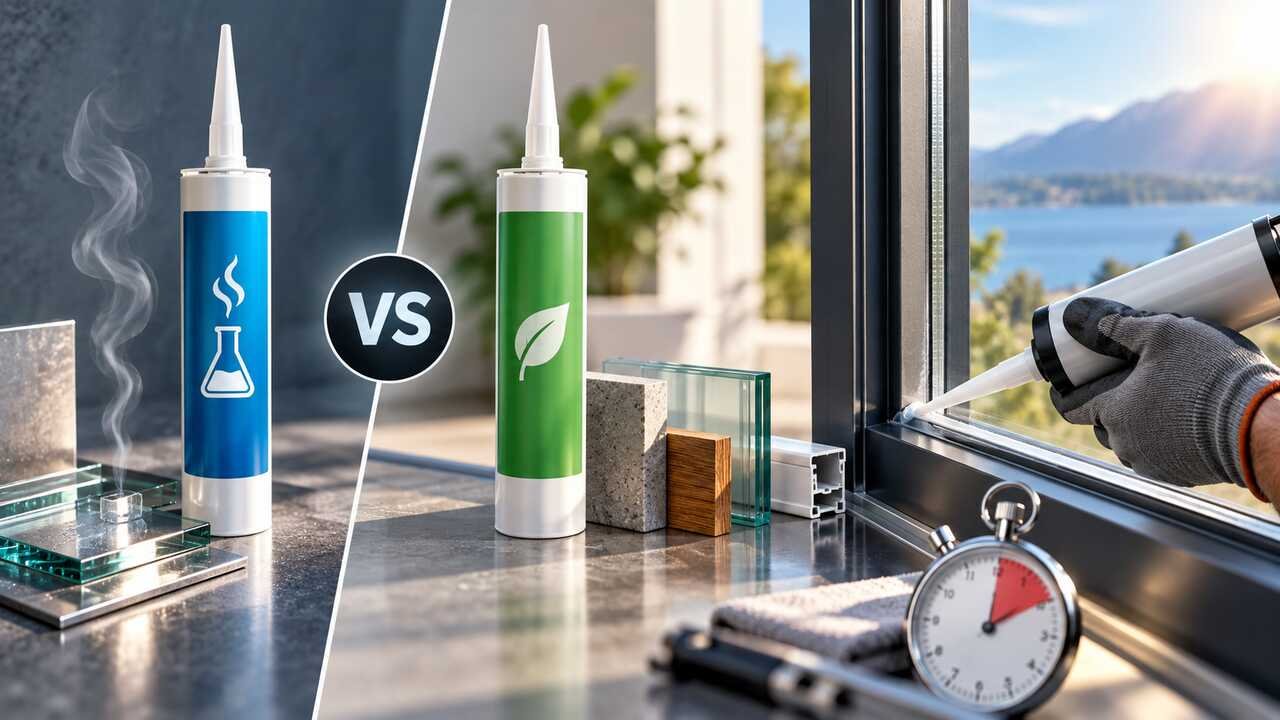
Neutral-cure silicone gets recommended by default in a lot of specifications now, often correctly, but that default has created a habit of treating acetic-cure silicone as the inferior option across the board. On the specific jobs it’s actually built for, acetic cure is faster, stronger, and cheaper; the trick is knowing where that specific case ends.
What Acetic Cure Actually Does Well
Acetic-cure silicone bonds strongly and quickly to non-porous, non-alkaline substrates principally glass and anodised aluminium. It skins and cures faster than neutral-cure alternatives, which matters on glazing work where the joint needs to be handleable or watertight quickly, and it typically costs less per cartridge than the neutral-cure equivalent.
For glass-to-glass and glass-to-anodised-aluminium joints specifically shower screens, display cases, aquariums, general glazing beads this is a legitimate, well-matched specification, not a corner cut.
Where the Substrate List Turns Against It
The acid released during cure is what limits acetic cure’s substrate range, and it’s a hard limit, not a minor consideration. On concrete, mortar, marble, and other cementitious surfaces, the acid attacks the alkaline substrate and can etch or discolour it marble in particular shows this damage permanently. On coated or galvanised metal, the acid corrodes many coatings and attacks galvanising directly. On the silvered backing of a mirror, it causes black-spotting over time.
None of this affects a genuine glass-to-glass or glass-to-anodised-aluminium joint. It becomes a problem the moment acetic cure gets specified or substituted on site for anything outside that substrate range.
The Failure Pattern When It’s Misapplied
When acetic cure is used on an incompatible substrate, the joint typically looks fine at handover and fails from the substrate side over the following six to eighteen months the bond degrades where the acid has been reacting with the surface, and thbusie bead eventually peels away cleanly, with no tearing or residue. That clean release is the diagnostic sign of a chemistry mismatch rather than an installation defect.
A Short Specification Check
Confirm both sides of the joint are genuinely non-porous, non-alkaline, and uncoated glass and anodised aluminium only. If either side is concrete, natural stone, coated metal, or mirror backing, specify neutral cure instead, regardless of the faster cure time acetic offers. For enclosed spaces like cold rooms or unventilated interiors, factor in that acetic acid vapour during cure is unpleasant and, in volume, can affect nearby metal work even on a compatible substrate.
Practical Takeaways
- Acetic cure is the right, economical choice for glass-to-glass and glass-to-anodised-aluminium joints specifically
- It is never the right choice for concrete, marble, coated or galvanised metal, or mirror backing
- Misapplication produces a joint that looks fine at handover and fails from the substrate side within 6-18 months
- A clean peel with no residue is the diagnostic sign of acid-substrate attack, not poor installation
- When in doubt about substrate compatibility, neutral cure is the safer default despite the slower cure time
Where to Start
An acetic cure silicone sealant is the right specification when the substrate list is confirmed glass and anodised aluminium only. First Sealant Technology’s AS-628 is formulated for exactly that non-porous glazing use case, alongside their N-100 and CW-1 neutral-cure ranges for anything outside it.
For substrate compatibility confirmation before a glazing job, their team can be reached at 096-818-9168, 097-959-5111, or 097-959-1222, Monday through Saturday, 08:30-17:30.Technical specifications referenced above are drawn from the manufacturer’s published product information. Confirm substrate compatibility and suitability for your application directly with the supplier.
For more informative content please follow YourBusinessBureau.