







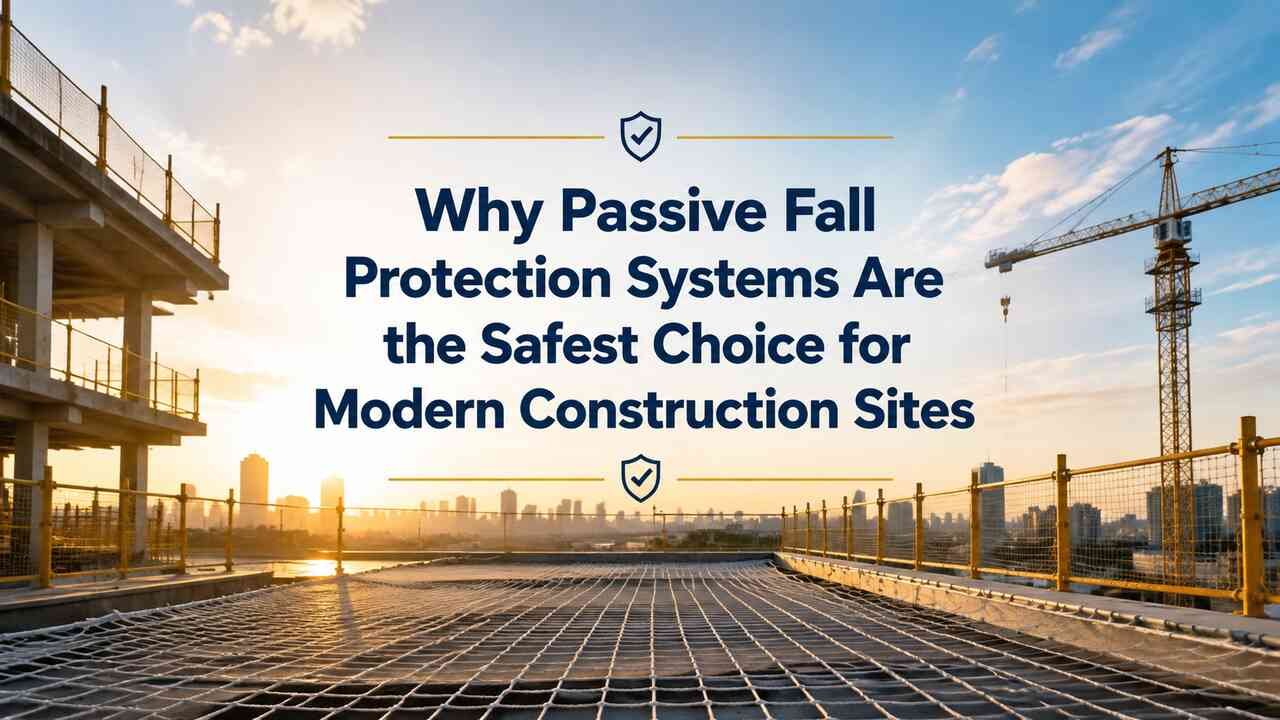
Despite improvements in construction safety regulations and technology, falls remain the top cause of construction worker fatalities (OSHA). Companies can invest in new harnesses, guardrails, and training, but all it takes is one slip-up to turn a job site into a crime scene. For that reason, project managers and site supervisors can no longer rely on traditional safety methods if they’re looking to maintain a clean, low-incident track record.
Where Passive Protection Sits on the Hierarchy of Control
Safety engineering measures are prioritized for a reason. Elimination and substitution are considered the most effective, followed by engineering controls, administrative controls, and finally personal protective equipment (PPE). Harnesses, lanyards, and anchor points fall under PPE and are at the bottom of the list because they only work when used correctly by a worker, tied off to the correct point, and the worker remains vigilant throughout their shift.
Guardrail systems and physical barriers are considered engineering controls as they physically isolate the hazard without relying on a worker to manage the hazard actively. A worker does not need to remember to use a handrail as a clipping point if they are working at heights, for instance. It is right there, serving its purpose regardless of whether anyone thinks about it at the time. Safe Work Australia and OSHA regulations both make reference to this hierarchy when considering if sufficient safety controls have been implemented to prevent falling, with a site that leans on PPE alone having a much harder time showing they have done their due diligence than a company that goes straight to physical barrier solutions.
Human Error is the Weak Point Active Systems Can’t Fix
The performance of active fall arrest systems relies on the human factor: the right harness, a properly working lanyard, a suitable attachment point, and appropriate behavior (clipping to the attachment point) of the worker. If any of these components of the system fails, the level of safety becomes extremely low. This may be the case if the worker is tired, under time pressure, poorly trained, or if the worker has neglected using the lanyard due to lazy or hasty habits.
Passive systems, on the other hand, do not have these failure rates. The railing does not change its protective function if the worker is tired, under time pressure, is new at the construction site, or the construction manager is absent. The safety level is stable and cannot be influenced by the individual “compliance decisions” of each worker or supervisor.
Building Protection Into Scaffolding From the Start
Scaffolding is one of the most evident cases where passive design must be mandatory. A scaffold is not a simple platform; it is a structure that workers must climb, load, and move around for weeks, and it must have edge protection integrated from the beginning of its assembly. This implies that top rails, mid-rails, and toe boards are part of the design in the erection phase, not added later as an accessory once the structure is installed.
The same level of risk, if not greater, is faced by workers during assembly and disassembly. Toe boards prevent tools, remnants, and loose parts from falling on the worker below. This hazard is not controlled by active fall arrest gear in any case. The scaffold is designed to do so.
Protecting the Roof While Protecting the Crew
Roof work often requires edge protection, but you certainly don’t want to puncture a membrane holding back thousands of liters of rain. Previous edge protection designs prevented falls by penetrating the roof surface, creating leaks and many other problems that only became visible months after the original job had been completed.
Damage caused by drilling is a common issue, but one that leads to long-term dysfunction in a system that most people don’t give a lot of thought to. A company may spend several thousand dollars installing new safety rails or barriers, only to discover that the process of fitting them has created thousands more in damage and voided their warranty.
Non-penetrating systems get around this by using ballasted bases or clamping mechanisms that grip the structure without piercing it. Modular, compliant roof handrail systems can be installed along exposed perimeters and provide continuous protection with no ongoing maintenance beyond routine checks, all without compromising the building’s waterproofing. For anyone managing a commercial roof project, that’s not a minor detail. It’s the difference between a safety measure that quietly does its job for the life of the building and one that creates a second problem the moment the first is solved.
The Load Standards Behind a Barrier That Actually Holds
Passive barriers aren’t just a rail bolted to a post. They’re engineered to specific load benchmarks because the consequences of failure are severe. A compliant guardrail has to withstand a concentrated force of at least 200 pounds, or the local equivalent, applied at the top rail in any downward or outward direction. That figure isn’t a guess. It accounts for a worker stumbling into the rail at speed, not just leaning on it casually.
Mid-rails and toeboards carry their own load requirements too, since a barrier that only resists force at the top but buckles lower down still lets someone through. This is why a proper risk assessment before construction begins should specify the exact barrier type, spacing, and anchoring method for each elevated work area rather than leaving it to whatever’s on hand. Working at heights isn’t a category you can eyeball your way through, and the engineering behind these systems reflects that.
What Active Systems Really Cost Over Time
Harnesses must be inspected annually, often more frequently based on use and conditions. If a lanyard stops a fall, it must be retired and replaced. The anchor points should be recertified periodically. Then there are the hidden costs, toolbox talks, refresher training, fit-checks prior to each shift and the loss of productivity each time a crew has to stop and manage their gear.
None of this can be viewed as a one-time cost. It’s an ongoing expense that multiplies with headcount and project duration. Passive barriers behave quite differently. Install them once and, since they meet the engineering standard, there is very little, other than a visual inspection, to do ongoing. On a project covering multiple trades with a schedule of many months, the cost delta of total ownership over the life of the project quickly adds up, with active systems rarely coming out ahead.
The Suspension Trauma Risk Nobody Talks About Enough
It is true that a fall arrest system saves a life by stopping a worker in mid-air (hopefully). However, after a fall, the worker still needs to be rescued, and quickly. A worker who is left suspended in a harness, even for a short period, may lose consciousness. Hanging in a harness after a fall can cause suspension trauma (orthostatic intolerance), resulting from blood pooling in the legs and decreased circulation of blood to the vital organs. In severe cases, the condition can be life-threatening in less than 10 minutes. Rescue is nothing more than a feel-good term if there is no reasonable expectation of performance on a busy site with difficult access.
Passive systems sidestep this entirely because there’s no fall to arrest in the first place. The worker never leaves the platform. That’s a meaningful distinction when you’re weighing which approach genuinely protects people versus which one just responds well after something’s already gone wrong.
Freedom of Movement Matters More Than People Assume
There is also a productivity aspect to this that is often not considered. Workers with lanyards are constantly managing their connection point, which might be attached to their back, chest or side depending on the work. They are having to re-tie off more frequently, reposition tie-off points, un-tangle lanyards from their feet as they walk around objects, and lift tools and materials over them. All of those are multiplication factors for the fact that they are tethered to an anchor point.
All of that takes time. In a busy workday, when you have multiple tasks to complete, the minutes spent over the course of a day managing the slack in a lanyard can really add up. A physical barrier removes all of that. Workers move along the edge freely, carry materials with both hands, and focus entirely on the task instead of managing their own safety gear.
Compliance is Easier to Prove With Physical Barriers
When a claim or investigation is launched due to an incident or accident, what regulators and insurers want to know is whether the site did everything reasonably practicable to prevent the fall. A defendant that can point to installed engineering controls, guardrails, toeboards, and edge protection that meet documented load standards is always in a better position than one that must rely on proof of training records and harness inspection logs.
That is the essence of passive system safety-by-design. Passive systems put the problem out in the open right from the beginning. Fall risk was engineered out during planning rather than managed after the fact through paperwork and PPE. One claim can more than offset the cost of the original installation. That’s one reason why most industry studies estimate that the long-term cost of a fall incident is at least ten times the direct expenses of medical and compensation payments. Passive fall protection isn’t a compliance checkbox, it’s an operational decision that pays off in fewer injuries, lower long-term costs, and a site that runs the same way regardless of who’s on shift that day. Once a barrier goes up, it keeps working without anyone having to think about it again.
Read Also: How to Navigate Changing Building Codes and Compliance in Modern Architecture


