








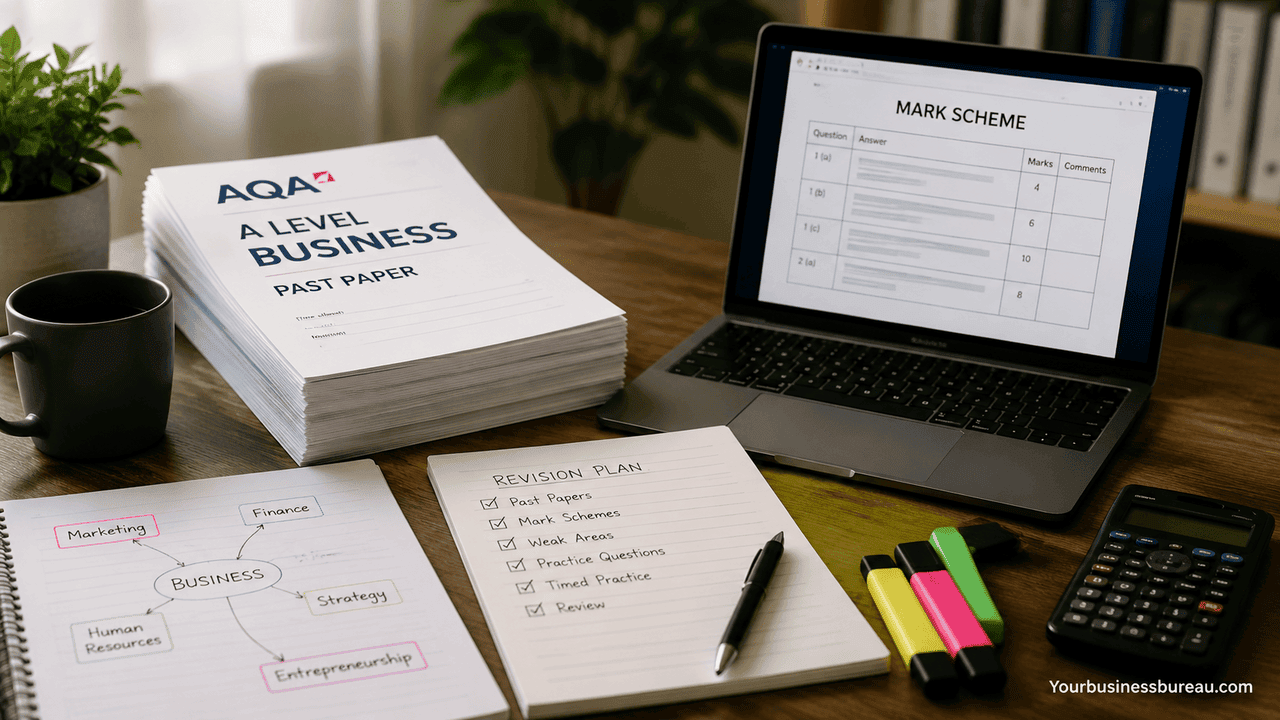
Preparing effectively for AQA A Level Business exams requires more than reading textbooks or memorising definitions. Success depends heavily on how well you use AQA A Level Business past papers to understand exam structure, master question patterns, and improve your answer technique. When used correctly, past papers become the most powerful revision tool for achieving top grades in the AQA specification.
AQA is one of the most widely used exam boards in the UK, and its Business specification is designed to test analytical thinking, application of theory, and evaluation skills. This makes structured practice with past papers essential for students aiming for high performance. This guide explains a complete, step-by-step system to use past papers strategically, not just repeatedly.
Access Official AQA A Level Business Past Papers
The first step is ensuring you are using authentic and up-to-date past papers aligned with the current specification. This ensures your practice reflects real exam standards and question formats.
Start by locating official exam resources that include question papers, inserts, and mark schemes. These are usually available in complete sets covering Paper 1 (Business 1), Paper 2 (Business 2), and Paper 3 (Synoptic or decision-making-based papers depending on specification structure).
To maximise effectiveness, ensure you are using papers that match the correct syllabus version. Older papers may contain different structures or assessment objectives, so they should only be used for additional practice, not core revision.
It is also important to download complete exam packs rather than isolated questions. Full papers allow you to simulate real exam conditions, understand timing, and practice interpreting case studies in context. Over time, this builds familiarity with how AQA frames business scenarios and applies assessment objectives across different topics.
Download and Interpret Mark Schemes Effectively
Once you have access to past papers, the next step is learning how to use mark schemes properly. Many students make the mistake of only checking answers after completing a paper, but effective revision involves analysing mark schemes during and after practice.
Mark schemes for AQA A Level Business outline exactly how marks are awarded, including application, analysis, and evaluation criteria. Understanding these breakdowns helps you see what examiners expect in high-scoring responses.
When reviewing mark schemes, focus on identifying:
- How application to the case study is rewarded
- Where analysis is developed step-by-step
- How evaluation is structured and justified
- Which keywords or phrases trigger higher marks
A deeper understanding of mark schemes allows you to reverse-engineer high-quality answers. Instead of simply checking correctness, you begin to understand the structure behind top band responses, which significantly improves your own writing technique.
Over time, this process trains you to think like an examiner, which is essential for achieving A and A* grades.
Organise Papers by Topic and Specification Coverage
A structured approach to organisation makes revision far more efficient. Instead of randomly completing papers, sort them according to topics in the AQA A Level Business specification.
Key areas usually include:
- Marketing and market position
- Operations and production
- Financial performance and analysis
- Human resource management
- Strategic decision-making
- Business environment and external influences
Each paper often integrates multiple topics, but tagging questions by theme helps you identify weak areas. This allows targeted revision rather than general repetition.
It is also useful to create a tracking system where you log which topics appear frequently in past papers. This helps you identify recurring themes, such as pricing strategies, cash flow problems, or competitive positioning.
Over time, this structured organisation turns past papers into a diagnostic tool rather than just practice material.
Build a Timed Exam Practice Routine
Time management is one of the biggest challenges in A Level Business exams. Practicing under timed conditions ensures that you develop speed, accuracy, and confidence under pressure.
Start by attempting individual questions before progressing to full papers. Gradually reduce the support you use until you can complete full exams in strict timing conditions.
A recommended structure includes:
- Short answer practice (10–15 minutes per question)
- Section-based practice (30–45 minutes per section)
- Full paper simulation (2–3 hours depending on exam format)
The key is consistency. Practicing once in a while is not enough. Regular timed sessions help you internalise how long each question type should take.
It is also important to replicate real exam conditions. Avoid distractions, use only permitted materials, and strictly follow time limits. This builds mental endurance and improves performance under pressure.
Analyse Examiner Reports for High-Scoring Answers
Examiner reports provide deep insight into how students perform across the country. These reports highlight common mistakes, successful strategies, and expectations for each question.
When reviewing examiner reports, focus on patterns such as:
- Frequent errors in application to case studies
- Weak evaluation or lack of judgement in conclusions
- Misinterpretation of command words like “analyse” or “evaluate”
- Repetitive issues with structure or timing
These insights help you avoid common pitfalls and refine your exam technique. Examiner reports also often include examples of high-scoring answers, which can be used as templates for your own writing style.
Over time, this improves not only accuracy but also your ability to construct well-balanced responses that meet assessment objectives.
Apply Past Papers to Case Study Questions
A Level Business exams heavily rely on case studies, which test your ability to apply theoretical knowledge to real-world scenarios. Practising past papers helps you develop this critical skill.
When working with case studies, focus on:
- Identifying key business issues in the extract
- Linking theory directly to the scenario
- Using specific data or references from the case
- Building logical chains of analysis
Case study application is often what separates average answers from top-band responses. It is not enough to define concepts; you must show how they operate in the given business situation.
Practising past papers repeatedly improves your ability to quickly extract relevant information from case materials. This reduces exam stress and increases writing efficiency.
Identify Common Question Patterns and Command Words
AQA exams frequently use repeated question structures and command words that indicate the depth of response required. Understanding these patterns is essential for effective preparation.
Common command words include:
- Define: Provide a clear meaning of a concept
- Explain: Develop reasoning with cause and effect
- Analyse: Break down into components and show relationships
- Evaluate: Make a justified judgement with evidence
- Discuss: Consider multiple viewpoints before concluding
Recognising these helps you structure answers appropriately. Many students lose marks because they fail to respond to the command word correctly, even when their knowledge is strong.
Past papers are the best way to become familiar with these patterns. Over time, you begin to anticipate question styles and respond more efficiently during exams.
Combine Past Papers with Revision Notes and Textbooks

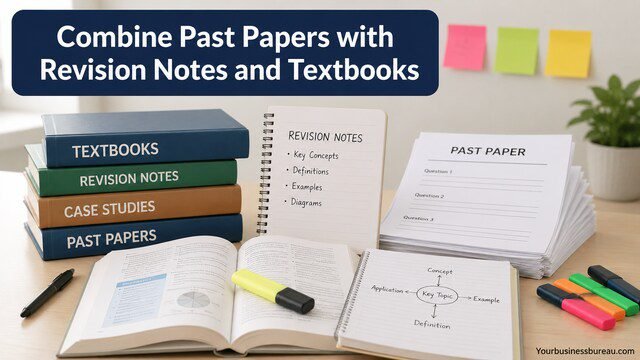
Past papers alone are not enough. They must be integrated with revision notes, textbooks, and case studies to build a complete understanding.
A balanced revision approach includes:
- Using textbooks to learn core theory
- Creating revision notes for quick recall
- Applying past papers to test knowledge
- Reviewing mistakes to refine understanding
This combination ensures that you are not just practising exam technique but also strengthening subject knowledge.
It is especially useful to revise a topic first and then immediately attempt related past paper questions. This reinforces learning and improves long-term retention.
Track Progress Using Score Analysis
Tracking performance is essential for identifying improvement areas. A simple scoring system helps you monitor progress across different topics and question types.
Below is an example of a structured tracking table:
| Paper Date | Topic Area | Score / Marks | Strengths | Weak Areas | Action Plan |
| Week 1 | Marketing | 24/40 | Good application | Weak evaluation | Practice essay questions |
| Week 2 | Finance | 30/40 | Strong calculations | Timing issues | Timed practice |
| Week 3 | Operations | 28/40 | Clear structure | Limited analysis | Improve depth |
This kind of tracking system helps you identify patterns in your performance. Instead of guessing where you need improvement, you rely on clear data.
Over time, this method increases efficiency and ensures that revision time is focused on the most important areas.
Final Exam Simulation Strategy
As the exam approaches, full simulation practice becomes essential. This involves recreating the exact exam environment, including timing, structure, and pressure conditions.
Start by completing full AQA A Level Business past papers under strict timing conditions. Then, review your answers using mark schemes and examiner reports.
Key strategies include:
- Completing full papers weekly before exams
- Reviewing mistakes immediately after completion
- Rewriting weak answers for improvement
- Focusing on evaluation quality and depth
This final stage of preparation ensures readiness for the real exam. It builds confidence, improves time management, and strengthens answer quality across all topics.
Conclusion
Using AQA A Level Business past papers effectively is one of the most reliable ways to achieve high grades in A Level Business. When combined with structured revision, mark scheme analysis, and consistent timed practice, past papers become a complete learning system rather than just practice material.
By engaging deeply with exam board expectations from AQA, students develop the analytical and evaluative skills needed for top performance. The key is not repetition alone, but intelligent use of past papers to refine technique, strengthen knowledge, and build exam confidence.
FAQ’s
Aim to complete at least 10–15 full papers across all exam components, along with targeted question practice.
Yes, but only for topic practice. Always prioritise papers from the current specification for full exam simulation.
Use balanced arguments, support points with case study evidence, and always end with a justified conclusion.
Yes, timed practice is essential to develop exam speed and manage pressure effectively.
Analyse how marks are awarded, then rewrite answers to match high-scoring structures.
No, they must be combined with strong theory revision, case study understanding, and consistent feedback review.


